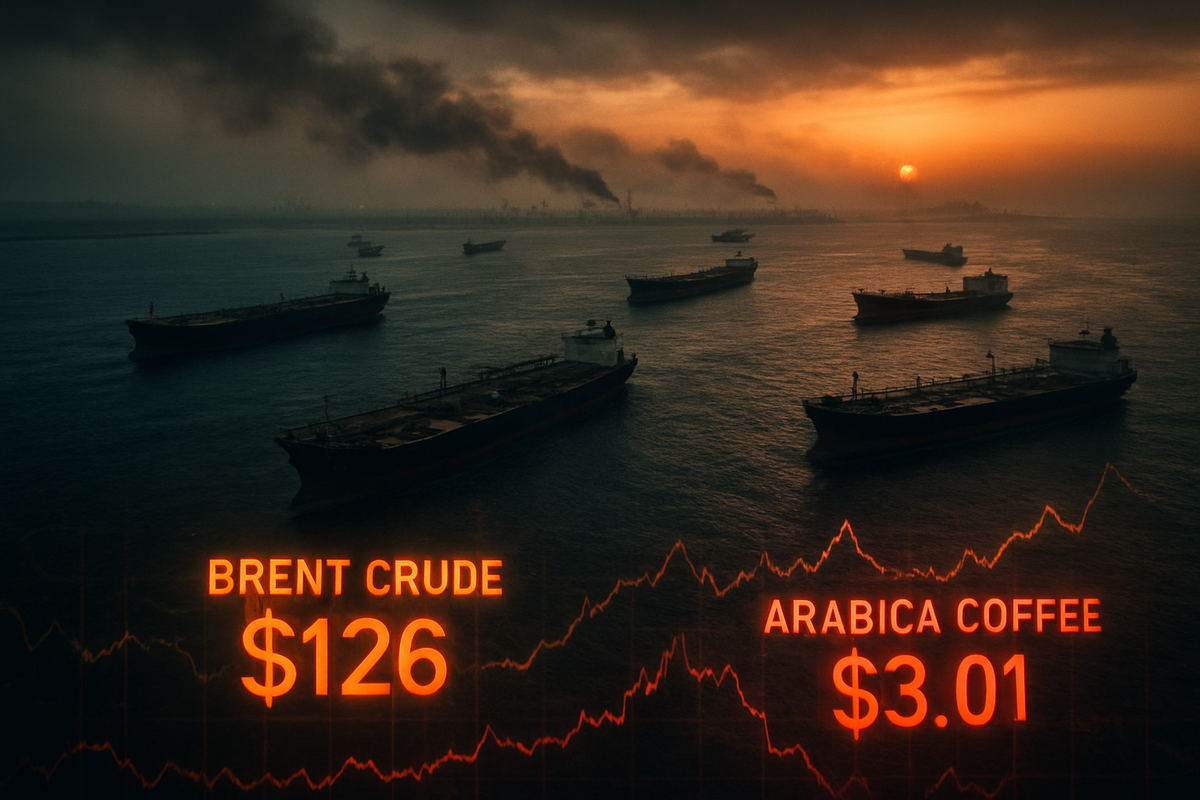
The global economy is currently reeling from the most significant disruption to maritime trade in decades. Since early March 2026, the Strait of Hormuz—a vital artery through which 20% of the world’s oil and nearly a quarter of its liquefied natural gas (LNG) flows—has been effectively shuttered. The closure has sent shockwaves through commodity pits, propelling Brent crude oil prices past the $126 per barrel mark and triggering an unprecedented supply crunch in soft commodities, most notably coffee and fertilizers. As tankers sit idle or reroute thousands of miles around the Cape of Good Hope, the immediate implications are clear: a sharp inflationary spike that threatens to derail the fragile post-2025 economic recovery.
Beyond the gas pump, the blockade has paralyzed the "just-in-time" logistics that define modern global commerce. Freight rates have quintupled on key routes, while war-risk insurance premiums have surged to as high as 10% of a vessel's hull value, adding millions of dollars in costs to every single voyage. With major ports in the Persian Gulf effectively cut off, the crisis is no longer just a regional conflict; it is a systemic threat to global food security and manufacturing stability, as the flow of essential agricultural inputs and consumer goods comes to a grinding halt.
The seeds of the current crisis were sown during the "Twelve-Day War" in mid-2025, but the definitive breaking point arrived on February 28, 2026. Following the collapse of diplomatic negotiations in Geneva, the United States and Israel launched Operation Epic Fury, a massive, coordinated campaign of airstrikes aimed at neutralizing Iranian ballistic missile sites. In a swift and retaliatory counter-move, the Islamic Revolutionary Guard Corps (IRGC) declared the Strait of Hormuz closed to all vessels "affiliated with the U.S. and its allies." By March 4, 2026, the blockade was total, enforced by a dense array of naval mines, fast-attack boats, and coastal missile batteries.
The market reaction was instantaneous and violent. Brent crude, which had been trading comfortably in the $75 range in late February, exploded upward, breaching $100 within days and hitting a multi-year high of $126 by mid-month. The impact on natural gas was even more severe; QatarEnergy (TADAWUL: 2222 - note: while Aramco is TADAWUL, QatarEnergy is state-owned but its partner ExxonMobil (NYSE: XOM) is public), one of the world's largest LNG exporters, was forced to declare force majeure on all shipments, sending European gas prices up 39% in a single trading session.
While energy was the primary driver, soft commodities were caught in the crossfire. Arabica coffee futures spiked to $3.01/lb on March 10, not because of a shortage of beans—Brazil is currently harvesting a record crop—but because of the sheer impossibility of moving cargo through traditional lanes. The logistical vacuum led to a 17.4% drop in Brazilian exports as shipping giants like Maersk (CPH: MAERSK-B) and Hapag-Lloyd (ETR: HLAG) suspended all Gulf transits, forcing a massive, expensive rerouting of global trade.
Key stakeholders, including the United Nations and the International Maritime Organization, have scrambled to intervene, but the IRGC's control over the narrow waterway remains firm. As of April 1, 2026, over 21 million barrels of oil per day remain stranded, and the backlog of container ships waiting for a resolution stretches from the Gulf of Oman to the Arabian Sea. The initial "wait-and-see" approach from markets has shifted into a "priced-for-disaster" reality, as the blockade shows no signs of an easy diplomatic resolution.
The closure has created a stark divide between companies insulated by geography and those dependent on the Strait’s passage. The clearest winners have been U.S.-based energy producers who are now the "lenders of last resort" for global fuel. Cheniere Energy (NYSE: LNG), the leading U.S. exporter of liquefied natural gas, saw its shares jump as Asian and European buyers scrambled to replace lost Qatari volumes. Similarly, EQT Corporation (NYSE: EQT), the largest natural gas producer in the U.S., hit all-time highs as the global supply deficit widened. Domestic oil majors like ExxonMobil (NYSE: XOM) and Chevron (NYSE: CVX) have also seen significant capital inflows, with investors viewing their Permian Basin and Guyanese assets as "safe-haven" barrels far removed from the volatility of the Middle East.
Conversely, the losers are widespread and varied. Global retailers such as Gap Inc (NYSE: GPS), Carter's (NYSE: CRI), and Oxford Industries (NYSE: OXM) are facing severe margin compression. These companies rely on manufacturing hubs in South Asia and Southeast Asia, and the closure has added up to 21 days to their shipping times, combined with massive "deviation surcharges" from carriers. The coffee industry is also seeing a dramatic squeeze; while Luckin Coffee (OTCMKTS: LKNCY) has managed to pivot toward premium margins in China to offset costs, giants like Starbucks (NASDAQ: SBUX) are facing a "double whammy" of rising commodity prices and logistical delays that threaten their operating margins.
Even industry titans are not immune. JDE Peet's (AMS: JDEP) has been forced into a "hand-to-mouth" procurement strategy, avoiding long-term futures contracts in hopes that the blockade will break before their inventories vanish. Meanwhile, Saudi Aramco (TADAWUL: 2222) faces the unique challenge of being the world's largest producer while having its primary export route held hostage. While Saudi Arabia can divert some oil through its East-West pipeline to the Red Sea, the capacity is insufficient to cover the 10 million barrel-per-day shortfall, leading to a significant loss in projected quarterly revenue despite the higher per-barrel price.
This event fits into a broader, more alarming trend of the "weaponization of chokepoints" that has defined 2020s geopolitics. Much like the Suez Canal obstruction of 2021 and the Red Sea tensions of 2024, the 2026 Hormuz blockade highlights the extreme vulnerability of the global "just-in-time" supply chain. However, the scale of this event is unprecedented; it represents the first time a major power has successfully closed a global chokepoint for an extended period in the modern era. The ripple effects are already being felt in the fertilizer market, where urea prices have surged 28%, threatening the 2026-2027 global harvest and raising the specter of a widespread food crisis.
From a regulatory standpoint, the crisis has forced the United Nations to adopt Resolution 2817, calling for an immediate humanitarian corridor. However, with China and Russia abstaining, the international community remains fractured. Historically, this event draws comparisons to the 1973 oil embargo, but with a crucial difference: the world is now far more interconnected. The "shadow war" has emerged into the light, and the policy implications are likely to include a permanent shift in how Western nations view energy security, potentially accelerating the transition to domestic renewables and nuclear power as a matter of national defense.
Furthermore, the surge in insurance and freight costs is expected to have a "ratchet effect" on global inflation. Once war-risk premiums are baked into shipping contracts, they rarely disappear overnight, even after hostilites cease. This suggests that even if the Strait were to open tomorrow, the cost of goods—from a cup of coffee at Starbucks (NASDAQ: SBUX) to a gallon of gas—will likely remain elevated for the remainder of 2026. This permanent shift in the "risk floor" of global trade is perhaps the most significant long-term consequence of the blockade.
Looking ahead, the immediate focus remains on April 6, 2026—the deadline set by the Trump administration's ultimatum to Tehran. Should the Strait remain closed, the potential for a "total obliteration" of Iran’s energy infrastructure could lead to an even more catastrophic global supply shock, or conversely, a forced reopening of the waterway through military might. In the short term, markets should expect continued extreme volatility, particularly in the energy and shipping sectors, as every headline regarding naval movements or diplomatic cables triggers massive swings in spot prices.
In the long term, a strategic pivot is already underway. Shipping companies are likely to decommission smaller vessels in favor of larger, "Cape-capable" tankers that can more efficiently navigate the long route around Africa. We may also see the emergence of new overland trade routes, such as the expanded use of rail through Central Asia, as companies seek to bypass maritime chokepoints altogether. For investors, the "Hormuz Risk Premium" will likely become a permanent fixture in the valuation of any company with a significant Middle Eastern footprint or a supply chain that crosses the Indian Ocean.
The closure of the Strait of Hormuz in March 2026 has fundamentally altered the landscape of global trade. By stranding 20% of the world's energy and paralyzing the flow of commodities like coffee and fertilizer, the blockade has proven that the global economy is only as strong as its narrowest passages. The surge in Brent crude to $126 and the doubling of Arabica prices are not just temporary spikes; they are symptoms of a world where geopolitical risk is now the primary driver of market value.
Moving forward, the reason the market will be defined by a shift toward domesticity and "friend-shoring." Investors should keep a close eye on U.S. energy producers like Cheniere Energy (NYSE: LNG) and EQT Corporation (NYSE: EQT), who stand to gain the most from this structural shift in supply. Conversely, high-volume, low-margin retailers and global coffee chains remain at extreme risk. The coming months will determine whether the international community can restore the freedom of navigation or if we are entering a new era of fragmented, expensive, and perilous global commerce.
This content is intended for informational purposes only and is not financial advice.