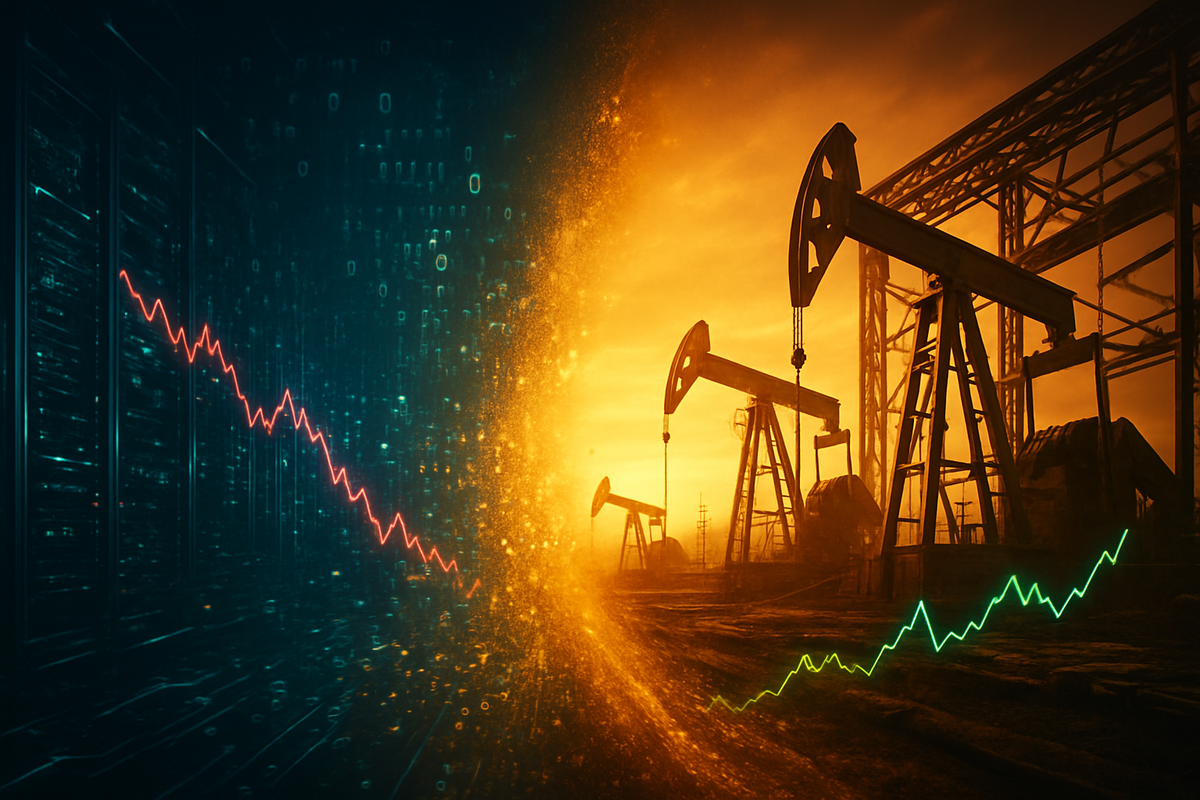
As of March 6, 2026, a seismic shift has taken hold of the global financial markets, marking what analysts are calling the "Great Sector Rotation." For years, the market’s momentum was dictated by the "Magnificent Seven" and a seemingly unstoppable surge in Artificial Intelligence (AI) valuations. However, in the first week of March, that narrative has fractured. Investors are aggressively fleeing high-multiple technology stocks and pouring capital into the "Old Economy"—Energy, Materials, Industrials, and Consumer Staples—driven by a combination of AI valuation fatigue, geopolitical volatility, and massive domestic fiscal stimulus.
The shift reached a fever pitch today following a disastrous February jobs report, which showed the U.S. economy unexpectedly lost 92,000 jobs, sending shockwaves through the tech-heavy Nasdaq. While software giants are seeing their margins questioned in a post-DeepSeek world, the "atoms over bits" trade is thriving. Crude oil prices are surging toward $85 a barrel amidst escalating tensions in the Middle East, further cementing the dominance of energy and commodity-linked equities in a market that is increasingly prioritizing tangible assets over digital promises.
The Anatomy of a Paradigm Shift
The seeds of this rotation were sown in early 2025, but the catalyst for the early 2026 acceleration was the "DeepSeek AI Shock" in February. When the open-source lab DeepSeek released its V4 and R1 architectures, it proved that frontier-level AI performance could be achieved at a fraction of the cost previously projected by U.S. hyperscalers. This sparked a "valuation crisis" across the software sector, as investors began to fear that AI would act as a margin compressor rather than a growth engine. By early March, many enterprise software firms had seen 20% to 30% retracements from their all-time highs.
Simultaneously, the implementation of the "One Big Beautiful Bill" Act (OBBBA) in January 2026—a $5 trillion fiscal package focused on domestic manufacturing and infrastructure—has created a massive pro-cyclical tailwind. The bill restored 100% bonus depreciation and immediate R&D expensing, incentivizing a domestic "building boom" that has funneled billions into heavy industry. This fiscal stimulus, combined with the "HALO" trade (Hard Assets, Low Obsolescence), has redirected the flow of "smart money" away from virtualized services and toward the physical infrastructure required to sustain the next decade of industrial growth.
Market volatility intensified during the first week of March 2026 as the U.S.-Israel-Iran conflict escalated. Strikes in the Middle East led to a partial shutdown of the Strait of Hormuz, threatening 20% of global oil consumption. This geopolitical "black swan" has provided a stark contrast between sectors: while tech stocks are viewed as vulnerable to slowing consumer spend and high interest rates, energy and materials companies are being treated as essential hedges against a reflating, resource-constrained global economy.
Winners and Losers: Silicon vs. Steel
The fallout from this rotation has created a stark divergence in corporate fortunes. NVIDIA (NASDAQ: NVDA) and Broadcom (NASDAQ: AVGO), the primary beneficiaries of the first phase of the AI boom, have faced heavy "sell-on-good-news" pressure. Despite reporting strong earnings this week, Broadcom saw its stock slide as investors questioned the sustainability of massive AI capital expenditures into 2027. Similarly, Microsoft (NASDAQ: MSFT) and Alphabet (NASDAQ: GOOGL) have seen their premiums erode as the market demands more immediate returns on their massive infrastructure investments.
The software-as-a-service (SaaS) sector has been hit even harder. Companies like Salesforce (NYSE: CRM), Adobe (NASDAQ: ADBE), and ServiceNow (NYSE: NOW) are navigating an "existential repricing" as agentic AI begins to disrupt traditional per-seat licensing models. In contrast, the "Old Economy" is seeing a renaissance. ExxonMobil (NYSE: XOM) has emerged as a top performer, with its stock up over 20% year-to-date as it benefits from the double tailwind of high oil prices and the OBBBA’s energy incentives.
In the industrial and materials space, Caterpillar (NYSE: CAT) and Nucor (NYSE: NUE) are hitting record highs, fueled by the domestic manufacturing resurgence. Freeport-McMoRan (NYSE: FCX) has seen massive inflows as copper demand for the "physical AI" buildout—power grids and cooling systems—reaches new heights. Even the defensive plays are changing; while Target (NYSE: TGT) has struggled with a consumer pullback, Kroger (NYSE: KR) and Procter & Gamble (NYSE: PG) have become safe havens for investors seeking dividend stability and "sticky" inflation hedges.
Analyzing the Significance: A Return to 2000?
This rotation mirrors the "Dot-com" crash of 2000 in several critical ways. Much like the transition at the turn of the millennium, 2026 is seeing a "mean reversion" after a period of extreme concentration in a few high-growth names. For the last three years, the S&P 500's returns were dominated by five to seven companies; today, the market is finally broadening. The "Code Phase" of the AI revolution (2023–2025) appears to be shifting into the "Copper and Kilowatts Phase," where the value is captured not by the software developers, but by the companies providing the physical foundation for the digital world.
The wider significance of this shift extends to the regulatory and policy landscape. The Trump administration’s public search for a successor to Federal Reserve Chair Jerome Powell, whose term ends in May 2026, has added a layer of political uncertainty. Investors are betting that a more "dovish" or growth-oriented successor will prioritize the domestic industrial boom supported by the OBBBA, even if inflation remains stubbornly above the 2% target. This has led to the "International Value" trade, where indices like the UK's FTSE 100—long dismissed as a "dinosaur index" for its high concentration in banks and energy—have outperformed the U.S. benchmarks, with the FTSE 100 breaching the 10,000-point milestone for the first time in history.
Historically, periods of rapid technological innovation are followed by a phase of "industrial application" where the gains are decentralized across the broader economy. We are likely witnessing that transition in real-time. The "moat" in 2026 is no longer an algorithm; it is a power plant, a lithium mine, or a fleet of heavy machinery.
What Comes Next: Navigating the "Two-Speed" Market
In the short term, the market is likely to remain in a "two-speed" state. The technology sector will face continued volatility as it digests the "DeepSeek Shock" and navigates the transition to agentic AI models that challenge existing revenue streams. Investors should prepare for a period where "good news is bad news" for tech—solid earnings may still lead to sell-offs if they don't justify the extreme valuations of the past two years.
Long-term, the strategic pivot required for many companies will be immense. Tech firms will need to prove they can use AI to radically improve their own productivity and margins, rather than just selling AI as a product to others. Meanwhile, the industrial and energy sectors must manage the "scarcity cycle." As demand for physical assets outstrips supply, these companies face the challenge of scaling quickly enough to meet the needs of a world that is re-shoring its supply chains and hardening its energy infrastructure.
Potential scenarios for the remainder of 2026 include a "Stagflation Scare" if the Middle East conflict continues to push energy prices higher while the labor market weakens. However, if the OBBBA’s domestic investments begin to yield productivity gains by late 2026, we could see a "Goldilocks" scenario where the industrial boom offsets the cooling tech sector, leading to a more balanced and sustainable bull market.
Wrap-Up: The New Market Reality
The Great Sector Rotation of March 2026 is more than just a temporary fluctuation; it is a fundamental rebalancing of the global economy. The key takeaway for investors is that the era of "free money" and "easy tech growth" has ended. Scarcity has moved from the digital realm to the physical one. The market is now rewarding businesses with "physical moats"—those that own the power, the materials, and the machinery that the modern world cannot function without.
Moving forward, the assessment for the market is one of "resilient cyclicals and vulnerable growth." Investors should watch for the Federal Reserve leadership transition in May and the continued implementation of the OBBBA as primary indicators of where the next leg of growth will emerge. While the headlines may focus on the "March Meltdown" in tech, the underlying reality is a robust, if turbulent, industrial renaissance. Silicon may have defined the last decade, but in 2026, it is Steel and Steam that are leading the way.
This content is intended for informational purposes only and is not financial advice.