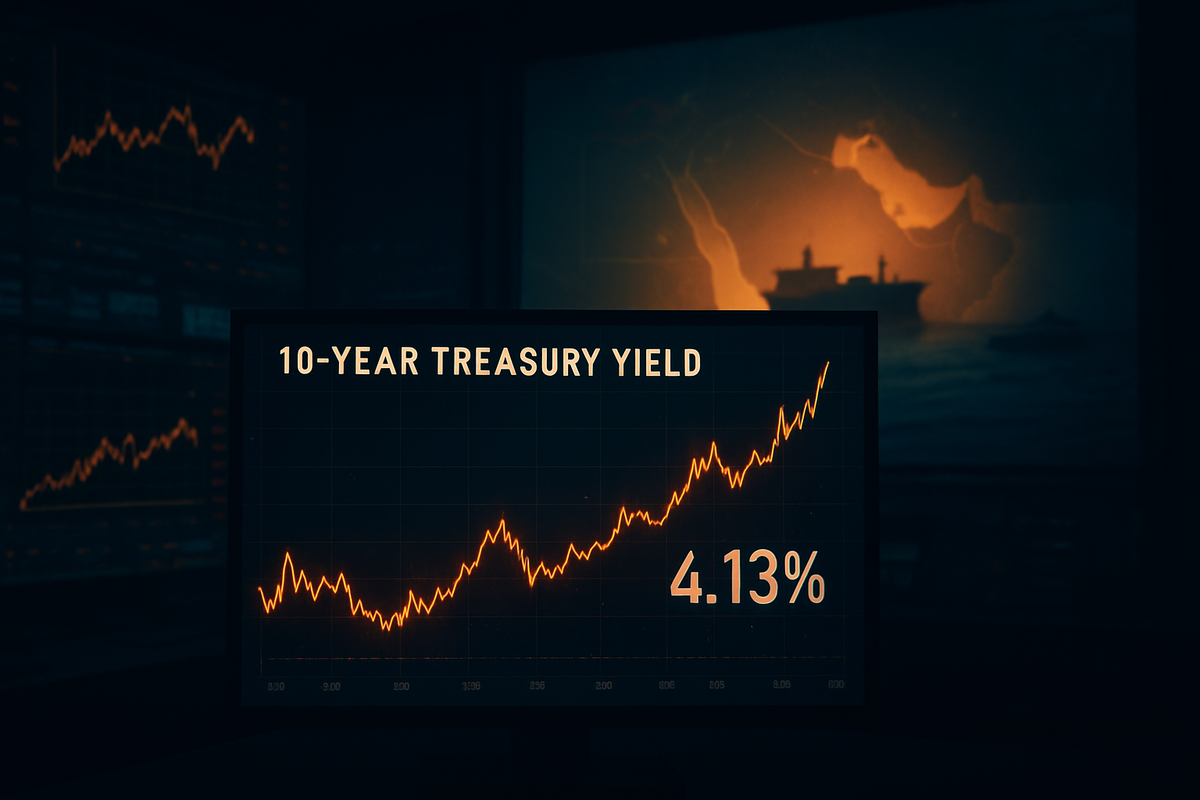
The traditional laws of safe-haven investing were rewritten this week as a sudden escalation in Middle Eastern conflict sent shockwaves through the global economy. In a move that defied decades of market logic, the yield on the benchmark 10-year U.S. Treasury note spiked to 4.132% on March 5, 2026, as a dramatic surge in oil prices reignited fears of a permanent inflationary "higher-for-longer" interest rate environment.
The market's reaction signals a transition from "geopolitical safety" to "inflation survival." Typically, global instability triggers a "flight to quality," where investors pile into Treasuries and drive yields down. However, with West Texas Intermediate (WTI) crude prices jumping over 18% in the first week of March to settle above $81 per barrel, the threat of an energy-driven inflation spike has overridden the desire for safety. The Federal Reserve, which many hoped would provide multiple interest rate cuts in 2026, now finds its hands tied by a looming stagflationary threat.
The Strait of Hormuz Standoff and the Yield Pivot
The immediate catalyst for the market turmoil was the escalation of "Operation Epic Fury," a multi-national conflict involving U.S., Israeli, and Iranian forces that culminated in the effective closure of the Strait of Hormuz on February 28, 2026. This vital maritime artery, responsible for a significant portion of the world's oil transit, is currently under what analysts call an "actuarial blockade." Major private insurers have canceled war-risk coverage for the region, and the U.S. Maritime Administration (MARAD) has issued emergency advisories for all commercial vessels to maintain a 30-nautical-mile standoff from military operations.
This supply-side shock arrived at an already sensitive time for the U.S. economy. On March 3, the ISM Manufacturing Index revealed a staggering 11.5-point jump in its "prices paid" component to 70.5, its highest level since the post-pandemic peak of 2022. The combination of rising energy costs and structural manufacturing inflation has forced bond traders to re-evaluate the Federal Reserve's 2026 trajectory. Swap markets have aggressively scaled back expectations for rate cuts this year, moving from an anticipated 60 basis points of easing down to a mere 35–40 basis points, with many doubting any movement before October 2026.
Energy Giants Gain While Tech and Transport Falter
The divergence in sector performance has been stark, creating a market of clear winners and losers. In the energy sector, Exxon Mobil (NYSE: XOM) and Occidental Petroleum (NYSE: OXY) have seen their shares climb by approximately 2.1% as they benefit from higher crude margins and a robust U.S.-based production profile. Oil services firm Baker Hughes (NASDAQ: BKR) has also positioned itself for the long term, recently pricing $10 billion in bonds to fund infrastructure acquisitions aimed at stabilizing global supply chains.
Conversely, the rise in yields has dealt a heavy blow to growth-sensitive sectors. Broadcom (NASDAQ: AVGO) and other semiconductor giants saw a 1.2% drop on March 5, weighed down not only by higher borrowing costs but also by new U.S. Bureau of Industry and Security (BIS) regulations. These "Compute Diplomacy" rules now require strict national security assurances and a 25% profit fee on advanced AI chip exports to non-treaty allies, complicating revenue streams in the Middle East.
Transport and housing sectors are also under immense pressure. United Airlines (NASDAQ: UAL) and Delta Air Lines (NYSE: DAL) faced significant selling pressure as jet fuel costs spiraled upward, while homebuilders like D.R. Horton (NYSE: DHI) and material suppliers like Sherwin-Williams (NYSE: SHW) struggled as the spike in the 10-year yield immediately translated into higher 30-year mortgage rates, effectively freezing the spring housing market.
A Historic Break from the 'Flight to Quality'
The current market behavior mirrors the "inflation beta" shocks of the late 1970s and early 1980s. Historically, during the 1979 Iranian Revolution, Treasury yields climbed alongside oil prices as the market prioritized pricing in terminal inflation over the safety of government bonds. The 2026 scenario is increasingly being viewed as a "broken playbook," where an energy crisis acts as a fire for inflation rather than a ballast for the economy.
Furthermore, the policy environment has become increasingly complex. The International Energy Agency (IEA) convened an emergency meeting on March 3 to coordinate a release from its 1.2 billion-barrel reserve, yet the U.S. has remained hesitant to tap the Strategic Petroleum Reserve (SPR) until physical infrastructure damage is confirmed. This regulatory caution, combined with the impending expiration of Fed Chair Jerome Powell’s term in May 2026, has introduced a layer of leadership uncertainty that is keeping the "term premium" on long-term bonds elevated.
What Lies Ahead: The October Outlook
In the short term, the market will remain fixated on the Strait of Hormuz. If the blockade persists, the "stagflation" narrative will likely harden, potentially pushing the 10-year yield toward the 4.5% mark. Investors are closely watching for any signs of a strategic pivot from the Federal Reserve. Richmond Fed President Tom Barkin recently noted that the central bank’s response will hinge entirely on the "longevity of the oil shock," suggesting that the Fed is in a "wait-and-see" mode that could last through the summer.
Market opportunities may emerge for defensive conglomerates and cash-rich entities. Berkshire Hathaway (NYSE: BRK.A / NYSE: BRK.B) has remained a pillar of stability, with CEO Greg Abel signaling confidence through personal share acquisitions. However, for most of the market, the challenge will be navigating a high-cost environment where both energy and capital are becoming more expensive simultaneously.
Navigating the New Inflationary Reality
The events of early March 2026 serve as a stark reminder that geopolitical shocks in an inflationary era do not follow the old rules of the "haven" trade. The rise of the 10-year yield to 4.13% is more than just a number; it is a signal that the era of easy money is being held hostage by global energy security and supply-chain fragility.
Moving forward, investors should keep a close eye on two critical metrics: the "prices paid" component of the upcoming services data and any shift in the "Compute Diplomacy" export permits, which could signal broader shifts in U.S.-Middle East relations. For now, the "higher-for-longer" mantra has regained its dominance, and the path to a 2026 interest rate cut remains narrow and fraught with risk.
This content is intended for informational purposes only and is not financial advice.