
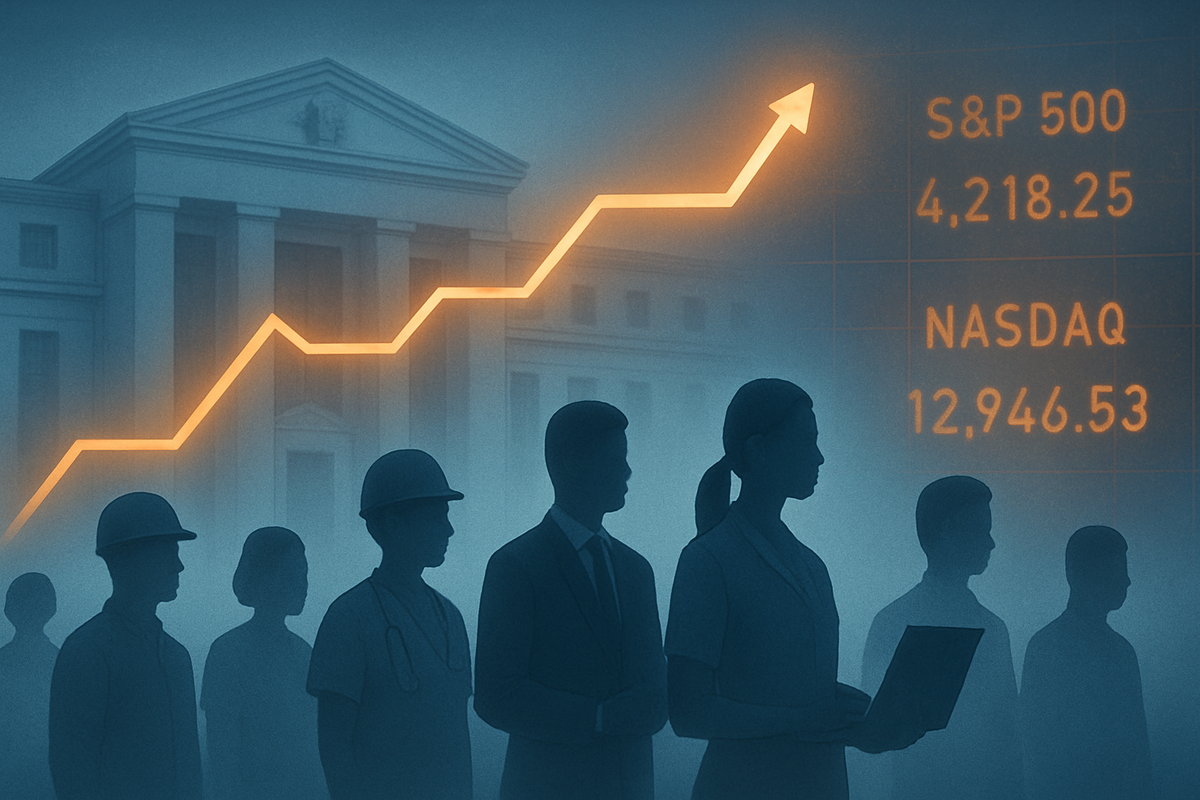
As of March 5, 2026, the United States labor market has entered a peculiar state of equilibrium that economists are calling a "low-hire, low-fire" freeze. With the Federal Reserve’s next interest rate decision just two weeks away, investors are hyper-focused on the delicate balance between cooling job growth and stubborn inflation. The most recent data reveals a resilient but sluggish economy, where firms are hoarding existing workers rather than expanding their payrolls, a trend that is complicating the Federal Open Market Committee’s (FOMC) path toward further rate cuts.
This "frozen" state of employment suggests that while the aggressive recession fears of late 2025 have largely subsided, the era of cheap money is not returning anytime soon. With the unemployment rate holding steady at 4.3% and wage growth remaining stickier than anticipated, Federal Reserve Chair Jerome Powell has signaled a "wait-and-see" approach. This policy stance, often termed "higher for longer," is designed to ensure that the 2.9% Personal Consumption Expenditures (PCE) inflation rate finally retreats to the central bank's elusive 2.0% target.
A Resilience Born of Stagnation: Breaking Down the Numbers
The immediate context for the current market anxiety stems from the January 2026 employment report, which saw a surprising rebound of 130,000 non-farm payroll positions after a dismal December. While this figure beat the bearish expectations of early winter, the underlying details painted a picture of a segmented economy. Job gains were almost entirely concentrated in the healthcare and construction sectors, while professional services and manufacturing saw virtually no net movement. This follows a volatile 2025 where average monthly gains were revised down to a mere 15,000, the lowest level of expansion since the post-pandemic recovery began.
The timeline leading to this moment has been defined by the Federal Reserve’s pivot in late 2025. After cutting the federal funds rate to its current range of 3.50% to 3.75%, the Fed abruptly paused its easing cycle in early 2026. This pause was triggered by a realization that while hiring had slowed, layoffs remained at historic lows, preventing the labor market "slack" necessary to drive inflation down to the 2% goal. Key stakeholders, including Fed Governor Christopher Waller and influential economist Stephen Miran, have voiced concerns that premature cuts could reignite price pressures, especially given the geopolitical volatility affecting energy prices, with oil currently trading between $74 and $81 per barrel.
Initial market reactions to this "higher for longer" messaging have been mixed but cautious. As of today, March 5, the S&P 500 sits at approximately 6,869, while the Nasdaq remains near 22,807. These indices have shown remarkable resilience, yet the volatility index (VIX) has begun to creep upward as the market awaits the February employment situation report, due for release tomorrow, March 6. Forecasts for that report are modest, with most analysts expecting a gain of only 58,000 to 80,000 jobs—a number that could be further depressed by the ongoing strike of the United Nurses Associations of California, which has sidelined roughly 31,000 healthcare workers.
Sector Shifts: Winners and Losers in the High-Rate Era
The persistence of elevated interest rates has created a stark divide in corporate performance. In the technology sector, the narrative has shifted from pure growth to a more scrutinized "AI Scare Trade." While infrastructure giants like NVIDIA (NASDAQ: NVDA) and Amazon (NASDAQ: AMZN) continue to benefit from the massive capital expenditures required to build artificial intelligence, software-centric firms have struggled. Investors are increasingly skeptical of whether AI-driven productivity is translating into bottom-line revenue or merely replacing white-collar roles. This sentiment led to significant pullbacks for companies like Salesforce (NYSE: CRM) and Adobe (NASDAQ: ADBE), both of which have seen their valuations compressed as the "higher for longer" environment makes future earnings less attractive when discounted at today’s rates.
Traditional finance and wealth management firms are also facing an identity crisis. While higher rates typically support net interest margins, the "low-hire" economy has stifled loan demand. Furthermore, firms such as Charles Schwab (NYSE: SCHW) and Raymond James Financial (NYSE: RJF) have faced unexpected competition from a new wave of autonomous AI-driven fintech platforms. These platforms, which automate tax and estate strategies, are threatening the traditional fee-based models of legacy brokerages just as the cost of capital remains high.
Conversely, the real estate sector remains in a state of suspended animation. Despite 30-year fixed mortgage rates dipping briefly below 6.0% in February, transaction volumes are at multi-year lows. Major commercial real estate players like CBRE Group (NYSE: CBRE) and Jones Lang LaSalle (NYSE: JLL) are navigating a market where sellers are "clinging" to legacy low-rate mortgages, and buyers are wary of a potential economic cooling. The high-rate environment has effectively locked the housing market, benefiting rental property managers but squeezing those dependent on transaction volume and new developments.
The Significance of the "Frozen" Equilibrium
The current labor market dynamics fit into a broader trend of structural shifts in the American workforce. We are moving away from the "Great Resignation" and into the "Great Retention," where workers are staying in their current roles due to a lack of outside opportunities, and employers are hoarding talent to avoid the high costs of future recruitment. This equilibrium is a double-edged sword; it prevents a sharp spike in unemployment but also keeps wage growth at a level (currently 3.7% year-over-year) that the Fed considers too high to be compatible with its 2% inflation mandate.
This situation finds a historical precedent in the early 1990s, where a period of low hiring and low firing led to a "jobless recovery." However, the 2026 version is complicated by the looming transition at the Federal Reserve. Jerome Powell’s term expires in May 2026, and the nomination of Kevin Warsh as his potential successor has introduced a layer of policy uncertainty. Warsh is perceived by some as more hawkish, leading to fears that the Fed might maintain these restrictive rates even if the unemployment rate begins to "tick up" toward 4.5% in the coming months.
Furthermore, the ripple effects on global markets are significant. The "higher for longer" policy in the U.S. has kept the dollar strong, putting pressure on emerging markets that hold dollar-denominated debt. Domestically, the regulatory environment is also shifting, as lawmakers express concern over the impact of high rates on affordable housing and the viability of small businesses, which are more sensitive to borrowing costs than their large-cap counterparts in the S&P 500.
Looking Ahead: The March 18 Decision and Beyond
The short-term focus for investors is squarely on the March 18 FOMC meeting. Current market probabilities suggest a 97% chance that the Fed will hold rates steady. However, the commentary accompanying the decision will be vital. If the February jobs report tomorrow shows a significant miss—perhaps due to the impact of the nurses' strike or a broader cooling—the Fed may have to pivot its rhetoric from "fighting inflation" to "supporting the labor market."
In the long term, the market must prepare for a possible strategic shift in how the Fed views its dual mandate. If inflation remains stuck at 2.9% while the labor market continues to soften, the central bank may be forced to accept a higher "neutral" rate of interest than was common in the 2010s. This would require companies to adapt their capital structures, favoring those with strong cash flows and minimal debt over those reliant on cheap financing for growth.
Scenario planning for 2026 suggests two primary paths: a "Soft Landing 2.0," where inflation gradually fades without a spike in layoffs, or a "Stagnation Trap," where the labor market eventually breaks under the weight of sustained high rates. The latter would likely trigger a rotation out of growth stocks and into defensive sectors like utilities and consumer staples, as the AI-fueled enthusiasm of the early 2020s meets the reality of a slowing macro-economy.
Wrap-Up: A Market in Search of a Catalyst
The recent U.S. labor market data has cemented the reality that the Federal Reserve is in no hurry to ease monetary policy. The "low-hire, low-fire" environment has provided a cushion against a recession but has also kept inflation uncomfortably high. For the Fed, the priority remains the 2% target, even if it means keeping the economy in its current "frozen" state for the foreseeable future.
Moving forward, the market’s resilience will be tested by the transition in Fed leadership and the realization that the era of ultra-low rates is likely over. Investors should shift their focus from the headline "beat or miss" of jobs numbers to the deeper metrics of labor participation and wage growth. These will be the true indicators of whether the Fed can achieve a soft landing or if the "higher for longer" policy will eventually lead to a more painful correction.
In the coming months, the March 6 jobs report and the subsequent March 18 Fed meeting will be the primary drivers of market sentiment. Beyond the numbers, the strategic pivots of major tech and financial firms as they navigate this high-rate plateau will define the next phase of the bull market. For now, the watchword remains "patience," as the economy waits for the first thaw of a long, high-rate winter.
This content is intended for informational purposes only and is not financial advice.