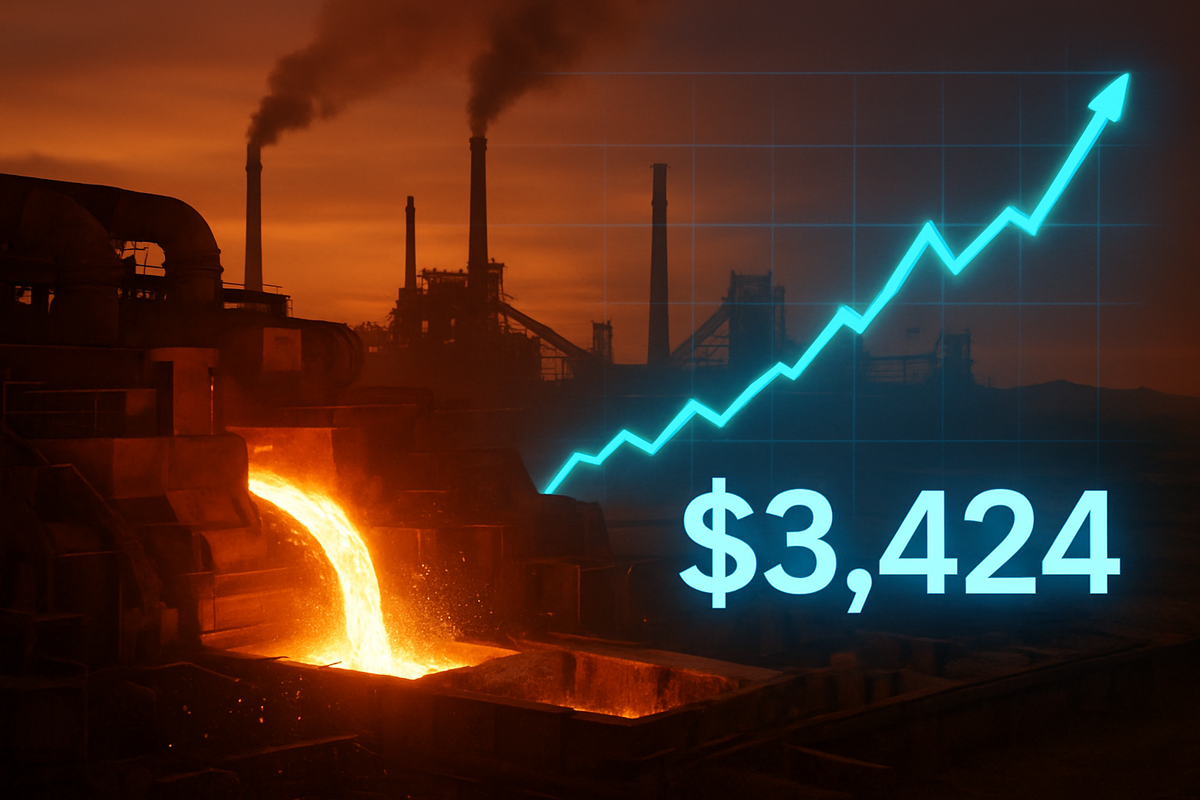
Global aluminum prices have catapulted to a four-year high of $3,424 per ton as the Middle East descends into a severe supply crisis. The sudden spike follows reports of targeted Iranian airstrikes on critical production infrastructure, including facilities owned by Aluminum Bahrain (ALBA) and Emirates Global Aluminum (EGA). With the region accounting for nearly 9% of the world’s primary aluminum supply, the disruption has sent shockwaves through the London Metal Exchange (LME) and raised immediate concerns about a prolonged global deficit.
The immediate implications are dire for the automotive, aerospace, and packaging industries, which rely on a steady flow of high-quality "premium" metal from the Gulf. Market analysts warn that the 60% collapse in LME-approved warehouse stocks over the past year has left the industry with virtually no buffer to absorb a shock of this magnitude. As regional producers declare force majeure and maritime insurance rates through the Strait of Hormuz skyrocket, the "light metal" is proving to be the most vulnerable link in the global commodities chain.
Strategic Strikes Paralyze the Gulf Production Corridor
The escalation began in late March 2026, following a series of precision drone and missile strikes launched from Iranian territory. These attacks specifically targeted the power grids and logistical hubs supporting Aluminum Bahrain (ALBA), which operates the world’s largest single-site smelter outside of China, and Emirates Global Aluminum (EGA), the dominant force in UAE’s industrial sector. Reports indicate significant damage to the potlines at ALBA’s Sitra facility, which had only recently celebrated record production levels of 1.62 million metric tonnes in 2025.
The timeline of the crisis unfolded rapidly over the last 48 hours. Following the initial strikes, EGA was forced to suspend operations at its Al Taweelah site in Abu Dhabi, citing safety concerns and interrupted gas supplies. This marks a catastrophic turn for a company that accounts for roughly 4% of total global production. The London Metal Exchange responded with a "limit-up" trading halt earlier today as traders scrambled to cover short positions, fearing that the total loss of Gulf exports—approximately 600,000 tonnes of metal—could be permanent for the remainder of the fiscal year.
Winners and Losers: A Regional Realignment
While the crisis spells disaster for Gulf-based producers, domestic North American and European players are seeing their valuations soar. Alcoa Corporation (NYSE: AA) is positioned as a primary beneficiary; its stock surged 12% in pre-market trading as investors bet on the company’s ability to fill the supply vacuum using its low-carbon assets in Australia and Canada. Similarly, Century Aluminum Company (NASDAQ: CENX) saw a massive influx of capital, particularly as its joint venture with EGA to build a new 750,000-tonne smelter in Oklahoma now takes on critical strategic importance for U.S. national security.
On the losing side, global diversified miners with significant Middle Eastern exposure are feeling the heat. Rio Tinto Group (NYSE: RIO), while protected by its vast Canadian hydroelectric smelting operations, faces significant logistical hurdles as its global supply chain relies on the stability of the Strait of Hormuz for the movement of bauxite and alumina. Meanwhile, Norsk Hydro ASA (OTC: NHYDY) is seeing mixed results; while the price spike helps its bottom line, the company’s European downstream customers are facing crippling costs that could lead to demand destruction in the automotive sector.
The Geopolitical Fragility of the "Just-in-Time" Supply Chain
This event fits into a broader, more dangerous trend of "commodity weaponization" that has characterized the mid-2020s. The vulnerability of the Middle East's aluminum corridor has long been discussed, but the 2026 airstrikes represent the first time the industry's heart has been directly targeted. The 60% drop in LME stocks prior to the strikes acted as a dry tinderbox; when the "spark" of the Iranian conflict hit, there was no physical inventory available to stabilize the market.
Historically, the market has seen price spikes during the 2018 Rusal sanctions and the 2022 energy crisis, but neither event combined physical infrastructure destruction with a total maritime blockade. Regulatory bodies in the U.S. and EU are already considering emergency measures to release strategic reserves, though aluminum lacks the formal stockpile infrastructure of crude oil. The ripple effects are expected to hit the U.S. Midwest Premium, which is already trending toward record levels of $1.00 per pound, further inflating the cost of everything from soda cans to electric vehicle frames.
Short-Term Volatility and the Long-Term Pivot to Onshoring
In the short term, the market remains in a state of high-alert. If the Strait of Hormuz remains closed or if additional strikes occur, analysts at major investment banks suggest aluminum could breach the $4,000 per ton mark by the end of Q2 2026. This would require a radical shift in procurement strategies for industrial giants, likely forcing many to declare their own force majeure on finished goods deliveries.
Looking further ahead, this supply shock will likely accelerate the "onshoring" trend that began earlier in the decade. The EGA-Century Aluminum project in Oklahoma is no longer just an expansion; it is now a blueprint for Western self-sufficiency. We expect to see a wave of new smelter restarts across North America and Europe, supported by government subsidies under the 2025 Strategic Materials Act. The age of relying on "cheap but distant" metal is effectively over, replaced by a "secure but expensive" paradigm.
Market Outlook: What Investors Should Watch
The key takeaway for the market is that aluminum's risk profile has been fundamentally rewritten. The metal is no longer just a proxy for global GDP growth; it is now a central piece on the geopolitical chessboard. Moving forward, the market will be hyper-sensitive to any diplomatic de-escalation or further military movements in the Persian Gulf.
Investors should closely monitor LME stock reports for any signs of "hidden" inventory being delivered to warehouses, as well as the progress of smelter restarts in the U.S. and Canada. The long-term impact of this crisis will likely be a permanent "geopolitical premium" added to the price of aluminum. While the $3,424 per ton level is a historic high for the decade, it may only be the baseline for a new era of scarcity and volatility in the industrial metals sector.
This content is intended for informational purposes only and is not financial advice.