In a landmark moment for the electric vehicle (EV) charging industry, EVgo Inc. (NASDAQ: EVGO) has reported its first-ever quarter of positive adjusted EBITDA, marking a significant shift from a period of heavy capital expenditure to one of operational sustainability. For the fourth quarter ending December 31, 2025, the company posted revenue of $118.5 million, a staggering 75% increase year-over-year, driven by record charging demand and a rapidly expanding footprint of high-speed stalls.
The achievement comes at a critical juncture for the U.S. energy transition. As of March 3, 2026, the industry is navigating a "post-subsidy" landscape following the expiration of several federal retail EV tax credits late last year. EVgo’s ability to turn a profit on an adjusted basis suggests that the "build it and they will come" phase of charging infrastructure is maturing into a high-utilization business model, providing a much-needed vote of confidence for investors who have long questioned the long-term viability of non-Tesla charging networks.
Financial Triumph and Operational Surge
The Q4 2025 earnings report, released earlier today, exceeded analyst expectations across nearly every key metric. The $118.5 million in revenue was anchored by a 37% year-over-year increase in charging network revenue, which reached $64 million. More importantly, EVgo’s adjusted EBITDA swung to a positive $24.9 million, a sharp reversal from the $8 million loss reported in the same period in 2024. While this figure was bolstered by a $25.9 million non-recurring ancillary contract closeout payment, management emphasized that the underlying business trajectory remains firmly in the black as margins expanded to 38%.
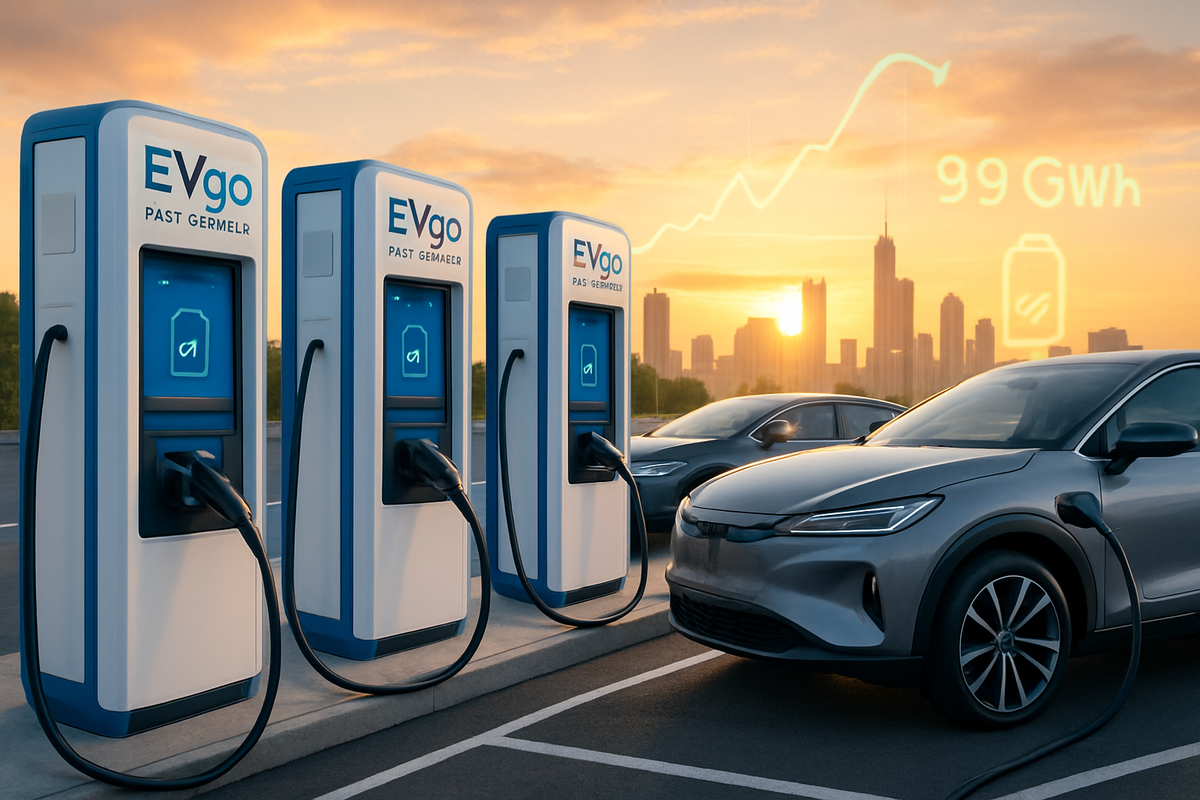
Operationally, EVgo reached a record network throughput of 99 GWh for the quarter, an 18% increase over the previous year. This growth was supported by the aggressive deployment of more than 500 new operational stalls in the final three months of 2025, bringing the company’s total count to 5,100 stalls across the country. Perhaps most impressive to analysts was the network’s utilization rate, which hit 24% in Q4. This indicates that EVgo’s stations are being used more frequently than those of many competitors, likely due to their strategic placement in high-traffic urban centers and retail corridors.
Winners and Losers in the Charging Wars
The move toward profitability places EVgo (NASDAQ: EVGO) in a direct showdown with Tesla (NASDAQ: TSLA), which still controls roughly 52% of the U.S. DC fast-charging market. Tesla remains a "winner" in this environment as it continues to open its Supercharger network to third-party manufacturers, but EVgo’s successful pivot to a profitable model proves there is room for a specialized "pure-play" charging provider. Partnerships with General Motors (NYSE: GM) and Honda (NYSE: HMC) have provided EVgo with a steady stream of "Autocharge+" users, further cementing its position as the preferred network for non-Tesla drivers.
On the other side of the ledger, companies like ChargePoint Holdings, Inc. (NYSE: CHPT) and Blink Charging Co. (NASDAQ: BLNK) are facing increased pressure to match EVgo’s path to profitability. While ChargePoint remains the largest network by total station count (primarily Level 2), its shift toward a "capital-light" software model has seen mixed results in a market that is increasingly demanding ultra-fast DC hardware. Meanwhile, Blink Charging has had to pivot heavily toward fleet-as-a-service to offset a slowdown in retail hardware sales, trailing behind EVgo in the race to capture high-speed highway and urban charging demand.
The NACS Pivot and Industry Shifts
The broader significance of EVgo’s results lies in the total industry consolidation around the North American Charging Standard (NACS/SAE J3400). EVgo has announced that its 2026 expansion will be defined by an "NACS-first" strategy, aiming to deploy over 500 NACS connectors by the end of the year. This move effectively doubles the company’s addressable market by allowing Tesla drivers to charge seamlessly without adapters. This shift mirrors a wider trend where hardware interoperability has become the baseline requirement for receiving state and federal funding.
Furthermore, the relaunch of the National Electric Vehicle Infrastructure (NEVI) program in early 2026 has provided a tailwind for the entire sector. After administrative delays throughout 2025, more than 40 states have now actively contracted projects, with over $5 billion in total funding being deployed. EVgo’s profitability milestone suggests that the industry is finally moving past the "bottleneck" phase of deployment, even as the retail EV market experiences a temporary "cooling" period. With used EV sales rising 35% and fleet adoption surging, the demand for reliable public charging remains higher than ever, regardless of the fluctuations in new vehicle sales.
2026 Roadmap: Scaling in a "Post-Subsidy" World
Looking ahead, EVgo has issued ambitious guidance for the full year 2026, projecting total revenue between $410 million and $470 million. The company plans to add between 1,400 and 1,650 new stalls this year, with a focus on high-penetration markets such as Phoenix, Chicago, Dallas, and San Francisco. A key component of this growth will be the integration of liquid-cooled NACS cables and "amenity-rich" hubs that feature cafes and lounges, moving away from the traditional model of isolated chargers in the back of parking lots.
However, challenges remain. As the U.S. market adjusts to the expiration of federal tax credits, EVgo must ensure that its pricing remains competitive against home charging and rising utility costs. The company’s ability to maintain a 97% uptime—a requirement for NEVI funding—will be tested as its network scales toward its long-term goal of adding 4,000 stalls annually by 2029. Strategic pivots toward medium- and heavy-duty (MDHD) vehicle charging may also be required as the "fleetification" of the U.S. economy continues to outpace retail adoption.
A New Era for Public Charging
EVgo’s Q4 2025 performance marks the end of the "experimental" era of EV infrastructure. By achieving positive adjusted EBITDA and demonstrating 75% revenue growth, the company has provided a blueprint for how a public charging network can thrive independently of vehicle manufacturing. The milestone of 99 GWh in throughput and the aggressive 2026 NACS expansion signal that the company is no longer just building for the future; it is servicing a massive, existing demand.
For investors, the coming months will be defined by execution. The market will be watching closely to see if EVgo can maintain its utilization lead as Tesla opens more Superchargers to the public and as NEVI-funded stations from competitors finally come online. As we move further into 2026, the focus will shift from "who has the most plugs" to "who has the best business model." For now, EVgo appears to have a significant lead in answering that question.
This content is intended for informational purposes only and is not financial advice.