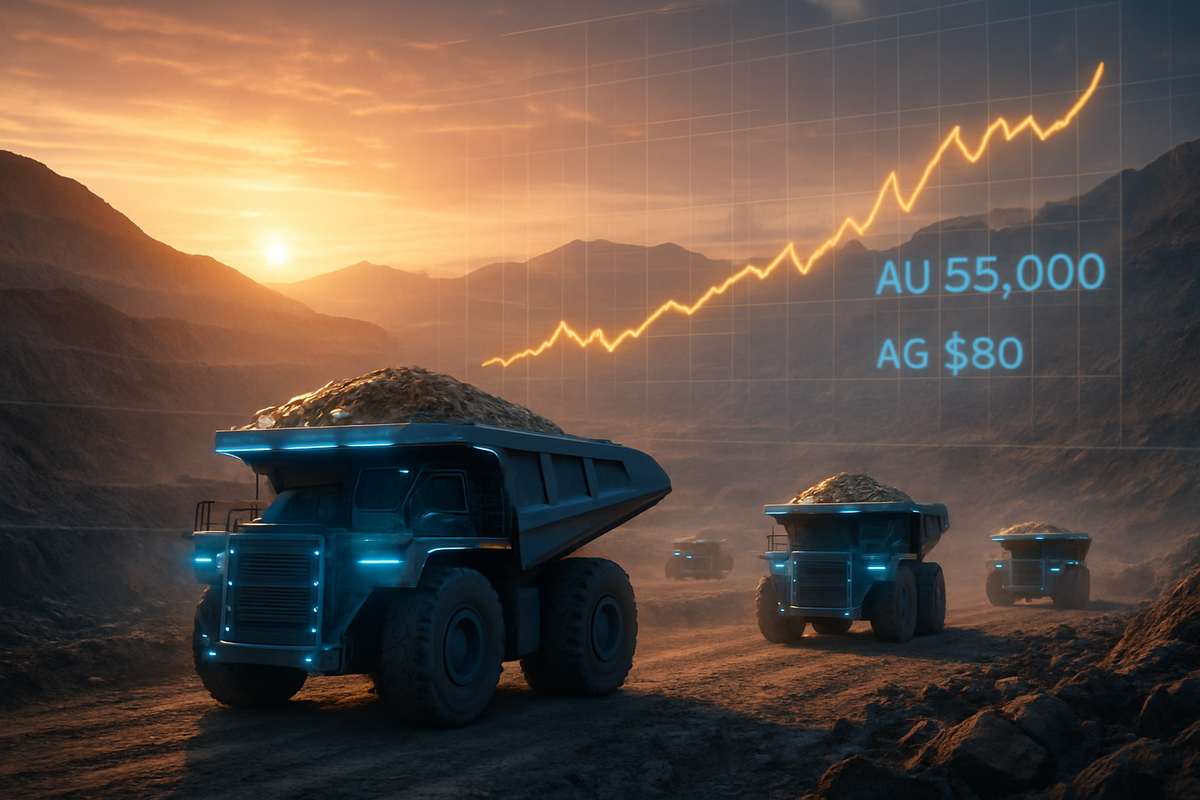
As of March 26, 2026, the global financial landscape has witnessed a tectonic shift in the precious metals sector, marking what analysts are calling the "New Golden Age" of junior mining. The VanEck Junior Gold Miners ETF (NYSE Arca:GDXJ) has delivered a staggering 225% return over the last 12 months, far outstripping broader market indices and even the impressive gains of physical gold itself. This rally comes as gold has firmly cemented its position above the $5,000 per ounce threshold, while silver has established a structural floor at $80 per ounce, driven by a combination of geopolitical instability, central bank accumulation, and an insatiable industrial appetite for high-conductive metals in the AI era.
The implications for the market are profound. For decades, junior miners were viewed as speculative, high-risk vehicles that often failed to capture the full upside of bullion rallies due to operational inefficiencies and capital mismanagement. However, the current cycle is different. The convergence of record-high prices and a technological revolution in extraction has created a "super-margin" environment, where the profitability of small-to-mid-cap miners is expanding at an exponential rate. As sovereign wealth funds transition from passive observers to aggressive buyers, the junior mining sector is no longer just a tactical play for "gold bugs"—it has become a core institutional allocation for 2026.
The March Flash Crash and the Sovereign Bid
The road to $5,000 gold was not without volatility. In early March 2026, the sector faced a "flash crash" triggered by a sudden algorithmic sell-off in the broader commodities market, briefly sending GDXJ down 12% in a single trading session. However, unlike previous cycles where such drops led to prolonged bear markets, this dip was met with immediate and aggressive buying from global sovereign wealth funds, including the Saudi Arabian Public Investment Fund and Singapore’s GIC. These institutional giants have increasingly viewed gold and high-quality mining equities as "neutral reserve assets" in a fragmented global economy, providing a permanent bid that has effectively "floor-priced" the sector.
This institutional support followed a historic 2025, during which gold surged past $4,500 on the back of aggressive central bank purchases, which averaged 70 tonnes per month. By the time gold hit $5,589 in January 2026, the narrative had shifted from inflation hedging to a structural "crisis of confidence" in fiat currencies. The current stability above $5,000 reflects a market that has priced in a new monetary reality. Similarly, silver’s rise to an $80 structural floor has been fueled by "dual-demand": traditional safe-haven buying paired with massive requirements for AI data center infrastructure and global solar expansion, sectors that have become the primary industrial drivers for the white metal.
Winners of the Super-Margin Era
The primary beneficiaries of this price surge are the mid-tier and junior producers that populate the GDXJ. Companies like Alamos Gold Inc. (NYSE: AGI) and Pan American Silver Corp. (NYSE: PAAS) have seen their free cash flow reach record levels, allowing them to pivot from capital-hungry exploration firms to high-yield dividend payers. Alamos Gold, in particular, has leveraged its low-cost jurisdiction profile to capture the full breadth of the $5,000 gold price, while Coeur Mining, Inc. (NYSE: CDE) and Equinox Gold Corp. (NYSE: EQX) have utilized the price floor to aggressively expand their production pipelines.
On the royalty and streaming side, Royal Gold, Inc. (NASDAQ: RGLD) has thrived by providing the necessary capital for smaller juniors to scale up operations without the dilutive effects of equity raises. However, the true "silent winners" of this boom are the technology providers enabling the industry's efficiency gains. Caterpillar Inc. (NYSE: CAT) has seen a surge in demand for its "Command for Hauling" autonomous systems, while software firms like Hexagon AB (OTC:HXGBY) are providing the AI-driven digital twins and predictive maintenance tools that have become mandatory for any miner looking to remain competitive in 2026. These tech-heavy miners are now significantly outperforming their "analog" peers who have been slower to adopt automation.
The "Super-Margin" Phenomenon and AI Integration
The most significant driver of the current mining boom is the "super-margin" phenomenon, a decoupling of production costs from spot prices. Historically, mining inflation—driven by rising diesel, labor, and equipment costs—often ate away at the profits generated by rising gold prices. In 2026, however, the widespread adoption of AI and autonomous fleets has slashed overhead by an average of 15% across the sector. This technological tailwind has allowed miners to capture nearly the full upside of the $5,000 gold price, creating a profit-per-ounce multiplier that was previously unimaginable.
For a typical junior miner with an All-In Sustaining Cost (AISC) of $1,850 per ounce, the jump from $2,500 gold to $5,000 gold represents a nearly 500% increase in profit per ounce, even while physical gold only doubled. This operational leverage is further enhanced by AI-driven predictive maintenance and autonomous haulage, which have eradicated the "run-to-failure" costs that plagued previous cycles. This shifts the historical precedent: while the SPDR Gold Shares (NYSE Arca:GLD) provides a stable 1:1 proxy for the metal, GDXJ offers the high-beta leverage of a tech-enabled industrial sector. While GLD remains the safer "store of value" with lower volatility (9% annualized), GDXJ has proven to be the superior wealth generator in this high-price environment, despite its higher historical volatility (18% annualized).
The Road Ahead: Structural Shifts and Strategic Pivots
Looking forward, the market is bracing for a period of intense consolidation. With junior miners flush with cash and trading at P/E multiples that finally rival the S&P 500, many are becoming attractive acquisition targets for "Senior" producers looking to replenish their reserves. We expect to see a wave of M&A activity throughout the remainder of 2026, as larger players seek to acquire the high-margin, tech-integrated assets developed by the juniors. Furthermore, the integration of on-site renewable energy and Battery Energy Storage Systems (BESS) is expected to further insulate these companies from future energy price shocks, potentially lowering the AISC floor even further.
The challenge for the sector will be managing this newfound wealth without falling back into the "growth-at-any-cost" trap of the 2011 cycle. Strategic pivots are already occurring, with boards prioritizing debt repayment and share buybacks over speculative "greenfield" exploration in high-risk jurisdictions. The market will also be watching for potential regulatory shifts, as governments in resource-rich nations may look to increase royalties or taxes to capture a larger share of the "super-margin" profits currently being enjoyed by the private sector.
Investment Summary and Market Outlook
The "New Golden Age" of junior gold miners is a testament to the power of technological disruption in a traditional industry. The combination of gold at $5,000, silver at $80, and a 15% reduction in overhead through AI automation has created a perfect storm for the GDXJ and its components. While the 225% return over the last year is historic, investors must remain cognizant of the sector’s inherent volatility. The early March flash crash served as a reminder that even in a bull market, leverage can be a double-edged sword.
Moving forward, the key indicators for investors to watch will be the continued participation of sovereign wealth funds and the pace of AI implementation across new projects. If the $5,000 price level holds, the junior mining sector could transition from a cyclical trade into a structural pillar of the modern investment portfolio. The era of the "speculative junior" is over; in its place stands a new class of high-efficiency, tech-driven commodity producers that are finally delivering on the promise of operational leverage.
This content is intended for informational purposes only and is not financial advice