

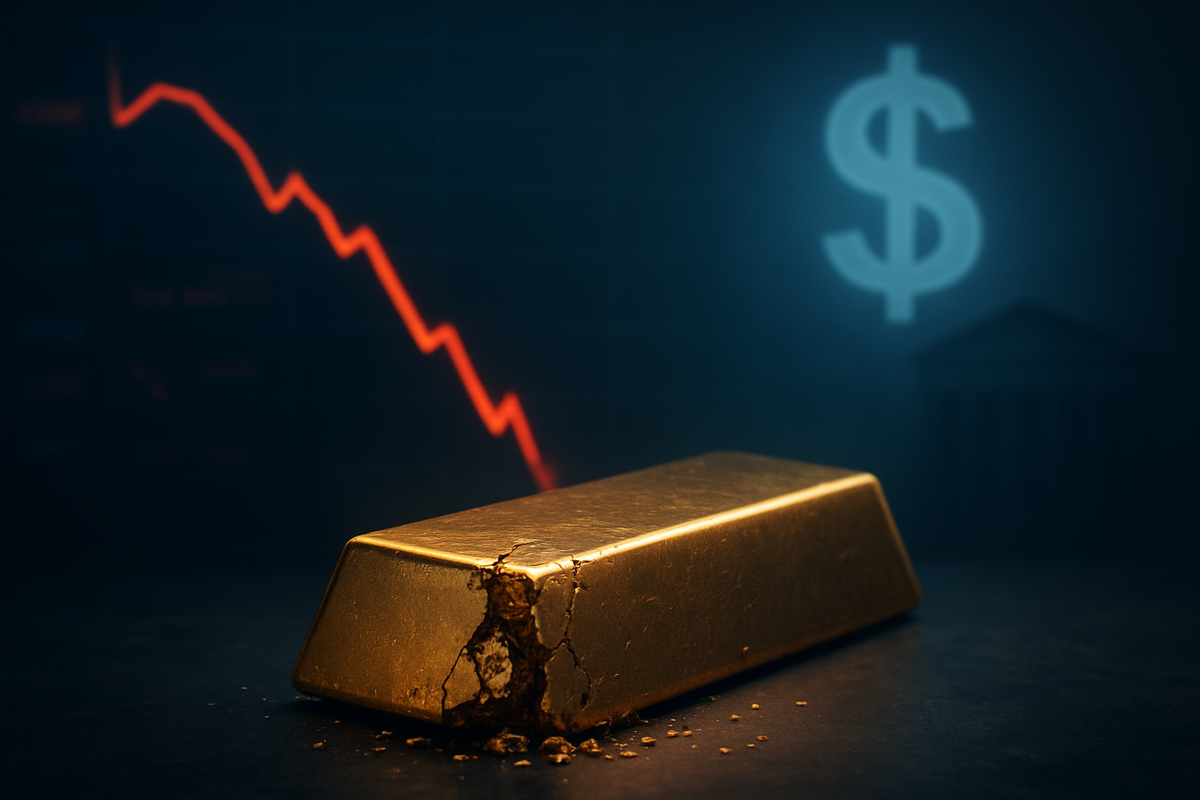
The gold market, which spent the early weeks of 2026 in a state of euphoric ascent, has been brought back to earth with startling velocity. After touching a staggering all-time high of $5,603.21 on January 29, 2026, the precious metal has entered a technical bear market, plummeting roughly 22% to hover near the $4,320 mark this week. This sudden reversal has caught many retail investors off guard, especially as geopolitical tensions traditionally serve as a tailwind for the safe-haven asset.
The primary driver behind this "Safe-Haven Paradox" is a revitalized U.S. Dollar and a Federal Reserve that has effectively abandoned its dovish stance. With inflation proving stickier than anticipated due to a surge in energy costs, the central bank’s latest projections now signal just one interest rate cut for the entirety of 2026. This hawkish pivot has sent 10-year real yields climbing toward 2.08%, creating a formidable headwind for non-yielding assets like gold and forcing a massive liquidation across the commodities complex.
The Anatomy of a Record Collapse: A Timeline of the Correction
The descent from $5,603 began not with a cooling of global tensions, but ironically, with their escalation. In late February 2026, as conflict intensified between the U.S. and Iran, Brent crude oil prices spiked above $112 per barrel. While gold initially gained on the news, the inflationary implications of $100+ oil forced the Federal Open Market Committee (FOMC) to rethink its 2026 roadmap. By the March 17–18 meeting, the Fed held the federal funds rate steady at 3.50%–3.75%, but the accompanying "dot plot" revision was the real blow, slashing the expected rate cuts from three down to just one.
As the market digested the Fed's "higher for longer" stance, the U.S. Dollar Index (DXY) surged, trading in a robust range between 99.60 and 100.36. This strengthening of the greenback made gold significantly more expensive for international buyers, further dampening demand. Simultaneously, the 10-year Treasury inflation-protected securities (TIPS) yield—a proxy for "real yields"—jumped from 1.50% to over 2.00% in a matter of weeks. When real yields rise, the opportunity cost of holding a non-interest-bearing asset like gold increases, triggering institutional sell-offs.
Initial market reactions have been characterized by heavy liquidations from institutional desks and algorithmic trading platforms. The volatility seen in the second half of March 2026 has been some of the highest on record for the bullion market, with single-day drops occasionally exceeding 3%. Analysts suggest that the "momentum trade" that fueled the 65% rally in 2025 has completely unwound, replaced by a defensive rotation into high-yield cash and short-term debt instruments.
Mining Giants and ETFs: The Winners and Losers of the Gold Rout
The equity side of the gold trade has been hit even harder than the spot price itself. Newmont Corporation (NYSE: NEM), the world’s largest gold miner, has seen its shares plummet approximately 26% since the January peak. The company is grappling with a "double whammy" of falling revenue and rising operational expenses. Management recently highlighted that 2026 is shaping up to be a "trough year," as All-In Sustaining Costs (AISC) have climbed toward $1,680 per ounce due to persistent labor shortages and high energy costs associated with mining operations.
Similarly, Barrick Gold Corporation (NYSE: GOLD) has retreated nearly 20% in March. Beyond the falling price of bullion, Barrick is navigating complex jurisdictional risks that have hampered production at several key African sites. For investors in mining equities, the current correction is particularly painful because it exposes the fragility of profit margins when gold prices fall while energy-driven input costs remain elevated.
The exchange-traded fund (ETF) sector has also seen a historic exodus. SPDR Gold Shares (NYSE Arca: GLD) recorded a staggering $2.91 billion single-day outflow in mid-March, representing one of its largest liquidations in over a decade. Total outflows from gold-backed ETFs have reached an estimated $7 billion this month alone. Meanwhile, investors looking for a "win" in this environment have turned to the ProShares UltraShort Gold ETF (NYSE Arca: GLL), which seeks to provide twice the inverse daily performance of gold, benefiting significantly from the metal’s 22% decline.
Broader Significance: Real Yields and the "Higher for Longer" Paradigm
The current correction represents a significant shift in the global macro narrative. Throughout 2025, the dominant market theme was "de-dollarization" and the steady erosion of U.S. Treasury dominance. Gold was the primary beneficiary of this trend. However, the events of early 2026 have reaffirmed the "Dollar Smile" theory, where the greenback remains the ultimate refuge during periods of both extreme global stress and high U.S. interest rates.
Historically, gold corrections of this magnitude have occurred when the Federal Reserve undergoes a sudden hawkish recalibration. The 2026 scenario bears a striking resemblance to the "Taper Tantrum" of 2013, albeit on a much larger scale due to the record highs involved. The key difference today is the role of 10-year real yields. With TIPS yields breaking above 2.0%, the fundamental floor that supported gold during the low-interest-rate era of the early 2020s has essentially vanished.
This event also signals a potential cooling in the commodities supercycle. If the Fed is willing to sacrifice growth—and gold prices—to combat energy-driven inflation, it suggests a broader tightening of global liquidity. For partners and competitors in the mining space, such as Agnico Eagle Mines Limited (NYSE: AEM), the focus has shifted entirely from expansion to cost-containment and capital preservation, a trend that may define the mining industry for the remainder of the decade.
What Comes Next: Potential Scenarios for the Yellow Metal
In the short term, technical analysts are watching the $4,100 to $4,200 range as a potential "psychological floor" where gold might attempt to form a base. However, a break below $4,000 could trigger a new wave of forced liquidations among leveraged hedge funds. Much will depend on the upcoming April and May inflation data. If the "one rate cut" projection turns into "no rate cuts" for 2026, the downward pressure on gold could persist through the summer.
Long-term, the strategic pivot for the gold market will involve a focus on central bank demand. While retail and ETF demand has cratered, many sovereign central banks, particularly in the BRICS+ nations, may view this 22% correction as a generational buying opportunity. Should central bank purchasing resume at the $4,000 level, it could provide the stability needed for a gradual recovery. Investors should also monitor energy markets; a significant de-escalation in the Middle East could lower inflation expectations and allow the Fed to return to a more dovish posture, which would be the ultimate catalyst for a gold rebound.
Summary: Key Takeaways for the Forward-Looking Investor
The descent of gold from its $5,603 pinnacle is a stark reminder of the metal’s sensitivity to real interest rates and Federal Reserve policy. The primary takeaway from this correction is that no asset is immune to the gravity of a 2% real yield and a hawkish central bank. The "Safe-Haven Paradox" of 2026 has proven that during times of conflict-driven inflation, the Fed's reaction function is a more powerful market force than the traditional flight-to-safety trade.
Moving forward, the market will remain hyper-fixated on two variables: the 10-year Treasury yield and the price of Brent crude. For investors, the coming months will be a test of patience. While the 22% correction has removed much of the "froth" from the 2025 bull run, a sustainable bottom will only be confirmed once the Federal Reserve provides clarity on when—and if—it will finally begin the easing cycle. For now, the "Hawkish Fed Reality" remains the dominant theme in the precious metals market.
This content is intended for informational purposes only and is not financial advice.