

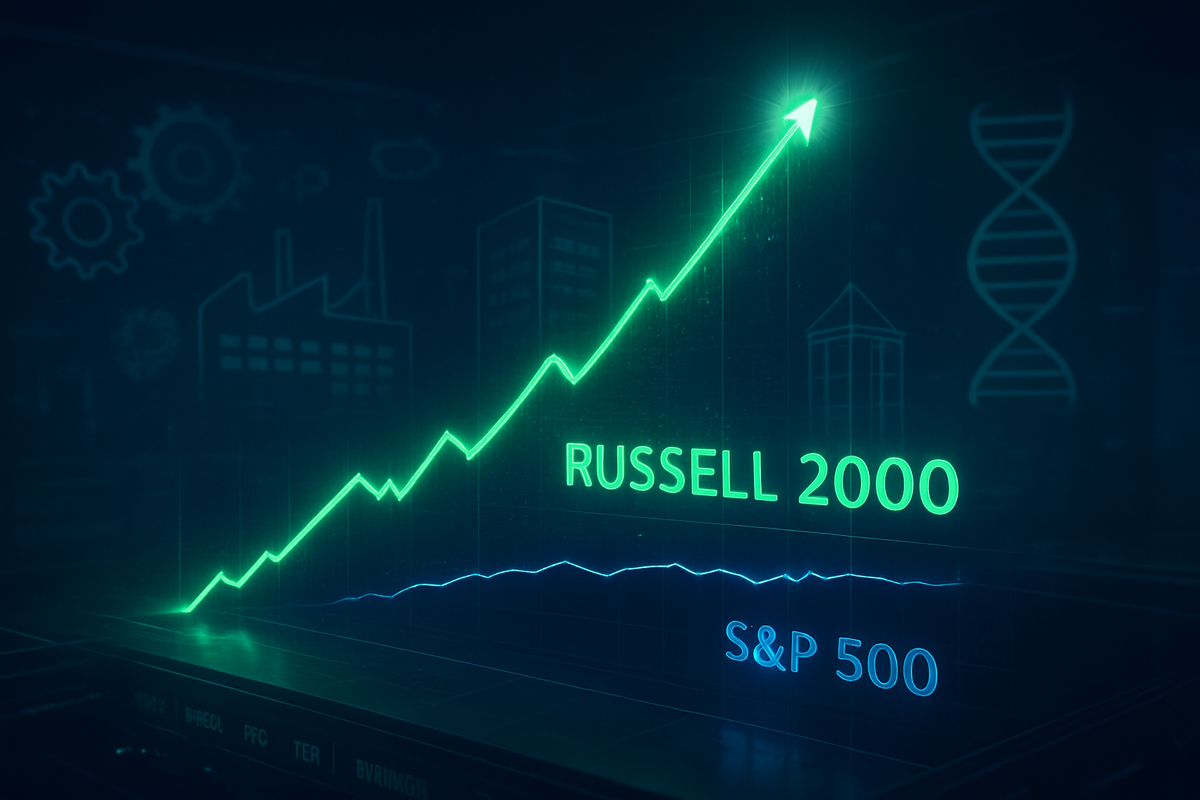
The financial landscape has undergone a tectonic shift in the opening months of 2026, as the long-dormant Russell 2000 index has surged to record highs, marking what many analysts believe is the definitive end of mega-cap dominance. After trailing the S&P 500 (NYSEARCA: SPY) for over a decade, small-cap stocks have ignored the gravity of high valuations in the "Magnificent Seven" and embarked on a four-week outperformance streak that has caught institutional investors by surprise.
As of March 25, 2026, the small-cap Russell 2000 (NYSEARCA: IWM) is up approximately 8% year-to-date, a staggering contrast to the S&P 500’s modest 1.5% gain. This divergence signals a fundamental "Great Rotation" away from the AI-driven tech heavyweights and toward the "real economy" companies that stand to benefit most from a stabilizing interest rate environment and new federal tax incentives.
The January Breakout and a Record-Setting Streak
The momentum for this historic move began to coalesce in the final weeks of 2025, but the true fireworks occurred in January 2026. The Russell 2000 hit eight separate record highs during the month, eventually peaking at a closing high of 2,718.77 on January 22. This rally was underpinned by a 15-session winning streak against the broader S&P 500—the longest such run of relative outperformance since 1996. The streak served as a wake-up call for fund managers who had been underweight small-caps for years, leading to a massive scramble for liquidity in smaller names.
This surge was not accidental but rather the result of a "perfect storm" of macro catalysts. The Federal Reserve, having successfully navigated a "soft landing," reduced the Federal Funds Rate to a range of 3.50%–3.75% by mid-January. For the approximately 40% of small-cap companies with floating-rate debt, this pivot provided immediate relief to their balance sheets. Combined with a projected US GDP growth rate of 2.7% for 2026, the economic environment has become increasingly hospitable for domestically focused businesses that lack the global hedging capabilities of their large-cap peers.
Sector Winners: From Regional Banks to Biotech
The rotation has not been uniform, with specific sectors within the small-cap universe leading the charge. Regional banks have been among the largest beneficiaries, as a steepening yield curve and a more favorable regulatory environment have boosted net interest margins. Shares of Five Star Bancorp (NASDAQ: FSBC) and Western Alliance Bancorporation (NYSE: WAL) have seen double-digit gains this quarter, fueled by a resurgence in small-business lending and a flurry of regional M&A activity. Live Oak Bancshares (NASDAQ: LOB) has also emerged as a leader, leveraging its position as a top SBA lender to capitalize on the entrepreneurial boom triggered by the new economic cycle.
In the industrial sector, the focus has shifted toward reshoring and automation. Comfort Systems USA (NYSE: FIX) and ATI Inc. (NYSE: ATI) have hit multi-year highs as they provide the essential infrastructure and materials for the "Industrial 4.0" wave. Meanwhile, the biotechnology sector has experienced a "thaw" after a long period of underperformance. With large pharmaceutical giants facing looming patent cliffs, they have turned to the Russell 2000 to replenish their pipelines. Cogent Biosciences (NASDAQ: COGT) and Structure Therapeutics (NASDAQ: GPCR) have been highlighted by analysts as primary examples of small-cap biotechs that are outperforming as clinical milestones and acquisition rumors drive prices higher.
The 'OBBBA' Catalyst and the End of AI Fatigue
A critical component of this rotation is the "One Big Beautiful Bill Act" (OBBBA), which took full effect on January 1, 2026. This legislation restored 100% bonus depreciation and reinstated the immediate expensing of research and development costs—policies that disproportionately benefit capital-intensive small-cap firms. By shifting the interest deductibility cap from 30% of EBIT to 30% of EBITDA, the bill has effectively lowered the cost of capital for the very companies that were most penalized by the high-rate environment of 2023 and 2024.
Furthermore, strategists note that "AI fatigue" has finally set in among the mega-cap tech stocks. The valuation gap between the Russell 2000 and the S&P 500 reached a 30-year extreme in late 2025, with small-caps trading at a nearly 31% discount on a forward P/E basis. As the "Magnificent Seven" hit valuation ceilings, investors began harvesting gains to fund allocations in these undervalued small-caps. This breadth expansion is seen as a sign of a healthier market, moving away from the extreme concentration that characterized the previous two years.
A Multi-Year Shift: Not Just a Tactical Bounce
While some skeptics initially dismissed the January rally as a simple "January Effect" or a tactical bounce, institutional strategists at firms like Goldman Sachs and J.P. Morgan are increasingly characterizing this as a multi-year leadership change. Historically, small-cap underperformance cycles last roughly nine years; the most recent cycle stretched to 12 years, making the current reversal statistically overdue. The earnings growth projections for the Russell 2000 are also compelling, with estimates suggesting an 18% to 35% increase in 2026, far outstripping the 11% to 14% expected for the S&P 500.
The challenge for investors moving forward will be navigating the increased volatility inherent in small-cap stocks. While the upside potential is significant, these companies are more sensitive to local economic shifts and regulatory changes than their global counterparts. However, the structural tailwinds provided by the Fed's pivot and the OBBBA suggest that the floor for small-caps has risen significantly. The primary risk remains a potential resurgence in inflation that could force the Fed to pause its rate-cutting cycle, though current data suggests a stable downward trend in consumer prices.
Final Outlook: What Investors Should Watch
The "Great Rotation" of early 2026 marks a pivotal moment in market history, proving that even the most dominant leadership cycles eventually yield to mean reversion and fundamental shifts. The Russell 2000’s record-breaking start to the year is not just a footnote but a clear signal that the market's internal mechanics have changed. Investors should look beyond the indices and focus on the quality of balance sheets within the small-cap space, as the "rising tide" will eventually favor those best positioned to utilize new tax incentives.
In the coming months, keep a close watch on the 10-year Treasury yield and the quarterly earnings reports of regional banks. If the yield curve continues to steepen and small-cap earnings growth meets the aggressive 30% forecasts, the Russell 2000 could very well become the primary engine of market returns for the remainder of the decade. For now, the "Magnificent Seven" have been replaced by a much broader, more resilient "Magnificent Two Thousand."
This content is intended for informational purposes only and is not financial advice.