

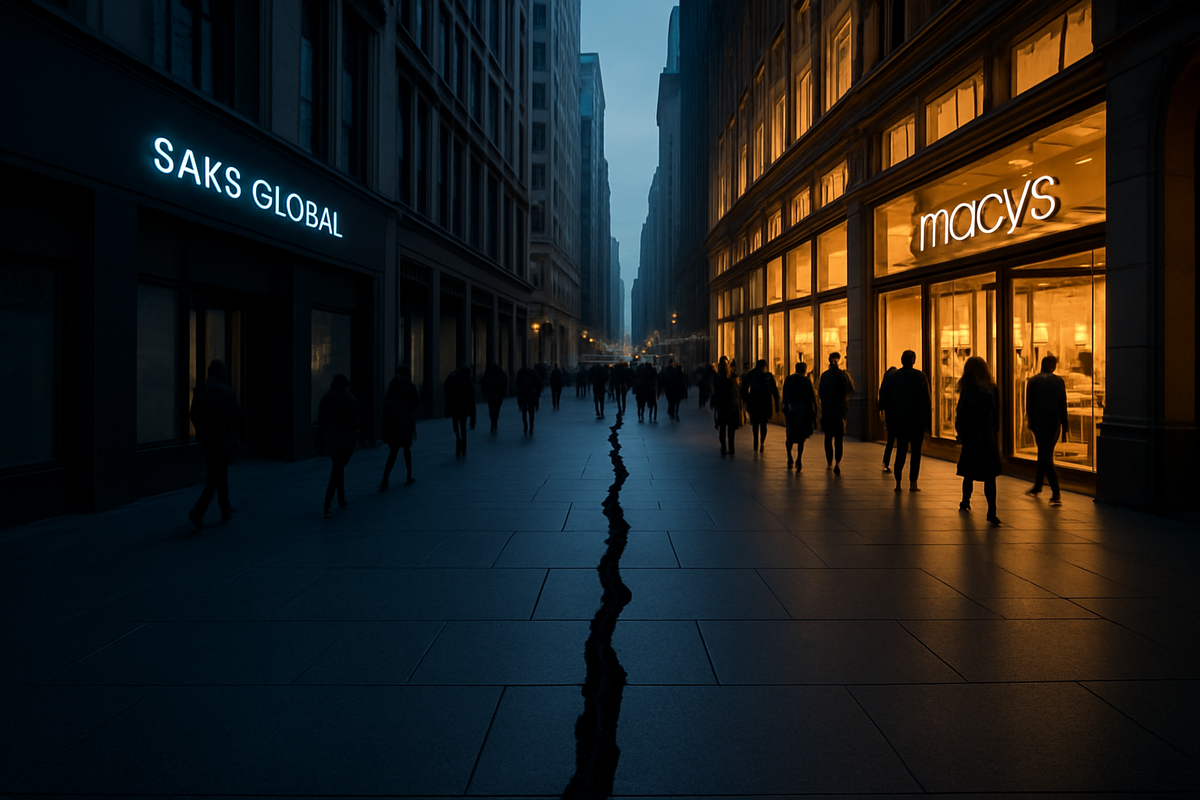
As of late March 2026, the American retail landscape has reached a definitive turning point, characterized by a stark "Great Bifurcation" between the nation’s two largest luxury purveyors. While Macy’s Inc. (NYSE: M) appears to have successfully navigated its ambitious "A Bold New Chapter" turnaround strategy, its primary rival, the newly formed Saks Global, is currently fighting for survival under the weight of a massive debt load and a recent Chapter 11 bankruptcy filing.
The immediate implications are profound: a massive shift in luxury market share is underway. With Saks Global shuttering scores of locations and grappling with vendor disputes, Bloomingdale’s—the luxury jewel in the Macy’s crown—has reported record-breaking growth, signaling a potential permanent realignment of where the American affluent class chooses to spend its capital.
A Tale of Two Strategies: Macy’s Offensive vs. Saks’ Restructuring
The current state of the market is the result of two diametrically opposed strategies that began to diverge in late 2024. Macy’s Inc. (NYSE: M), under the leadership of CEO Tony Spring, doubled down on a lean-and-mean approach titled "A Bold New Chapter." This plan involved the aggressive closure of 150 underperforming namesake stores to reinvest capital into its high-performing luxury banners: Bloomingdale’s and Bluemercury. By March 2026, the strategy has yielded significant fruit. In its FY 2025 results, Macy’s reported net sales of $21.8 billion, with comparable sales turning positive for the first time in years, driven by a nearly 10% jump in Bloomingdale’s holiday revenue.
In contrast, the 2024 merger of Saks Fifth Avenue and Neiman Marcus to form "Saks Global" has encountered severe turbulence. What was intended to be a $2.7 billion luxury powerhouse instead became a cautionary tale of over-leverage. Facing a $4.7 billion debt pile and a "vicious spiral" of unpaid invoices to major fashion houses like Chanel and LVMH, Saks Global filed for Chapter 11 bankruptcy protection on January 13, 2026. The company has since announced the closure of nearly all its off-price "Saks OFF 5TH" and "Neiman Marcus Last Call" locations, choosing to focus on a skeletal fleet of just 45 flagship full-price stores.
The market reaction has been swift. While Macy’s stock has surged roughly 45% over the past twelve months, trading near $22.00, investor sentiment toward the broader department store sector remains cautious. Analysts note that while Macy’s has proved it can execute, the bankruptcy of Saks Global has cast a long shadow over the viability of the traditional luxury department store model in an era of direct-to-consumer dominance.
Identifying the Winners and Losers of the Luxury Reset
The primary beneficiary of the current retail shakeup is undoubtedly Bloomingdale’s. As Saks Global retreated from several key suburban markets in early 2026, Bloomingdale’s "Bloomie’s" small-format stores have stepped in to fill the void, capturing an estimated $700 million in "up-for-grabs" luxury spend. Similarly, Bluemercury has emerged as a "crown jewel" for Macy’s Inc. (NYSE: M), posting 18 consecutive quarters of growth and expanding its footprint by 30 new locations this year alone.
Nordstrom (NYSE: JWN) is also emerging as a winner in this environment. By maintaining a stable balance sheet while its competitors were either restructuring or merging, Nordstrom has seen double-digit growth in regions where Saks has shuttered its full-line doors. The company’s focus on its "Rack" off-price division has also allowed it to capture the "aspirational" luxury shopper who has been abandoned by Saks Global’s exit from the off-price segment.
On the losing side, Saks Global’s restructuring has left its parent company, Hudson's Bay Company (HBC), in a precarious position. Furthermore, Amazon (NASDAQ: AMZN), which had previously taken an equity stake in Saks as part of a high-profile "Saks on Amazon" luxury partnership, has largely retreated from the venture. Sources indicate Amazon has labeled its equity stake as virtually worthless following the bankruptcy filing, marking a significant setback for the e-commerce giant's ambitions to dominate the high-end luxury fashion space.
The Wider Significance: Luxury Retail’s New Reality
The events of early 2026 represent more than just corporate competition; they signify a structural shift in how luxury is sold in America. The "Great Bifurcation" highlights a trend where mid-tier, mall-dependent retail is dying, while "ultra-luxury" and "prestige beauty" remain resilient. This follows the historical precedent of the 2008 financial crisis, which similarly wiped out weaker department store players, but the 2026 version is driven by debt-service costs in a higher-for-longer interest rate environment.
Furthermore, the pivot toward Retail Media Networks (RMNs) has become a critical lifeline. Macy’s has successfully transformed its digital platforms into advertising hubs, creating high-margin revenue streams that offset the rising costs of labor and logistics. This digital-first approach to luxury is now a requirement for survival, as seen by Saks Global’s failed attempt to integrate its digital and physical businesses without sufficient liquidity.
Regulatory and policy implications also loom large. As Macy’s navigates 2026, it faces potential headwinds from shifting tariff policies that analysts estimate could impact earnings per share by as much as $0.20. The ability of retailers to pass these costs onto luxury consumers—who are traditionally less price-sensitive—will be a major test for the industry in the coming fiscal year.
The Road Ahead: Strategic Pivots and Market Scenarios
Looking forward, Macy’s Inc. (NYSE: M) is expected to transition from its "Chapter 1" restructuring phase to a "Chapter 2" growth phase. This will likely involve an even heavier reliance on the Bluemercury banner and the potential for international expansion of the Bloomingdale’s brand. Short-term challenges remain, particularly as high-income consumer spending shows signs of cooling in mid-2026, but Macy’s leaner store fleet and improved inventory management provide a significant cushion.
For Saks Global, the path is much narrower. The company must successfully exit Chapter 11 by late 2026 with a restructured debt load and a repaired relationship with its vendors. If it fails to secure long-term shipping agreements with key luxury houses, the company faces the very real possibility of a Chapter 7 liquidation—an outcome that would leave Nordstrom and Bloomingdale’s as the last true luxury department stores standing in many American cities.
Wrapping Up: What Investors Should Watch
The narrative of early 2026 is one of survival of the fittest. Macy’s Inc. (NYSE: M) has proven that a traditional department store can reinvent itself through disciplined store closures and a focus on high-margin luxury and beauty. Saks Global, meanwhile, serves as a stark reminder of the dangers of aggressive consolidation fueled by excessive debt in an unstable economic climate.
As we move into the second half of 2026, investors should keep a close eye on Macy’s "Next 75" store revamps and the continued performance of Bluemercury. These metrics will determine if the current stock rally has more room to run. For the broader market, the successful (or unsuccessful) restructuring of Saks Global will be the ultimate bellwether for the health of the American luxury sector. For now, the "Bold New Chapter" at Macy’s appears to be the winning script in a volatile retail era.
This content is intended for informational purposes only and is not financial advice.