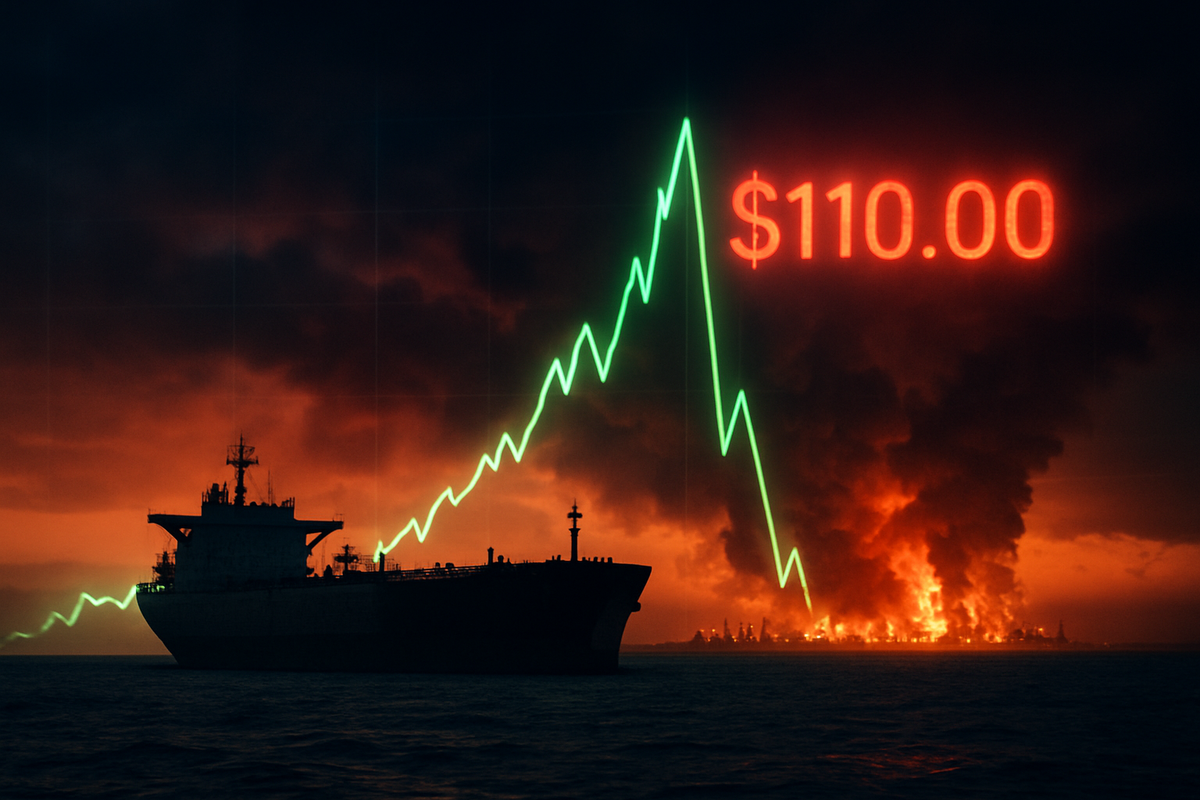
The global energy landscape was plunged into chaos on March 20, 2026, as Brent crude surged to $110 per barrel and West Texas Intermediate (WTI) tested $96. This dramatic price spike follows a week of intensifying military hostilities between a U.S.-Israeli coalition and Iran, effectively paralyzing the Strait of Hormuz—the world’s most vital oil artery. As commercial traffic through the waterway plummeted by an estimated 97%, the "Hormuz Premium" has returned with a vengeance, stoking fears of a prolonged inflationary spiral and a return to the stagflationary pressures of decades past.
The immediate implications are being felt across every sector of the global economy. In the United States, gasoline prices have jumped more than 30% in a single month, hitting a national average of $3.84 per gallon, while European and Asian markets face even steeper energy costs. Central banks, which had been signaling a shift toward interest rate cuts earlier this year, are now being forced into a defensive "higher-for-longer" posture. The sudden removal of 20% of the world’s daily oil and liquefied natural gas (LNG) supply has left traders scrambling to price in a conflict that shows no signs of immediate de-escalation.
The Fog of War: From Shadow Tactics to Direct Confrontation
The current crisis traces its roots to "Operation Epic Fury," a massive joint U.S.-Israeli air campaign launched in late February 2026. The operation targeted Iran’s most sensitive nuclear enrichment sites at Natanz and Fordow using GBU-57 "Bunker Buster" munitions, aiming to permanently disable Tehran's nuclear breakout capability. The strikes, while achieving their immediate tactical goals, triggered a seismic shift in regional stability. Following the reports of the death of Supreme Leader Ali Khamenei during the initial bombardment, his son, Mojtaba Khamenei, was swiftly elevated to the position, unifying hardline Islamic Revolutionary Guard Corps (IRGC) elements for a massive retaliatory response.
In the weeks leading up to March 20, the conflict expanded from targeted air strikes to a wide-scale assault on regional energy infrastructure. Iran’s retaliation has been asymmetric and brutal, utilizing "swarm" drone tactics and anti-ship missiles to target U.S. military bases and allied energy facilities. On March 12, Iranian drones successfully struck the Ras Laffan industrial city in Qatar, forcing QatarEnergy to declare force majeure on several LNG shipments. This was followed by strikes on Saudi Arabia’s Red Sea port of Yanbu, signaling that even bypass pipelines designed to avoid the Strait of Hormuz are no longer safe from long-range precision attacks.
The Strait of Hormuz itself is now a "no-go" zone for commercial shipping. While the U.S. Navy has attempted to maintain a presence, the threat of sea mines and high-speed IRGC interceptor boats has effectively shuttered the route. The result is a logistical nightmare; tankers and cargo ships are now being rerouted around the Cape of Good Hope, adding 15 days to transit times and doubling freight rates overnight. This disruption has created a massive supply-demand gap, particularly for Asian economies like Japan and South Korea, which rely on the Middle East for nearly 95% of their crude imports.
Market Bifurcation: The Winners and Losers of the Energy Crisis
In the equity markets, the reaction has been a sharp "risk-off" rotation, though the energy and defense sectors are seeing record-breaking inflows. U.S.-based supermajors ExxonMobil (NYSE: XOM) and Chevron (NYSE: CVX) have seen their stock prices climb as they benefit from surging crude prices and a heavy geographic tilt toward the relative safety of the Americas and West Africa. Occidental Petroleum (NYSE: OXY), with its heavy focus on domestic U.S. shale, has become a primary beneficiary of the rise in WTI, as the "Hormuz Premium" makes American-sourced energy more attractive than ever before.
The defense industry is also experiencing a surge in demand as the U.S. and its allies move to replenish depleted interceptor stockpiles. Lockheed Martin (NYSE: LMT) and RTX Corporation (NYSE: RTX) are reporting a massive uptick in orders for Patriot missile systems and Iron Dome interceptors, respectively. Similarly, Northrop Grumman (NYSE: NOC) is seeing increased interest in its long-range strike and stealth technology. For the Israeli defense firm Elbit Systems (NASDAQ: ESLT), the conflict has resulted in a swelling order book as the Israel Defense Forces (IDF) maintain a high-tempo operational status across multiple fronts.
Conversely, the transportation and consumer sectors are bearing the brunt of the volatility. Major airlines, including Delta Air Lines (NYSE: DAL), United Airlines (NASDAQ: UAL), and American Airlines (NASDAQ: AAL), have seen their shares drop by 7% to 10% in the last 48 hours as jet fuel costs erode profit margins. Global shipping giants like AP Moller-Maersk (OTC:AMKBY) are struggling with the operational chaos of rerouting their fleets, while cruise operators such as Royal Caribbean (NYSE: RCL) and Carnival (NYSE: CCL) face the double threat of rising fuel costs and evaporating demand for Mediterranean and Middle Eastern itineraries.
A Geopolitical Turning Point: Broader Economic and Regulatory Significance
The surge in oil to $110 represents more than just a temporary supply shock; it is a fundamental threat to the global disinflation trend that dominated 2025. Federal Reserve Chair Jerome Powell, in a statement earlier today, noted that while the U.S. economy remains resilient, the energy-led spike in prices could necessitate keeping interest rates in the 3.50%–3.75% range for the foreseeable future. This "higher-for-longer" environment is a blow to emerging markets and highly leveraged tech companies that were banking on a low-rate environment to fuel growth in 2026.
Historically, this event draws comparisons to the 1973 oil embargo and the 1979 Iranian Revolution, but with the added complexity of modern global supply chains. The shift in LNG markets is particularly significant; as Qatari supplies are bottled up, American LNG exporters like Cheniere Energy (NYSE: LNG) have become the primary "lenders of last resort" for European and Asian energy needs. This pivot is likely to accelerate the build-out of U.S. export infrastructure, potentially leading to new regulatory fast-tracking for energy projects under the guise of national security.
Furthermore, the crisis is forcing a rethink of the global green energy transition. While high fossil fuel prices usually incentivize a shift toward renewables, the immediate need for energy security is driving a short-term pivot back to coal and domestic oil production. Governments are being forced to choose between long-term climate goals and the short-term economic survival of their citizens. This tension is expected to dominate political discourse throughout 2026, potentially leading to a rollback of environmental regulations in favor of "energy independence" initiatives across the West.
The Path Forward: Escalation, Diplomacy, or Stalemate?
In the short term, the market remains on a knife-edge. If Iran follows through on threats to launch even more widespread attacks on Saudi oil fields, some analysts predict Brent crude could test the $150 mark. Conversely, any sign of a diplomatic backchannel—perhaps mediated by Oman or Switzerland—could lead to a rapid $20/barrel "relief rally" in the opposite direction. For now, the U.S. administration is weighing a massive release from the Strategic Petroleum Reserve (SPR), though levels are already at historic lows following the interventions of previous years.
Strategic pivots will be required for companies across the board. Manufacturers are likely to accelerate "near-shoring" efforts to insulate their supply chains from Middle Eastern volatility, while logistics firms will need to invest heavily in fuel-hedging strategies. The market may also see an emergence of new "energy-secure" investment vehicles, focusing on nuclear power and U.S. shale as the only reliable bedrocks in an increasingly fractured geopolitical landscape.
The long-term scenario remains clouded by the succession in Iran. If Mojtaba Khamenei chooses to cement his rule through continued regional aggression, the world may be entering a multi-year period of heightened energy costs. Investors should watch for signs of "demand destruction"—where prices become so high that consumers stop spending—which would signal the onset of a global recession. The coming months will determine if this is a temporary spike or the start of a new, more expensive era for the global economy.
Market Wrap-up: Navigating the 2026 Energy Shock
The events of March 20, 2026, have fundamentally altered the investment landscape. The primary takeaway is that geopolitical risk is no longer a peripheral concern but a core driver of market valuation. The surge in oil prices has created a stark divide between energy producers and energy consumers, with the former reaping windfall profits while the latter face a daunting outlook of rising costs and shrinking margins.
Moving forward, the market will be hyper-sensitive to any military movement in the Persian Gulf. Investors should closely monitor the "Hormuz Premium" and watch for potential ripple effects in the bond market, where rising inflation expectations could drive yields higher and pressure equity valuations. The resilience of the U.S. consumer in the face of $4/gallon gasoline will be the ultimate test for the economy in the second half of 2026.
Ultimately, the U.S.-Israel and Iran conflict has reminded the world that energy security is the foundation of economic stability. As the "War of 2026" continues to unfold, the ability to adapt to a high-cost energy environment will be the defining characteristic of successful companies and portfolios alike. Watch for upcoming corporate earnings reports in the transportation and retail sectors for the first clear signs of the conflict's toll on the bottom line.
This content is intended for informational purposes only and is not financial advice.