
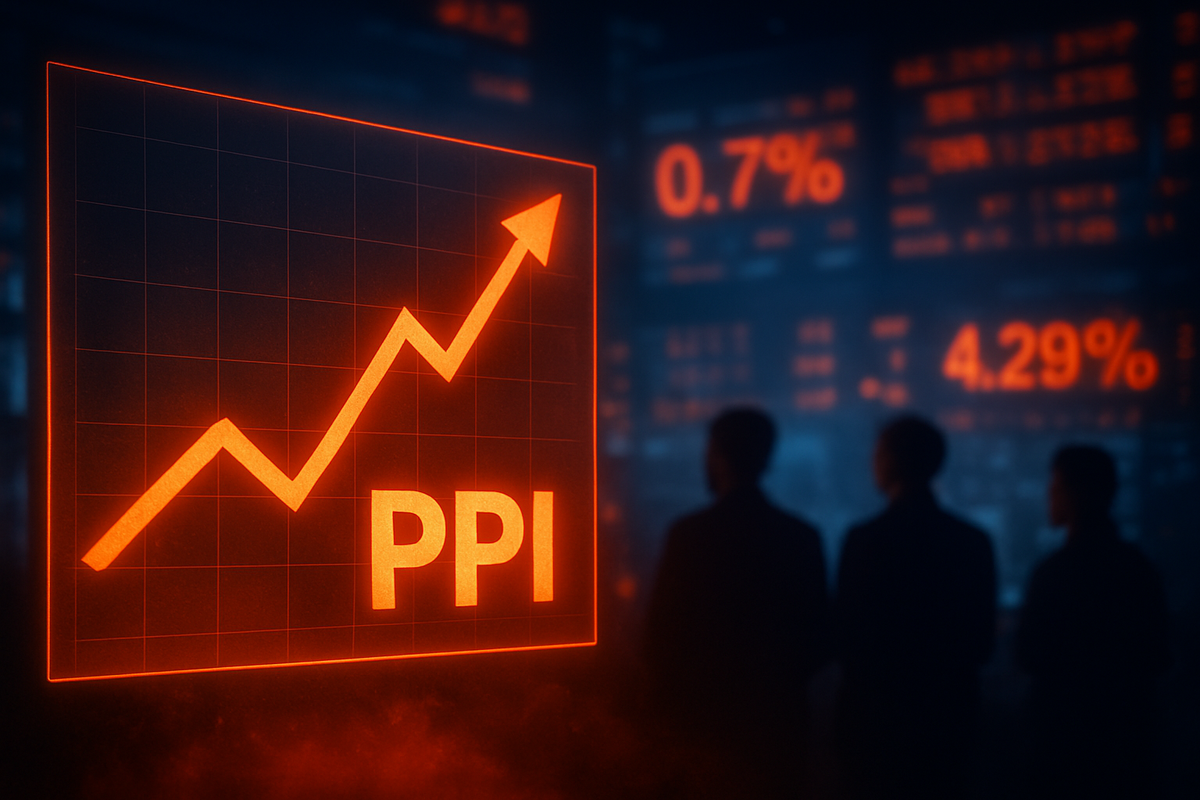
The financial markets were dealt a sobering blow on the morning of March 19, 2026, as the Bureau of Labor Statistics released a February Producer Price Index (PPI) report that significantly outpaced economist expectations. Wholesale prices surged by 0.7% for the month, far exceeding the consensus estimate of 0.4% and marking the sharpest monthly increase in over two years. This "hotter-than-expected" data has effectively dismantled the prevailing market narrative that inflation was on a glide path toward the Federal Reserve’s 2% target, replacing it with fears of "sticky" inflation that could remain anchored well above desired levels.
The immediate fallout was visible across the bond and equity markets. As the realization set in that the Federal Reserve may be forced to maintain restrictive interest rates for much longer than anticipated, the 10-year Treasury yield spiked to 4.29%, its highest level in months. For investors who had spent the early part of 2026 pricing in a series of rate cuts, the PPI data served as a harsh reminder that the "last mile" of the inflation fight is proving to be a grueling marathon rather than a victory lap.
The Wholesale Shock: Breaking Down the February PPI Numbers
The 0.7% surge in the PPI was driven by a volatile mix of structural and geopolitical pressures. While energy costs played a significant role—with Brent crude prices climbing toward $110 per barrel due to renewed tensions in the Middle East—the report’s "core" readings were equally concerning. Core PPI, which excludes the more volatile food and energy components, rose by 0.5%, suggesting that price pressures are no longer confined to commodities but are deeply embedded in the services sector and broader supply chains.
Key drivers within the report included a 5.7% jump in traveler accommodation and a staggering 14.4% increase in wholesale trade margins for machinery. This indicates that labor-intensive sectors and high-end industrial goods are continuing to pass on costs to consumers. The timeline leading up to this moment has been one of cautious optimism; throughout late 2025, many analysts believed the Fed had successfully engineered a "soft landing." However, the February data, arriving on the final day of the Fed’s March policy meeting, has forced a dramatic rethink of that timeline.
The Federal Reserve, led by Chair Jerome Powell, found itself in a precarious position as the data hit the wires. While the Fed maintained the federal funds rate at 3.50%–3.75% during its March 19 announcement, the accompanying "dot plot" of future rate expectations was revised significantly. Previously, officials had signaled up to three rate cuts for 2026; following this PPI shock, that outlook has been slashed to one or possibly zero cuts, with some hawkish members even hinting at the possibility of a rate hike if inflation does not cool by summer.
Market Shifting: Winners and Losers in a High-Rate Environment
The return of the "higher-for-longer" interest rate narrative has created clear divisions in the equity markets. The primary losers in this environment are high-growth technology companies and "long-duration" assets. Apple Inc. (NASDAQ: AAPL) and NVIDIA Corporation (NASDAQ: NVDA) saw immediate selling pressure as the rise in Treasury yields increased the discount rate applied to their future earnings. Investors are increasingly skeptical that the AI-driven productivity gains promised in 2025 can materialize fast enough to offset the rising cost of capital.
Similarly, the interest-rate-sensitive housing sector took a hit. Large-scale homebuilders like DR Horton, Inc. (NYSE: DHI) faced a sell-off as the spike in bond yields translated directly into higher mortgage rates, threatening to further dampen buyer demand in an already stretched market. On the other hand, the energy sector emerged as a primary beneficiary of the inflationary spike. Exxon Mobil Corp (NYSE: XOM) and Chevron Corp (NYSE: CVX) saw their stock prices climb as higher producer-side prices and surging crude oil bolstered their top-line revenue and profit margins.
The financial sector presented a more complex picture. Large-cap banks, such as JPMorgan Chase & Co. (NYSE: JPM) and Bank of America Corp (NYSE: BAC), initially saw their shares stabilize as higher interest rates typically allow for expanded Net Interest Margins (NIM). However, this optimism is tempered by the growing risk of a "policy error"—the fear that the Fed might keep rates so high for so long that it triggers a deep recession, leading to a spike in loan defaults and a slowdown in capital markets activity.
The "Last Mile" Becomes a Marathon: Wider Economic Implications
This PPI report is more than just a data point; it represents a shift in the broader economic cycle. Analysts are beginning to draw uncomfortable parallels to the 1970s, a period characterized by multiple "waves" of inflation where price stability proved elusive. Much like the 1970s oil shocks, the 2026 energy spike is complicating the Fed’s dual mandate, forcing it to prioritize price stability even as unemployment begins to tick upward, reaching 4.4% in early 2026.
The "sticky" nature of this inflation is also attributed to the "Liberation Day" tariffs enacted in 2025, which have continued to filter through the supply chain. These policy-driven costs, combined with an aging workforce that keeps labor costs high, suggest that the U.S. economy may be entering a "stagflationary" period—a challenging environment defined by low growth and persistent inflation. This deviates from the 2022 inflationary spike, which was largely seen as a byproduct of pandemic-related supply chain clogs that could be resolved through normalization.
Furthermore, the strength of the U.S. dollar, which surged following the PPI release, is creating ripple effects for global partners. As the Federal Reserve remains more hawkish than the European Central Bank or the Bank of England, the dollar's dominance (DXY > 100) is making it more expensive for emerging markets to service dollar-denominated debt. This divergence in global monetary policy could lead to increased volatility in international trade and currency markets throughout the remainder of the year.
The Path Ahead: Policy Pivots and Investor Strategies
Looking forward, the market is now bracing for a period of extreme data dependency. The short-term focus will shift to the upcoming Consumer Price Index (CPI) and Personal Consumption Expenditures (PCE) reports to see if the wholesale price increases have already been passed through to consumers. If these reports confirm the PPI trend, the Federal Reserve may be forced to formally abandon its easing bias in favor of a "restrictive hold" that could last through the end of 2026.
Strategic pivots are already underway among institutional investors. There is a growing movement toward "value" and "quality" factors, prioritizing companies with strong balance sheets and the ability to maintain pricing power in an inflationary environment. Investors are also looking toward alternative assets, such as commodities and inflation-protected securities, as a hedge against the eroding purchasing power of the dollar. The "no landing" scenario—where the economy continues to grow despite high rates but inflation stays high—is now the base case for many Wall Street firms.
However, the risk of a "hard landing" remains on the table. If the Fed is forced to hike rates again to break the back of this 3% inflation plateau, the stress on regional banks and commercial real estate could reach a breaking point. Market participants will be watching the Fed’s rhetoric closely in the coming weeks for any signs of internal disagreement on how to handle this second wave of inflation.
Navigating the New Inflationary Reality
The February PPI report has served as a wake-up call for the financial world. The 0.7% jump is a clear signal that the inflationary dragon has not yet been slain. For the Federal Reserve, the path to a 2% target has become infinitely more complicated, and the "Goldilocks" scenario of falling rates and steady growth appears increasingly out of reach. Investors must now recalibrate their expectations for a world where money is no longer cheap and inflation is a persistent feature of the landscape.
As we move into the second quarter of 2026, the key takeaways are clear: the bond market remains the primary source of volatility, energy is once again a dominant market force, and the Federal Reserve is trapped between a rock and a hard place. The market’s resilience will be tested in the months ahead as it grapples with the reality that the "last mile" of inflation might actually be the start of a new, more difficult chapter in economic history.
Investors should watch for the next round of labor market data and the Fed’s updated economic projections in June. Until then, the theme remains one of caution, as the "sticky" inflation narrative continues to rattle the foundations of the 2026 bull market.
This content is intended for informational purposes only and is not financial advice