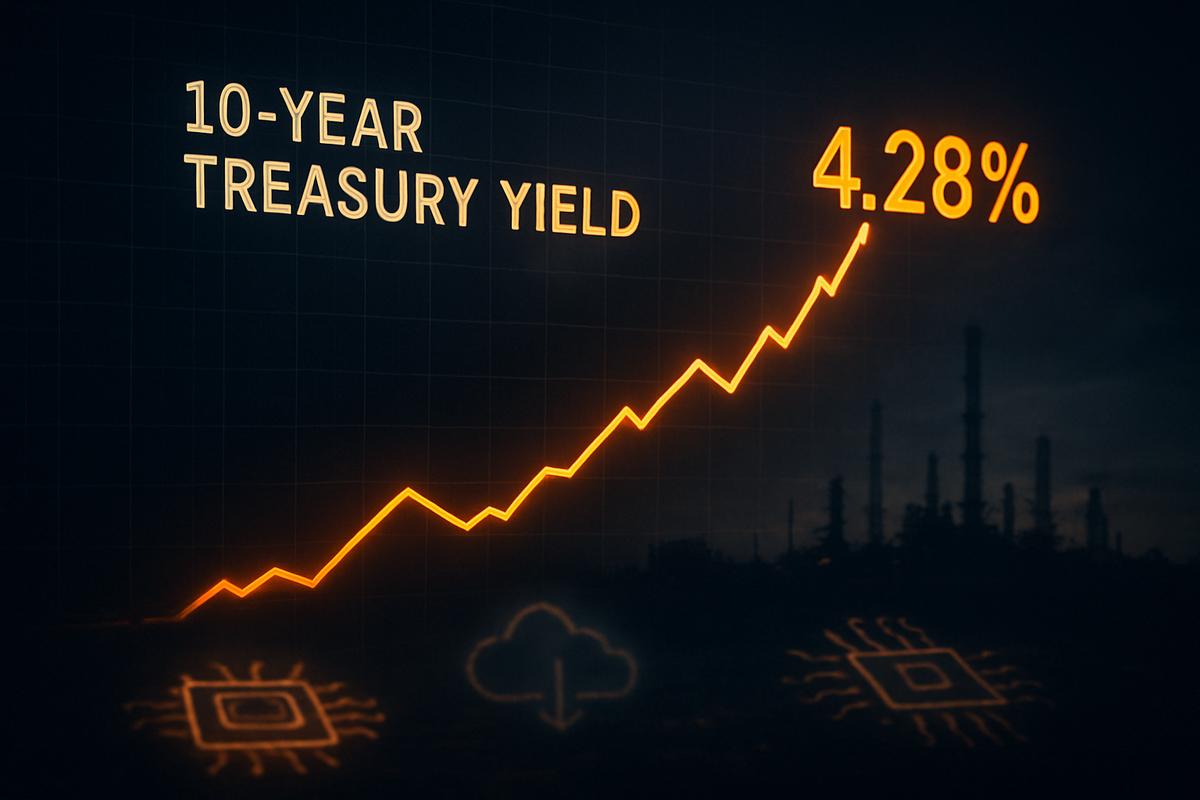
NEW YORK — The global financial landscape is grappling with a sudden and aggressive repricing of risk as the U.S. 10-year Treasury yield holds steady near 4.28% this mid-March. This marks the steepest two-week climb in over a year, a 32-basis-point surge from a late-February low of 3.96%. The rapid ascent has sent shockwaves through equity markets, exerting massive pressure on high-flying technology stocks and forcing a fundamental rethink of broader market valuations.
As of March 16, 2026, the "risk-free" rate has become anything but peaceful. Driven by a combination of geopolitical volatility in the Middle East and stubbornly high inflation data, the bond market’s move is being characterized by analysts as a "valuation gravity" event. For every basis point the 10-year yield rises, the present value of future corporate earnings—particularly for growth-oriented companies—shrinks, leading to a brutal reassessment of the 2026 market outlook.
The Perfect Storm: Geopolitics and 'Sticky' Inflation
The primary catalyst for this historic bond sell-off can be traced back to the final days of February 2026. Following coordinated airstrikes involving Iran on February 28, a significant "war premium" was immediately priced into global energy markets. Crude oil prices (WTI) surged toward $120 per barrel as threats to the Strait of Hormuz intensified. Unlike traditional "flight-to-safety" periods where investors rush into Treasuries (pushing yields down), this crisis is viewed as inherently inflationary, driving investors out of bonds as they anticipate higher prices for longer.
Simultaneously, the latest Core PCE Price Index—the Federal Reserve’s preferred inflation metric—was released at 3.1%, significantly overshooting the central bank's 2% target. This data point, combined with the energy shock, has effectively dismantled hopes for a rapid rate-cutting cycle in 2026. The Federal Reserve, led by Chair Jerome Powell, has signaled a hawkish "hold" at current levels (3.75%–4.00%), with traders now pricing in only a single 25-basis-point cut, likely not occurring until December 2026. Fiscal concerns have also resurfaced, as a 43-day government shutdown earlier this year and increased military spending have forced the Treasury to issue more debt, requiring higher yields to attract buyers in an increasingly cautious global market.
Winners and Losers: The Great Sector Rotation
The surge to 4.28% has created a stark divide between the "haves" and "have-nots" in the equity market. The hardest hit have been the technology titans, whose high valuations are built on the promise of cash flows far into the future. Apple Inc. (NASDAQ: AAPL) and Microsoft Corp. (NASDAQ: MSFT) have faced significant valuation resets as the discount rate used by analysts jumped. Even AI leaders like NVIDIA Corp. (NASDAQ: NVDA), which dominated 2025, are seeing "AI anxiety" set in; investors are questioning whether the massive capital expenditure on hardware can be sustained when the cost of capital is nearly 4.3%. Similarly, Amazon.com Inc. (NASDAQ: AMZN) has seen its shares retreat as rising energy costs and borrowing rates threaten to squeeze consumer discretionary spending.
Conversely, the energy and defense sectors are emerging as clear winners. Exxon Mobil Corp. (NYSE: XOM) hit record highs near $154 per share in mid-March, a 28% gain year-to-date, as it benefits from both the oil price spike and its robust production in the Permian Basin and Guyana. Chevron Corp. (NYSE: CVX) followed suit, touching all-time highs near $200. In the banking sector, JPMorgan Chase & Co. (NYSE: JPM) saw its market capitalization cross the $900 billion threshold, as higher yields allow for Net Interest Margin (NIM) expansion. Defense contractors such as RTX Corp. (NYSE: RTX) and Lockheed Martin Corp. (NYSE: LMT) have also reached 52-week highs, buoyed by the escalating conflict in the Middle East and the resulting increase in defense procurement.
Broader Significance and Historical Precedents
This 4.28% threshold is more than just a number; it represents a psychological and structural shift in the market. The move is the steepest two-week climb since the volatility of late 2024 and 2025, signaling that the era of "easy money" is not coming back anytime soon. This shift has placed the U.S. economy on a "stagflation" watch—a rare and difficult period where growth stalls while inflation remains high. The ripple effects are already visible in the housing market, where the 30-year fixed mortgage rate has spiked back toward 7%, effectively freezing a market that had only recently begun to show signs of a recovery.
Furthermore, the U.S. Dollar Index (DXY) has surged to a 3.5-month high, reaching approximately 100.35. While a strong dollar reflects high U.S. yields, it puts immense pressure on emerging markets that hold dollar-denominated debt. This event fits into a broader trend of "global fragmentation," where geopolitical alliances and energy security are increasingly dictating market returns rather than traditional corporate fundamentals. The historical precedent of the 1970s oil shocks is being frequently cited by strategists as a cautionary tale of how energy-driven inflation can become entrenched if not managed aggressively by central banks.
What Comes Next: Navigating the 4.28% Reality
In the short term, investors should prepare for continued volatility as the market digests the March 2026 inflation print and further developments from the Iran-Israel conflict. A strategic pivot toward "defensive growth" and "inflation-protected assets" appears likely. Companies with strong balance sheets and the ability to self-fund their operations will likely outperform those reliant on debt markets. We may see a "Great Rotation" continue, where capital moves out of the "Magnificent 7" tech stocks and into small-cap value and industrial firms that have more attractive valuations in a high-interest-rate environment.
Long-term, the central question is whether 4.28% is a temporary peak or a new floor. If geopolitical tensions de-escalate and oil prices return to the $80 range, we could see a rapid "relief rally" in bonds. However, if energy prices remain elevated, the Federal Reserve may be forced to hold rates high throughout 2027, potentially triggering a recession. Strategic adaptations will be required for corporate boards, many of whom are already moving toward cybersecurity and automation to hedge against rising labor and energy costs.
Summary and Investor Outlook
The recent surge in the U.S. 10-year Treasury yield to 4.28% marks a pivotal moment for the 2026 economy. The "steepest two-week climb" in a year has effectively reset the bar for equity valuations, punishing high-duration tech while rewarding energy, defense, and large-cap banks. The combination of a Middle Eastern conflict and resilient inflation has created a "higher-for-longer" environment that few anticipated at the start of the year.
Moving forward, the market will be hyper-sensitive to any signs of energy supply disruptions or changes in the Federal Reserve’s rhetoric. Investors should watch for the upcoming April inflation data and keep a close eye on the performance of Micron Technology Inc. (NASDAQ: MU) and other AI infrastructure plays to see if the "AI Supercycle" can survive the high-yield onslaught. While the 4.28% yield presents a challenge for many, it also offers a new benchmark for income-seeking investors who have spent years searching for such returns in a low-rate world.
This content is intended for informational purposes only and is not financial advice.