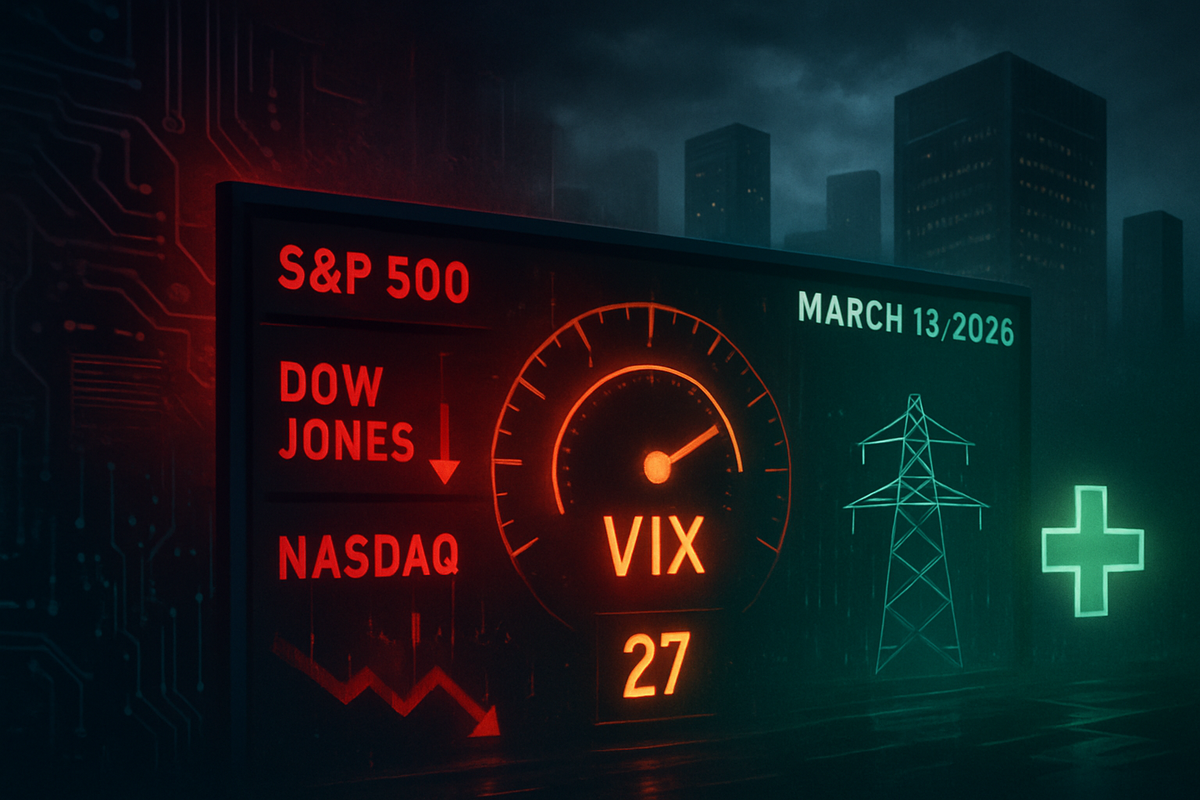
Wall Street is enduring a punishing midday session this Friday, March 13, 2026, as a "perfect storm" of geopolitical anxiety and shifting monetary expectations sends the major averages tumbling. The S&P 500 (NYSEARCA:SPY), the Dow Jones Industrial Average (INDEXDJX:.DJI), and the tech-heavy Nasdaq Composite (INDEXNASDAQ: .IXIC) are all trading firmly in the red, marking what is poised to be their third straight week of declines. Investor sentiment has soured as the CBOE Volatility Index (INDEXCBOE:VIX), widely known as the market's "fear gauge," surged to 27—a level not seen since the banking jitters of early 2025.
The midday slide reflects a broader "risk-off" environment where the optimism of the early-year rally has been replaced by cold calculations regarding "AI CapEx fatigue" and a looming transition at the Federal Reserve. With the midday clock ticking, the Nasdaq is leading the retreat, down nearly 1.8%, while the Dow’s more industrial-heavy component is showing relative, though still negative, resilience with a 0.7% decline.
A Triple Threat: Geopolitics, The Fed, and The "Power Wall"
The current market turmoil is the culmination of three weeks of escalating pressures. At the forefront is the uncertainty surrounding the Federal Reserve. With Chair Jerome Powell’s term set to expire in May 2026, the absence of a clear successor from the White House has left traders guessing about the future of interest rate policy. Currently, the federal funds rate sits between 3.50% and 3.75%, but the "sticky" nature of core PCE inflation—holding at 2.5%—has dampened hopes for further cuts in the immediate future.
Compounding domestic policy jitters is a sharp escalation in global tensions. WTI Crude oil prices have spiked toward $120 a barrel following renewed disruptions in Middle Eastern shipping lanes and an unexpected diplomatic standoff over Arctic resource rights. This "Greenland Crisis" has introduced an unusual geopolitical risk premium into the markets, forcing algorithmic traders to hedge against a broader disruption in global trade routes.
The timeline leading to today's selloff began in late February when several major software firms issued cautious guidance, citing a slowdown in enterprise AI spending. This sparked a re-evaluation of the "AI trade," which had been the primary engine of growth for the previous two years. As investors began to question when the massive capital expenditures of 2024 and 2025 would translate into bottom-line profits, the Nasdaq-100 entered correction territory, losing over 10% from its January highs.
Tech Titans Retreat as Defensive Havens Shine
The divergence between sectors today is stark. The technology sector, once the darling of the market, is facing a significant exodus. Shares of Nvidia (NASDAQ: NVDA) and Microsoft (NASDAQ: MSFT) are down 3.2% and 2.5% respectively at midday, as investors rotate out of high-growth names and into "real economy" sectors. Apple (NASDAQ: AAPL) has also felt the pinch, with concerns over global consumer spending power in a high-energy-cost environment weighing on its hardware margins.
Conversely, defensive sectors are acting as the only ballast in an otherwise sinking ship. Consumer staples and healthcare companies are seeing modest inflows as investors seek shelter in predictable dividends and stable earnings. Procter & Gamble (NYSE: PG) and UnitedHealth Group (NYSE: UNH) are among the few Dow components trading in positive territory today. Similarly, the energy sector remains a standout; Exxon Mobil (NYSE: XOM) is trading near all-time highs as the surge in oil prices provides a windfall for upstream producers.
Utility companies are also benefiting from a unique 2026 tailwind: the "Power Wall." Despite the selloff in AI software, the physical infrastructure required to power data centers remains in high demand. This has created a paradoxical situation where tech companies are losing market cap, but the utilities that provide their electricity, such as NextEra Energy (NYSE: NEE), are outperforming the broader market.
The Great Rotation: AI Fatigue Meets Industrial Reality
The current market action fits into a broader industry trend dubbed the "Great Rotation of 2026." For years, the market was bifurcated between the "Magnificent Seven" and everyone else. Today’s midday summary suggests that the "everyone else" category—specifically industrials, materials, and staples—is finally regaining its footing relative to the tech giants. This shift is partly driven by a realization that the initial "gold rush" of AI integration has moved from the speculative phase to the implementation phase, where margins are thinner and competition is fiercer.
Historically, this period mirrors the post-dot-com bubble correction of the early 2000s, albeit with much stronger balance sheets among the current tech leaders. However, the regulatory environment is significantly more hostile today. Ongoing antitrust scrutiny in both the U.S. and the E.U. has limited the ability of large-cap tech to acquire their way out of growth slowdowns, leaving them more vulnerable to shifts in investor sentiment.
The policy implications are also significant. If the market continues to slide, the Federal Reserve may face increased pressure to provide more clarity on its leadership transition or even signal a more accommodative stance despite inflation risks. For now, the "wait-and-see" approach from the central bank is only adding fuel to the VIX’s fire.
Looking Ahead: The March FOMC and Earnings Season
As we look toward the close of Friday and into next week, the primary focus for market participants will be the upcoming March FOMC meeting. Investors are desperate for any indication that the Fed is prepared to prioritize financial stability over the "last mile" of its inflation fight. If the Fed remains hawkish, the 4,800 level for the S&P 500 could be the next major floor to be tested.
In the short term, the market is likely to remain volatile until there is a de-escalation in the Middle East or more clarity on the U.S. budget negotiations. The "Friday the 13th" selloff may be seen by some contrarians as a "capitulation" moment, but with the VIX at 27, most institutional desks are advising caution. Strategic pivots toward "quality" and "yield" are expected to continue, with a preference for companies with high free cash flow and low debt-to-equity ratios.
Summary and Investor Outlook
The midday status of the market on March 13, 2026, serves as a stark reminder that the era of "easy money" and unchecked tech growth has transitioned into a more complex, volatile chapter. With all three major indices underwater and heading for a third straight weekly loss, the narrative of 2026 is becoming one of resilience and rotation rather than pure growth.
Moving forward, investors should watch for three key triggers: the announcement of the next Fed Chair nominee, the movement of WTI Crude prices, and the first-quarter earnings reports from major industrial players. While the headline numbers look grim today, the underlying strength in defensive sectors suggests that the market is not experiencing a total collapse, but rather a painful, necessary rebalancing toward the "real economy."
This content is intended for informational purposes only and is not financial advice