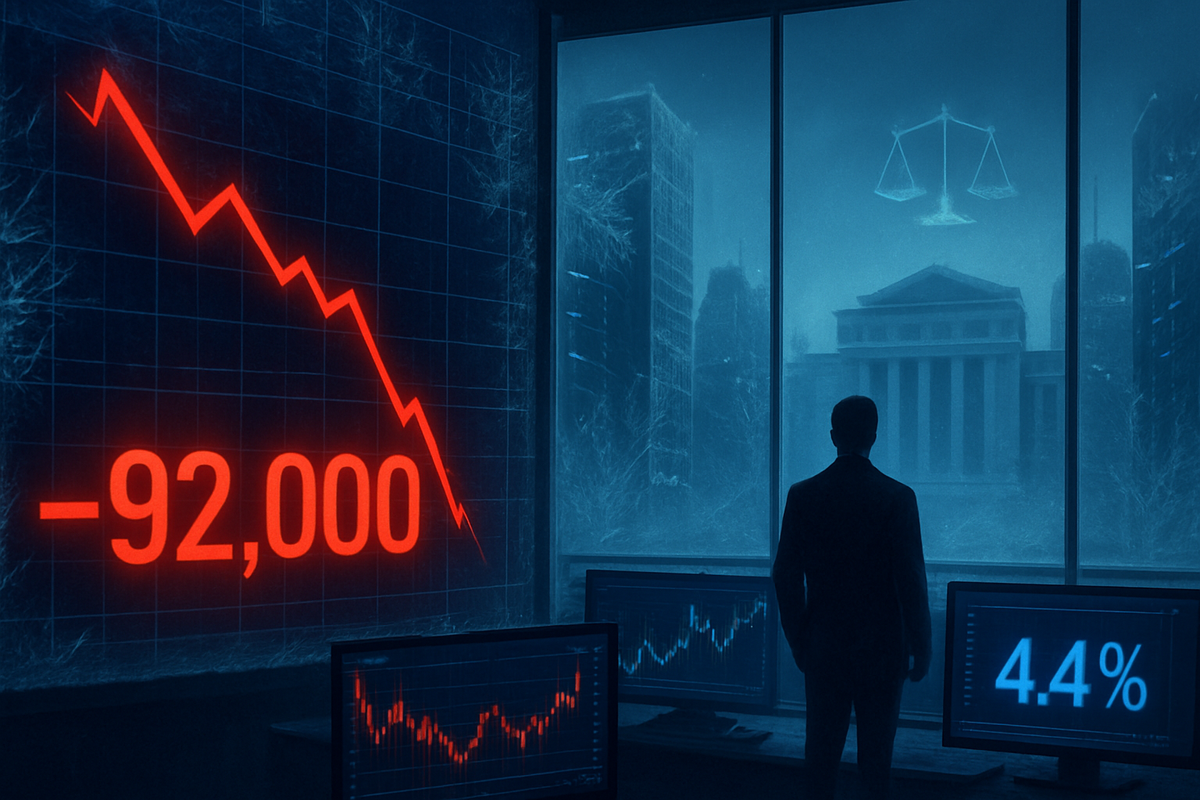
The U.S. labor market sent shockwaves through global financial centers following the release of the February 2026 employment report, which revealed a staggering net loss of 92,000 jobs. This figure stood in stark contrast to economist expectations of a 70,000-job gain, marking the sharpest divergence from consensus in nearly two years. The data, released by the Bureau of Labor Statistics (BLS) on March 6, sent the national unemployment rate climbing to 4.4%, a level not seen since the post-pandemic stabilization era.
The immediate implications were felt across the SPDR S&P 500 ETF Trust (NYSEArca:SPY) and the Invesco QQQ Trust (NASDAQ: QQQ), both of which plummeted roughly 1.6% within hours of the announcement. This "February Freeze" has abruptly halted the "soft landing" narrative that had buoyed markets throughout 2025, forcing investors to confront the reality of a cooling economy coupled with persistent inflationary pressures from global trade tensions.
A Sudden Contraction: Anatomy of the February Jobs Report
The February report was characterized by broad-based weakness that caught even the most bearish analysts at Goldman Sachs (NYSE: GS) and JPMorgan Chase & Co. (NYSE: JPM) by surprise. While the headline loss of 92,000 jobs was the primary driver of market anxiety, the underlying data painted an even bleaker picture. Downward revisions to December and January payrolls stripped an additional 69,000 jobs from the previous totals, indicating that the labor market's foundation had been eroding silently for months. The spike in the unemployment rate to 4.4% suggests that the "Sahm Rule"—a reliable recession indicator—is now flashing a bright yellow, if not red, signal.
Sector-specific data revealed that the pain was concentrated in areas previously thought to be resilient. The healthcare sector, a traditional pillar of stability, shed 28,000 jobs, largely due to ongoing labor disputes and a massive mental health worker strike at major providers. Manufacturing followed suit, losing 12,000 positions, marking the 14th month of contraction for the sector in the last 15 months. High borrowing costs and a 15% global tariff regime have finally begun to choke off domestic production, leading to a visible retreat in industrial activity.
The timeline leading up to this moment was defined by a series of "mini-shocks." Throughout late 2025, the Federal Reserve maintained a restrictive stance to combat 2.9% PCE inflation. This pressure, combined with a 900-point drop in the Dow Jones Industrial Average on the day of the report, has created a sense of urgency. Key stakeholders, including outgoing Fed Chair Jerome Powell and his nominated successor Kevin Warsh, are now under immense pressure to pivot before the labor market enters a self-reinforcing downward spiral.
Winners and Losers in a Cooling Labor Market
In the wake of the report, the divide between defensive and cyclical stocks has widened significantly. Companies heavily reliant on discretionary spending or high-volume manufacturing are facing a difficult road ahead. Caterpillar Inc. (NYSE: CAT) and other industrial giants have seen their valuations pressured as construction employment fell by 11,000 jobs in February. Similarly, the tech sector, represented by giants like Amazon.com, Inc. (NASDAQ: AMZN), is navigating a "structural realignment" where junior-level hiring has frozen in favor of AI-driven automation, a shift that may protect margins but further suppresses overall job growth.
Conversely, "safe haven" assets and certain defensive sectors are emerging as relative winners. UnitedHealth Group Incorporated (NYSE: UNH) and other large insurers may see temporary volatility from healthcare labor unrest, but they typically benefit from the flight to quality during periods of economic uncertainty. The most dramatic "winner" of the report was Gold, with spot prices hitting an all-time high of $5,174.59 per ounce as investors hedged against both recession and currency devaluation.
Financial institutions like Bank of America Corporation (NYSE: BAC) are in a precarious position. While higher for longer rates initially boosted net interest margins, the threat of a "hard landing" increases the risk of credit defaults. If unemployment continues its upward trajectory toward the 10% mark envisioned in recent Fed stress tests, the banking sector could face significant headwinds in their loan portfolios, offsetting any gains from elevated interest rates.
The 'Hard Landing' Debate and the Fed's Policy Dilemma
This event represents a critical turning point in the post-2024 economic cycle. For much of the past year, the market operated on the assumption that the Federal Reserve could navigate a soft landing. However, the February jobs report suggests the "Fed Put"—the idea that the central bank will always step in to support the market—is being tested like never before. The current Federal Funds Rate of 3.5%–3.75% now looks excessively restrictive given the job losses, but the Fed is trapped by a "wage-price spiral" fear, as hourly earnings rose 0.4% in the same month.
Historically, such a sharp jump in unemployment has almost always preceded a recession. The current situation is complicated by external factors, including the conflict with Iran and global trade tariffs, which keep inflation sticky even as demand falls. This creates a "stagflationary" environment reminiscent of the 1970s. The policy implications are profound; if the Fed cuts rates to save the labor market, they risk reigniting inflation. If they hold steady, they risk a deep recession.
Regulatory scrutiny is also expected to intensify. The "One Big Beautiful Bill Act," a major fiscal package currently in the works, is now being viewed as a necessary lifeline rather than just a policy preference. Markets are watching closely to see if the fiscal boost from planned tax cuts can arrive fast enough to offset the "February Freeze" and prevent the current contraction from becoming a long-term economic winter.
What Comes Next: Strategic Pivots and Scenarios
In the short term, the market will likely remain in a state of high volatility as it awaits the Federal Open Market Committee (FOMC) meeting in late March. Investors are pricing in a high probability of a "panic cut," though many analysts believe the Fed will wait until Powell's term ends in May to allow Kevin Warsh to initiate a new policy era. Companies will likely accelerate their "AI-first" transitions, using the labor market downturn as a justification for further corporate restructuring and cost-cutting measures.
A "best-case" scenario involves the February report being a statistical anomaly caused by severe winter storms and temporary strike activity. If March payrolls rebound, the "soft landing" remains on the table. However, a "worst-case" scenario would see a credit event triggered by the rising unemployment, leading to a sharp contraction in consumer spending. In this environment, market opportunities will likely shift toward "recession-proof" staples and high-yield fixed income, as the era of aggressive growth-at-any-cost comes to an end.
The Bottom Line: A Market at a Crossroads
The February 2026 jobs report is a stark reminder that the labor market is not invincible. The loss of 92,000 jobs against a backdrop of expected growth is a "clear and present danger" signal to investors. The primary takeaway is that the era of easy choices for the Federal Reserve is over. They are now faced with a binary choice between fighting inflation and saving jobs, with no middle ground in sight.
Moving forward, the market will be hyper-focused on two things: the PCE inflation data and the next set of initial jobless claims. Investors should watch for a potential change in leadership tone as Kevin Warsh prepares to take the helm at the Fed. While the "February Freeze" has chilled sentiment, the long-term impact will depend on whether fiscal stimulus can arrive in time to thaw the economy before a full-scale recession sets in.
This content is intended for informational purposes only and is not financial advice