
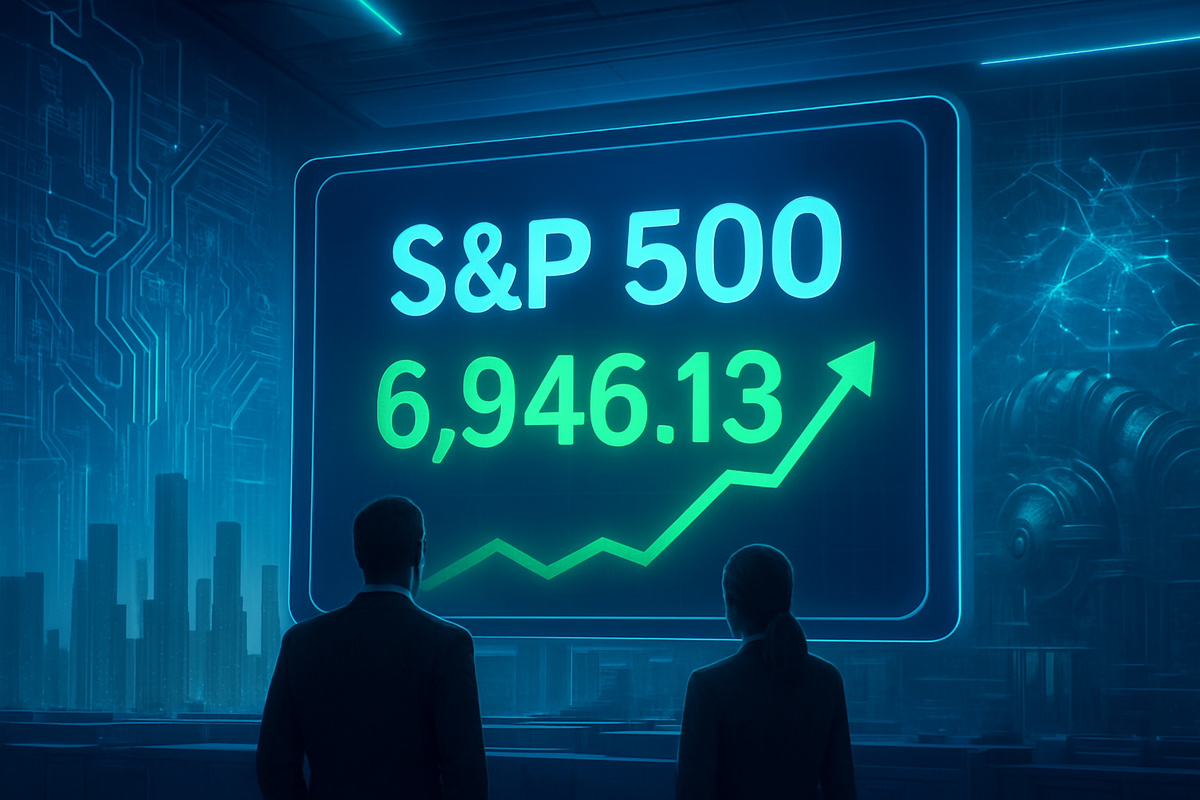
The S&P 500 Index climbed toward a historic psychological threshold on Thursday, closing at 6,946.13 as investors shook off early-year volatility to chase the next major market milestone. The 0.8% daily gain reflects a resilient appetite for equities, driven by a "second wave" of artificial intelligence investment and a revitalized financial sector. As the index sits less than 1% away from the 7,000 mark, the market's internal dynamics suggest a broadening of the rally that has characterized much of the 2025–2026 bull cycle.
While the rally was once confined to a handful of software and semiconductor giants, today’s move was supported by a diverse array of sectors. The CBOE Volatility Index (CBOE: VIX), often referred to as the market's "fear gauge," retreated to 17.93, signaling that while institutional caution remains higher than in previous years, the immediate panic that gripped markets in early February has begun to subside. Investors are increasingly focused on a robust corporate earnings outlook and a massive "AI capex super-cycle" that shows no signs of slowing down.
The Long March to 7,000: A Technical and Fundamental Surge
The current ascent toward 7,000 marks one of the most efficient 1,000-point gains in the history of the S&P 500. After first crossing the 6,000-point threshold in November 2024, the index spent much of 2025 grinding higher on the back of resilient consumer spending and the implementation of the "One Big Beautiful Bill Act" (OBBBA) in mid-2025. This fiscal legislation, which made 2017 tax cuts permanent and provided significant tax relief for overtime and tipped income, injected an estimated $500 billion in liquidity into the economy, providing a sturdy floor for equity valuations throughout the year.
The index briefly touched an intraday high of 7,002.28 on January 28, 2026, but failed to sustain that level as "sell-the-news" reactions to big tech earnings triggered a period of consolidation. Throughout February 2026, the S&P 500 has oscillated between the 6,800 and 7,000 levels, a process analysts describe as "digesting" the massive gains of the previous 14 months. Today's 0.8% jump is seen by many as the "final push" needed to reclaim the 7,000 handle, backed by a fifth consecutive quarter of double-digit earnings growth across the index's components.
Key stakeholders, including major institutional asset managers and pension funds, have pivoted their strategies in early 2026. Rather than chasing pure-play software growth, the market has rewarded companies that provide the physical "picks and shovels" of the digital era. The initial reaction to today's price action was overwhelmingly positive, with trading volume in the SPDR S&P 500 ETF Trust (NYSE: SPY) surging in the final hour of trading, suggesting a "fear of missing out" (FOMO) among retail and institutional participants alike.
Winners and Losers: The "Great Rotation" in Action
The march to 7,000 has created a stark divide between the winners of the initial AI hype and the winners of the current AI implementation phase. Nvidia (NASDAQ: NVDA) remains the undisputed leader of this era, recently reporting fiscal Q4 2026 revenue of $68.1 billion—a staggering 73% year-over-year increase. Despite its massive size, Nvidia continues to drive the index higher, though its 2026 gains have been more measured as investors demand proof of long-term sustainable demand.
Conversely, some former darlings are facing a valuation reset. Microsoft (NASDAQ: MSFT) has struggled in early 2026, with its stock down nearly 19% year-to-date. While its Azure cloud business continues to grow at a 39% clip, the market has become increasingly sensitive to the company’s massive capital expenditure, which reached $37.5 billion in the most recent quarter. This "capex fatigue" has led investors to rotate out of high-multiple software stocks and into the industrial firms building the power and cooling systems for AI data centers. GE Vernova (NYSE: GEV) and Vertiv Holdings (NYSE: VRT) have been standout performers, with GE Vernova surging 13% year-to-date as it works through a $135 billion backlog for gas turbines and grid equipment.
The financial sector has also emerged as a primary engine of the S&P 500's latest leg up. JPMorgan Chase (NYSE: JPM) and Goldman Sachs (NYSE: GS) are trading near all-time highs as the initial public offering (IPO) market and merger and acquisition (M&A) activity reached a five-year peak in early 2026. JPMorgan, in particular, has seen its $19.8 billion technology budget bear fruit, with AI-driven efficiencies in trading and fraud detection contributing to a projected 9% increase in Net Interest Income for the year.
Analyzing the 7,000 Significance: AI Capex and the New Volatility Regime
The significance of the S&P 500 nearing 7,000 extends far beyond a round number on a screen. It represents the market's validation of the "AI Infrastructure Phase," where the focus has shifted from training large language models to the massive physical build-out required for inference and enterprise deployment. Hyperscalers such as Amazon (NASDAQ: AMZN) and Meta Platforms (NASDAQ: META) are projected to spend a combined $650 billion on AI-related capital expenditures in 2026 alone. This spending is rippling through the economy, benefiting networking leaders like Arista Networks (NYSE: ANET) and custom chip manufacturers like Marvell Technology (NASDAQ: MRVL).
Historically, the VIX staying near 18 during a bull run would be a cause for concern, but in 2026, this has become the "new normal." The VIX at 17.93 reflects a market that is richly valued but fundamentally supported. Unlike the dot-com bubble of 2000, today's rally is backed by tangible earnings and massive cash flows. However, the higher VIX level indicates that institutional investors are maintaining expensive downside protection, wary of potential geopolitical shifts or "gamma walls" of derivatives at the 7,000 strike price that could trigger sudden volatility.
Furthermore, the broader industry trend shows a "regime change" toward industrial and utility-grade technology. Companies that solve power bottlenecks, like Eaton (NYSE: ETN), are now being valued with the premiums usually reserved for high-growth SaaS companies. This shift suggests that the "S&P 7,000" market is more structurally sound than previous peaks, as it is less reliant on a single sector and more integrated into the "real economy" infrastructure.
The Road Ahead: Resistance, Resilience, and Risk
In the short term, the 7,000 level is expected to act as a significant psychological and technical resistance point. Many analysts anticipate a "churning" period where the index may breach 7,000 several times without establishing it as a firm floor. A potential 5% to 10% "healthy correction" is frequently cited as a possibility in the coming months, which would allow the market to work off overbought conditions and give latecomers an entry point.
Strategic pivots will be required for investors as the "Inference Inflection" takes hold. The next phase of the market will likely reward companies that can prove their AI investments are yielding actual revenue and margin expansion, rather than just promising future potential. This "show me the money" phase will be the ultimate test for the Magnificent Seven and their peers.
Longer-term, the outlook for 2026 remains bullish, provided that inflation remains within a manageable range and the "OBBBA" fiscal stimulus continues to support domestic consumption. If the current trajectory holds, the S&P 500 could end 2026 well above the 7,200 mark, driven by a forecasted 15% blended earnings growth rate that significantly outpaces historical averages.
Wrap-Up: Navigating a Milestone Market
The S&P 500's climb to 6,946.13 and its pursuit of the 7,000 milestone mark a historic moment in financial history. The rally is a testament to the transformative power of artificial intelligence and the resilience of the U.S. corporate sector, which has successfully navigated shifting interest rates and evolving fiscal policies. The "Great Rotation" into financials and industrial AI infrastructure provides a broader base for this bull market than we saw in 2024, potentially offering more stability for the long haul.
Moving forward, the market is likely to remain in a high-volatility, high-reward environment. The VIX holding at 17.93 serves as a reminder that the path to 7,000 and beyond will not be a straight line. Investors should watch for consistency in AI-related revenue and any shifts in the Federal Reserve's stance on liquidity as the economy continues to absorb the effects of 2025's massive fiscal stimulus.
As the index hovers on the edge of 7,000, the message from the market is clear: the AI revolution is no longer a speculative future—it is a $600 billion annual reality that is reshaping the very foundations of the global economy.
This content is intended for informational purposes only and is not financial advice.