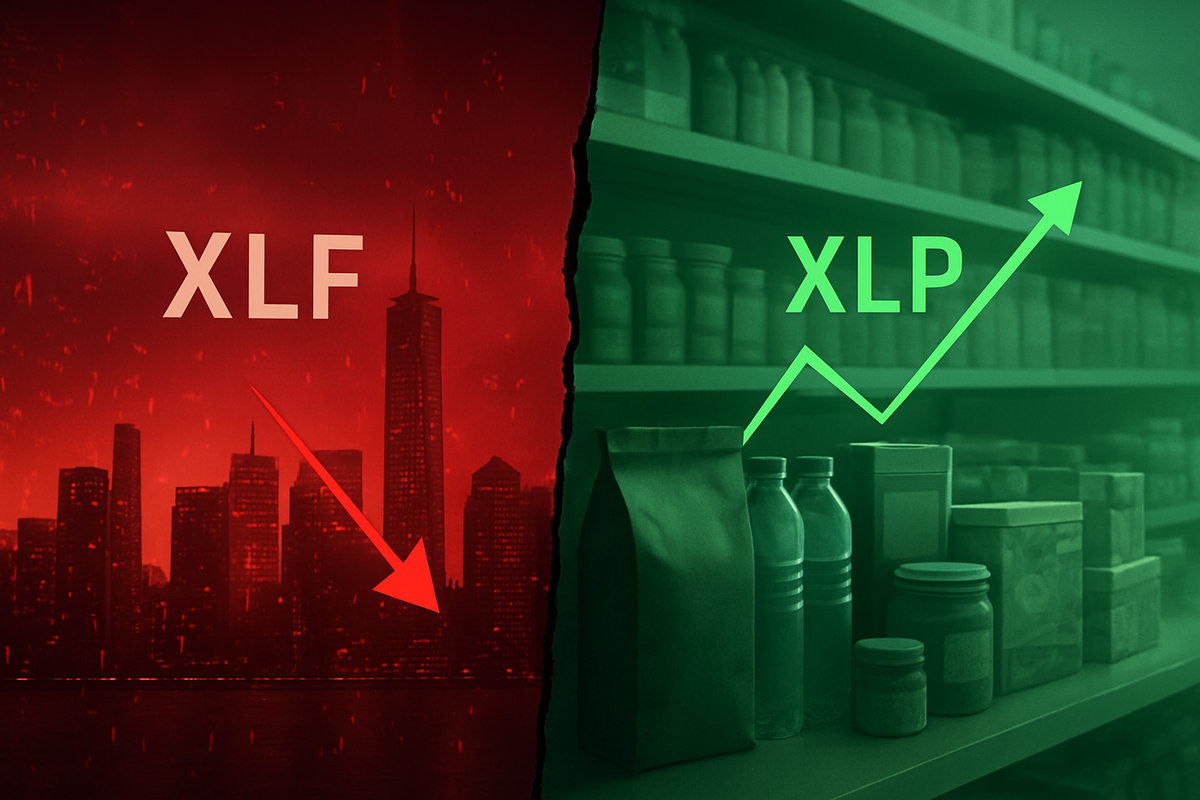
NEW YORK — In a dramatic session that redefined the market leadership of 2026, investors witnessed a sharp and unsettling divergence in sector performance on Tuesday, February 24, 2026. The Financial Select Sector SPDR Fund (NYSE Arca: XLF) plummeted 3.3%, marking its steepest single-day decline of the year, as a liquidity squeeze in the private credit market sent shockwaves through Wall Street. Simultaneously, a pronounced "flight to safety" lifted the Consumer Staples Select Sector SPDR Fund (NYSE Arca: XLP) — often mistakenly cited by its energy-sector ticker (XLE) in early-morning volatility reports — by a robust 1.5%, as traders sought refuge in defensive assets amid escalating trade tensions and domestic economic uncertainty.
The divergence underscores a growing "Great Rotation" out of high-growth and leverage-heavy financials into "evergreen" staples. While the broader indices like the S&P 500 and Nasdaq Composite dipped roughly 1%, the internal mechanics of the market revealed a more systemic anxiety. The collapse in the financial sector was triggered by what analysts are calling the "SaaSpocalypse," where the $3 trillion private credit market faced a reckoning over its exposure to software-as-a-service (SaaS) firms now threatened by the rapid rise of autonomous "agentic AI" technologies.
The day’s events were catalyzed by a series of high-stakes developments that began over the preceding weekend. On February 20, 2026, the Federal Reserve held an unscheduled emergency meeting, slashing interest rates by 50 basis points. While intended to provide liquidity, the move was widely interpreted as a "panic signal," suggesting that the central bank was behind the curve on a deepening credit crunch. This sentiment was exacerbated by a "hot" Personal Consumption Expenditure (PCE) report released the same day, which showed inflation stubbornly holding at 3.0%, complicating the Fed’s ability to provide further relief.
By Tuesday morning, the situation turned critical when Blue Owl Capital Inc. (NYSE: OWL) announced it would permanently halt redemptions at its OBDC II fund, following a wave of withdrawal requests. This sparked a liquidity panic across the alternative asset management space. Industry titans like Blackstone Inc. (NYSE: BX) and KKR & Co. Inc. (NYSE: KKR) saw their share prices crater as investors feared their non-traded business development companies (BDCs) would face similar redemption "gates." Adding fuel to the fire, JPMorgan Chase & Co. (NYSE: JPM) CEO Jamie Dimon issued a stern warning during an industry conference, suggesting that "AI euphoria" had masked deteriorating credit quality in bank portfolios.
The volatility was further intensified by a sudden shift in trade policy. Following a Supreme Court ruling on February 20 that struck down previous reciprocal tariffs, the Trump administration retaliated by implementing a new 10% global import surcharge under Section 122 of the Trade Act of 1974, effective at 12:01 AM on February 24. While the administration floated a 15% rate, the immediate implementation of the 10% surcharge caught global markets off guard, leading to a sharp sell-off in trade-sensitive financial institutions and a 2% spike in gold prices.
The primary casualties of the day were the alternative asset managers and the banking heavyweights. Blackstone Inc. (NYSE: BX) fell 5.65%, closing near $113.71, as analysts pointed to its significant software exposure in its private credit arms. KKR & Co. Inc. (NYSE: KKR) fared even worse, plummeting nearly 9% over a 48-hour period to close at $92.19. Traditional banking giants were not immune; American Express Company (NYSE: AXP) dropped 7.4% on fears of cooling consumer spend and credit delinquency, while JPMorgan Chase & Co. (NYSE: JPM) slid 4.5%.
Conversely, the Consumer Staples sector emerged as the day's unequivocal winner. Keurig Dr Pepper Inc. (NASDAQ: KDP) led the charge, rising on the back of a strong fourth-quarter earnings report that showcased resilient demand for its refreshment beverages despite inflationary pressures. Other defensive stalwarts like PepsiCo, Inc. (NASDAQ: PEP), The Coca-Cola Company (NYSE: KO), and Walmart Inc. (NYSE: WMT) saw significant inflows as investors prioritised "recession-proof" balance sheets.
Retail-focused staples like BJ's Wholesale Club Holdings, Inc. (NYSE: BJ) and Casey’s General Stores, Inc. (NASDAQ: CASY) also outperformed, acting as "volatility dampener" in a market searching for stability. This rotation suggests that the "soft landing" narrative of late 2025 is being replaced by a more cautious "defensive hedge" strategy for the remainder of 2026.
The divergence of February 24 is being viewed by historians and analysts as a watershed moment for the "shadow banking" sector. For years, private credit had been marketed as a stable alternative to public markets, but the current liquidity crisis suggests that these opaque structures may be more vulnerable to technical "trap doors" than previously believed. When the XLF broke through its critical technical support level of $50.90 today, it triggered a cascade of automated sell orders that exposed the fragility of the financial sector's current valuation.
Furthermore, the pivot to Section 122 tariffs represents a significant regulatory escalation. Unlike previous trade actions, this "temporary import surcharge" is tied to national security and balance-of-payments deficits, giving the executive branch broad power to bypass traditional legislative hurdles for up to 150 days. The ripple effect on global supply chains is expected to be profound, particularly for financial institutions that finance international trade. The exemption of energy and semiconductors from these tariffs explains why some tech sectors held up better than the financials, but it did little to soothe the nerves of those invested in the global banking system.
The immediate focus for the coming weeks will be on whether the private credit liquidity issues remain isolated or spread to broader commercial banking. Market participants are closely watching for any further "gating" of funds from firms like Apollo Global Management, Inc. (NYSE: APO), which fell 5.1% today despite its more diversified asset base. If redemptions continue to mount, the Fed may be forced into more aggressive liquidity injections, even at the risk of reigniting inflation.
Strategically, investors are expected to maintain a heavy tilt toward staples and "quality" factors. The challenge for the Financials sector will be to prove that its "valuation marks" are accurate in a world where AI is disrupting traditional revenue models. We may see a strategic pivot among asset managers to divest from "legacy SaaS" and move toward hardware and energy infrastructure—sectors that appear more resilient to the current tariff regime and AI shifts.
The events of February 24, 2026, serve as a stark reminder that market leadership is never permanent. The 3.3% drop in the XLF and the 1.5% rise in Consumer Staples mark a definitive end to the unbridled optimism that characterized the start of the year. Investors are now operating in a "show-me" environment where liquidity and defensive positioning are paramount.
The key takeaway for market participants is the vulnerability of the "private credit" miracle. As the "SaaSpocalypse" continues to unfold, the transparency of bank balance sheets will become a premium asset once again. Moving forward, the market will be hyper-focused on the 150-day tariff window and the Fed's next move in March. For now, the "Great Rotation" is in full swing, and the defensive walls of Consumer Staples appear to be the only safe harbor in a burgeoning storm.
This content is intended for informational purposes only and is not financial advice