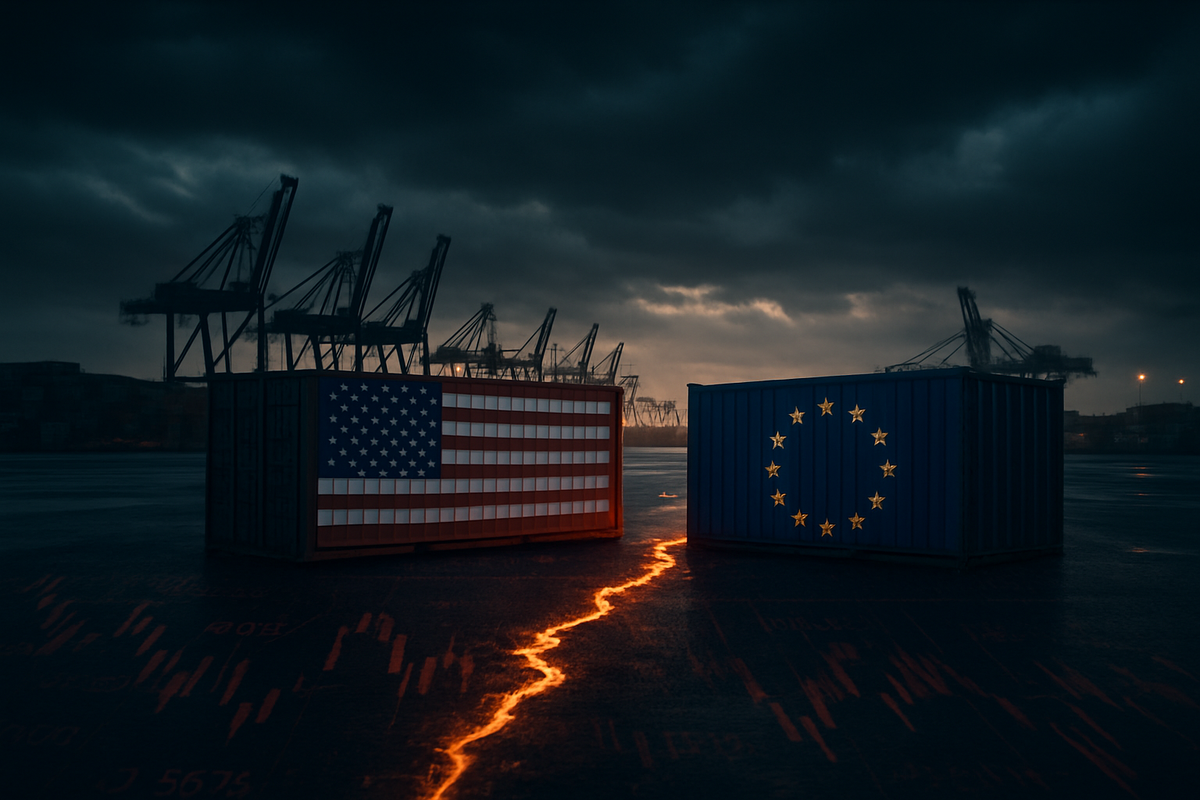
BRUSSELS — In a dramatic escalation of global trade tensions, the European Parliament officially voted on February 23, 2026, to halt the ratification of the "Turnberry Agreement," a landmark trade deal intended to stabilize the multitrillion-dollar economic relationship between the European Union and the United States. The suspension follows a week of legal and political chaos in Washington that has effectively dismantled the fragile "tariff ceiling" established only months ago, threatening to plunge the transatlantic economy into a protectionist spiral not seen in decades.
The decision to freeze the deal, also known as the Scotland Accord, was triggered by an aggressive new 15% universal import surcharge announced by the U.S. administration. This surcharge, introduced immediately following a U.S. Supreme Court ruling on February 20 that curtailed certain executive trade powers, was viewed by Brussels as a direct breach of the Turnberry Agreement’s core promise: a stable 15% tariff baseline in exchange for massive European investments in U.S. energy and infrastructure. With the new surcharge potentially stacking on top of existing duties, EU officials warned that European exports could soon face cumulative tariffs as high as 30%, a level that Bernd Lange, Chair of the European Parliament’s Trade Committee, described as "economically untenable and diplomatically insulting."
The Collapse of the 'Peace-for-Security' Accord
The Turnberry Agreement, signed in July 2025, was heralded as a "peace-for-security" trade-off. Under its terms, the EU agreed to a permanent 15% tariff on its exports to the U.S. and committed to approximately $600 billion in American investments and Liquefied Natural Gas (LNG) purchases. In return, the U.S. provided continued security guarantees for the European continent and a promise of regulatory "certainty." However, the timeline of the past few days has obliterated that certainty. On February 20, 2026, the U.S. Supreme Court struck down the administration's use of the International Emergency Economic Powers Act (IEEPA) to impose "reciprocal" tariffs. In a defiant response, the White House invoked Section 122 of the Trade Act of 1974 to implement a 10% to 15% universal import surcharge, effectively bypassing the court and the spirit of the Turnberry deal.
Key players in this unfolding drama have taken entrenched positions. Maroš Šefčovič, the EU Trade Commissioner, emphasized that "a deal is a deal," suggesting that the EU cannot move forward while the U.S. executive branch is in a state of "legal volatility." Conversely, U.S. Trade Representative Jamieson Greer defended the new surcharge as a separate national security necessity, urging European partners to "compartmentalize" the trade dispute from the broader security alliance. The initial market reaction was swift; the Euro weakened against the Dollar as investors braced for a prolonged period of "customs chaos," while industrial indices across Frankfurt and Paris saw sharp declines in early trading on Monday.
Corporate Fallout: Winners and Losers in the Tariff Crossfire
The suspension of the Turnberry Agreement has sent shockwaves through the boardrooms of the world's largest public companies. The automotive sector, particularly German manufacturers, finds itself at the epicenter of the crisis. Volkswagen (XETRA: VOW3), which imports over 270,000 vehicles annually to the U.S., reported a 20% decline in U.S. sales in the final quarter of 2025 as it pre-emptively adjusted for tariff headwinds. The company recently disclosed a €1.1 billion loss, largely attributed to the inability to absorb the rising costs of these trade barriers. Similarly, Mercedes-Benz (XETRA: MBG) has been forced to revise its 2026 margin targets downward by 150 to 200 basis points, citing the 15% surcharge as a direct hit to its luxury SUV exports.
In the aerospace duopoly, the stakes are equally high. Airbus (Euronext: AIR) saw its shares fall approximately 8% following the ratification halt. While Airbus has a production presence in Mobile, Alabama, roughly 30% of its total order backlog remains tied to North American carriers who now face "desynchronized" delivery schedules due to tariff-related legal uncertainty. Meanwhile, its American rival, Boeing (NYSE: BA), remains highly vulnerable to potential retaliatory EU tariffs. Major European carriers like Lufthansa have already warned that they may cancel orders if the EU retaliates with its own 15-20% duties on aircraft. Boeing’s stock has remained volatile, trading near $232, as the company navigates a "tariff-upon-tariff" scenario that threatens its recovery in the European market.
The luxury sector is also reeling. LVMH (Euronext: MC), the world’s largest luxury goods group, saw its Paris-listed shares slump 8% in early 2026. Its Wines & Spirits division has been the hardest hit, with profits plunging 25% as U.S. duties on Cognac and Champagne made high-end French products significantly more expensive for American consumers. Conversely, some industrial players are finding silver linings. ArcelorMittal (Euronext: MT) has remained resilient, with its stock boosted by 2026 guidance that favors domestic European production. As trade barriers rise, ArcelorMittal is expected to benefit from European trade protections like the Carbon Border Adjustment Mechanism (CBAM), which helps domestic mills regain market share from foreign imports. However, U.S. giant Caterpillar (NYSE: CAT) warned of a massive $2.6 billion tariff bill in 2026, as the cost of imported steel components for its machinery continues to surge despite record revenues from domestic data center demand.
Broader Implications: The Death of Globalism?
The halt of the Turnberry ratification is more than a diplomatic spat; it signals a fundamental shift in the global economic order. For decades, the World Trade Organization (WTO) served as the arbiter of trade disputes, but the current "tariff-first" diplomacy suggests a definitive move toward a post-WTO era. This event fits into a broader trend of "de-risking" and "decoupling," where national security and domestic industrial policy—such as the U.S. Inflation Reduction Act (IRA)—take precedence over free trade principles. The EU’s move to freeze the deal is a defensive posture against what it perceives as an unreliable partner that uses tariffs as a primary tool of foreign policy rather than a last resort.
The ripple effects extend to the "Green Trade" movement. The EU has prioritized its CBAM and green subsidies, while the U.S. has pushed for a carbon-based tariff wall that critics say is protectionism disguised as environmentalism. The failure of the Turnberry Agreement to resolve these "Green Steel" and electric vehicle (EV) disputes suggests that the transatlantic relationship may remain fragmented for years. Historically, this level of tension mirrors the trade wars of the 1930s, though it is now layered with the complexities of modern global supply chains and digital economies.
What Lies Ahead: The July Health Check
The immediate future of the EU-US relationship hinges on a scheduled "one-year health check" of the Turnberry Agreement set for July 2026. If the U.S. administration does not provide a legal carve-out for European goods from the universal surcharge, the EU Parliament is unlikely to resume the ratification process. Short-term, we can expect "strategic pivots" from major corporations; companies like BMW and Airbus may accelerate the "localization" of their supply chains, moving more production directly into the U.S. to bypass the border taxes entirely. However, such moves are capital-intensive and could take years to yield results.
A more dire scenario involves a full-scale trade war. If the EU implements its own "Industrial Accelerator Act" and retaliates with tariffs on iconic American exports like bourbon, motorcycles, and tech services, the resulting inflationary pressure could force central banks on both sides of the Atlantic to reconsider their interest rate paths. Market opportunities may emerge for "neutral" trade hubs or domestic manufacturers who do not rely on transatlantic components, but for the majority of multi-national investors, the period ahead is one of extreme caution.
The Investor’s Wrap-Up
The suspension of the Turnberry Agreement on February 23, 2026, marks a watershed moment for the global economy. The key takeaway for investors is that the "rules-based order" has been replaced by a "negotiation-based order," where trade terms can change with a single court ruling or executive order. The market is likely to remain in a defensive crouch as it awaits the July health check, with a premium placed on companies that have diversified production bases or "tariff-proof" balance sheets.
Moving forward, the lasting impact will be felt in the cost of goods and the efficiency of global supply chains. Investors should keep a close watch on the U.S. Trade Representative’s office for any signals of a "mini-deal" to exempt certain sectors, as well as the EU’s retaliatory list, which could target high-profile U.S. tech firms. The era of cheap, frictionless transatlantic trade appears to be closing, and in its place, a new, more expensive, and far more volatile economic reality is taking shape.
This content is intended for informational purposes only and is not financial advice.