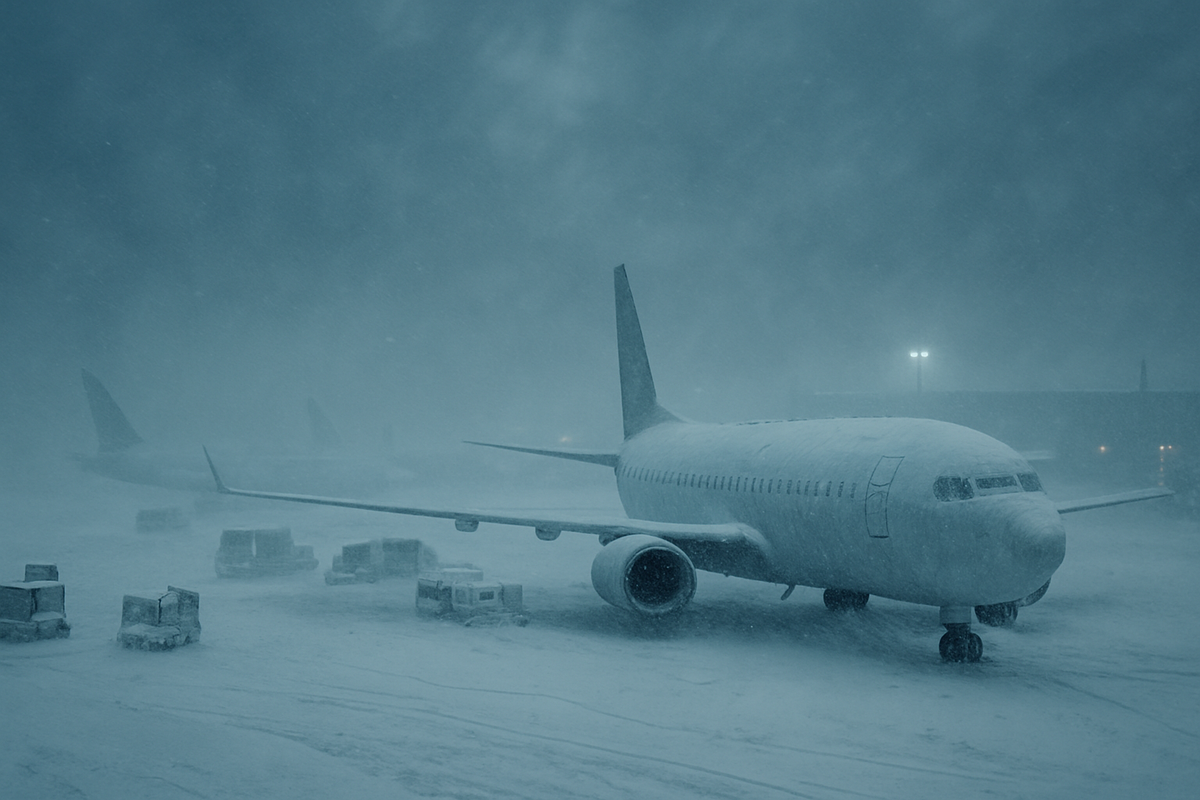
The aviation sector faced a brutal start to the week as a massive winter storm, dubbed "Winter Storm Fernando" by meteorologists, tore through the Northeast United States on February 23, 2026. Characterized as a "bomb cyclone," the storm brought historic snowfall and high winds to the I-95 corridor, forcing the "Big Three" U.S. carriers to suspend operations at some of the nation's busiest transit hubs. The operational paralysis triggered a sharp sell-off in airline equities, with investors bracing for a multi-million dollar hit to first-quarter earnings.
By midday Monday, total flight cancellations for the two-day period beginning Sunday had surged past 8,000, with over 5,600 flights grounded on Monday alone. The scale of the disruption was most visible at New York’s LaGuardia Airport, which saw a near-total shutdown as cancellation rates peaked at 96%. The immediate implications for the market were clear: a loss of high-yield business travel revenue and a massive logistical backlog that could take the remainder of the week to resolve.
A Perfect Storm: Timeline of the "Fernando" Fallout
The crisis began to take shape on Saturday, February 21, as weather models confirmed the rapid intensification of a low-pressure system off the Atlantic coast. By Sunday evening, the storm had officially reached "bomb cyclone" status, with pressure dropping precipitously and wind gusts exceeding 40 mph at Newark Liberty International and Boston Logan. United Airlines (NASDAQ: UAL) and Delta Air Lines (NYSE: DAL) were among the first to issue widespread travel waivers, attempting to steer passengers away from airports before the heaviest snow arrived.
As the blizzard hit its peak early Monday morning, the impact on airport infrastructure was absolute. Boston Logan (BOS) reported 18 inches of snow by 10:00 AM, leading to a 92% cancellation rate. John F. Kennedy International (JFK) and Philadelphia International (PHL) followed suit, with suspension rates of 61% and 80%, respectively. Key stakeholders, including the Federal Aviation Administration (FAA) and state governors, declared states of emergency, with New York Governor Kathy Hochul imposing a ban on commercial vehicle traffic on major interstates to keep roads clear for emergency crews.
The initial market reaction was swift and punitive. United Airlines saw its shares drop by 4.9% in morning trading, while American Airlines (NASDAQ: AAL) fell 4.5%. Delta Air Lines, which historically maintains a slightly higher operational cushion, saw a more tempered but still significant decline of 4.1%. Analysts noted that while weather events are often viewed as temporary "blips," the sheer volume of cancellations in the high-traffic Northeast Corridor suggests a deeper impact on the quarter's bottom line than a standard winter front.
Winners, Losers, and the Resilience Gap
In the wake of the storm, the "Big Three" carriers emerged as the primary losers, but the degree of impact varied. American Airlines appeared particularly vulnerable; having already struggled with the aftermath of "Winter Storm Fern" in late January, the company now projects a Q1 loss between $150 million and $200 million due to its heavy exposure at its Philadelphia and New York hubs. Conversely, Delta Air Lines entered the storm from a position of relative financial strength, having recently reported a record $4.6 billion in free cash flow, providing it a larger buffer against these operational shocks.
Outside of the airlines, the storm created a distinct set of "weather winners." Retail giants like Home Depot (NYSE: HD), Lowe’s (NYSE: LOW), and Walmart (NYSE: WMT) saw a massive pre-storm surge in demand for generators, snow blowers, and emergency supplies, pulling forward an estimated $1.5 billion in revenue. In the logistics sector, companies utilizing AI-driven routing, such as United Parcel Service (NYSE: UPS), were able to reroute shipments around the most affected zones, whereas smaller, traditional trucking fleets were left stranded by road closures and sub-zero mechanical failures.
Furthermore, technology providers specializing in disruption management saw their profiles rise. Sabre Corporation (NASDAQ: SABR) and Amadeus (OTCMKTS: AMADY) played critical roles as their automated recovery tools—such as Sabre’s "Plan3" integration and Amadeus's "Altéa" ecosystem—allowed airlines to re-accommodate thousands of passengers via AI-driven dashboards. These systems reduced the "recovery window"—the time it takes for an airline to return to normal operations—by an estimated 35%, potentially saving the carriers millions in manual rebooking costs and hotel vouchers.
Broader Significance: The Shift Toward "Automated Recovery"
The events of February 23 fit into a broader trend of "extreme weather adaptation" within the aviation industry. In previous decades, a storm of this magnitude might have crippled the domestic flight network for over a week. However, the 2026 response highlighted a shift from simple "weather avoidance" to "automated recovery." United Airlines, for instance, utilized generative AI-powered chatbots to allow passengers to self-service their rebookings, significantly reducing the burden on human call centers and preventing the days-long phone wait times that characterized the 2022 Southwest holiday meltdown.
Regulatory scrutiny is also expected to intensify. With each major weather event, the Department of Transportation (DOT) has pushed for stricter rules regarding passenger compensation for delayed and canceled flights. While weather is typically considered an "uncontrollable" factor exempting airlines from certain payouts, the efficiency with which airlines re-accommodate passengers during the "recovery phase" is becoming a new benchmark for regulatory compliance. This storm serves as a high-stakes test case for the FAA’s recently updated NextGen air traffic control protocols, which aim to optimize flight paths in congested corridors during severe weather.
Historically, this event draws comparisons to the "Great Blizzard of 2010," but with a modern twist: the financial "ripple effects" are now more concentrated. Because the Northeast accounts for a disproportionate share of premium and business travel revenue, a two-day shutdown in New York and Boston can erase the profit margins of an entire month for regional carriers and "Big Three" hubs alike.
The Horizon: Short-Term Pain and Strategic Pivots
Looking ahead, the short-term priority for United, American, and Delta is "re-fleeting"—the complex logistical dance of getting aircraft and crews back to their scheduled positions. Investors should expect a volatile week for airline stocks as the full extent of the "cascading delays" becomes clear. If the carriers can return to 90% operational capacity by Thursday, February 26, the market is likely to view the event as a manageable disruption. However, if crew-timing issues or maintenance backlogs persist into the weekend, the sell-off could deepen.
In the long term, this storm may accelerate the strategic pivot toward "weather-resilient" technology. We are likely to see increased capital expenditure on de-icing infrastructure and AI-driven predictive maintenance. Airlines that continue to rely on legacy manual scheduling systems will find themselves at a competitive disadvantage, as the frequency of "bomb cyclones" and other volatile weather patterns appears to be on the rise, necessitating a more robust and automated response strategy.
Market Wrap-Up: What to Watch
The 2026 Northeast blizzard serves as a stark reminder of the inherent volatility in the aviation sector. While United (NASDAQ: UAL), American (NASDAQ: AAL), and Delta (NYSE: DAL) have all made strides in financial recovery post-pandemic, their vulnerability to the elements remains a significant risk factor. The key takeaway from today's market action is that while "weather wins" for retail and tech firms are short-lived, the "weather losses" for airlines are becoming increasingly expensive due to rising labor and fuel costs.
Moving forward, investors should keep a close eye on the Q1 earnings calls for these carriers in April. Specific metrics to watch include "cost per available seat mile" (CASM) excluding fuel, which will reveal exactly how much the "Fernando" disruptions added to operational overhead. Additionally, the performance of the U.S. Global Jets ETF (NYSEARCA: JETS) will serve as a broader barometer for whether the sector can bounce back from this mid-quarter frost. For now, the focus remains on the "recovery window"—the faster the planes get back in the air, the sooner the stocks can find their floor.
This content is intended for informational purposes only and is not financial advice