

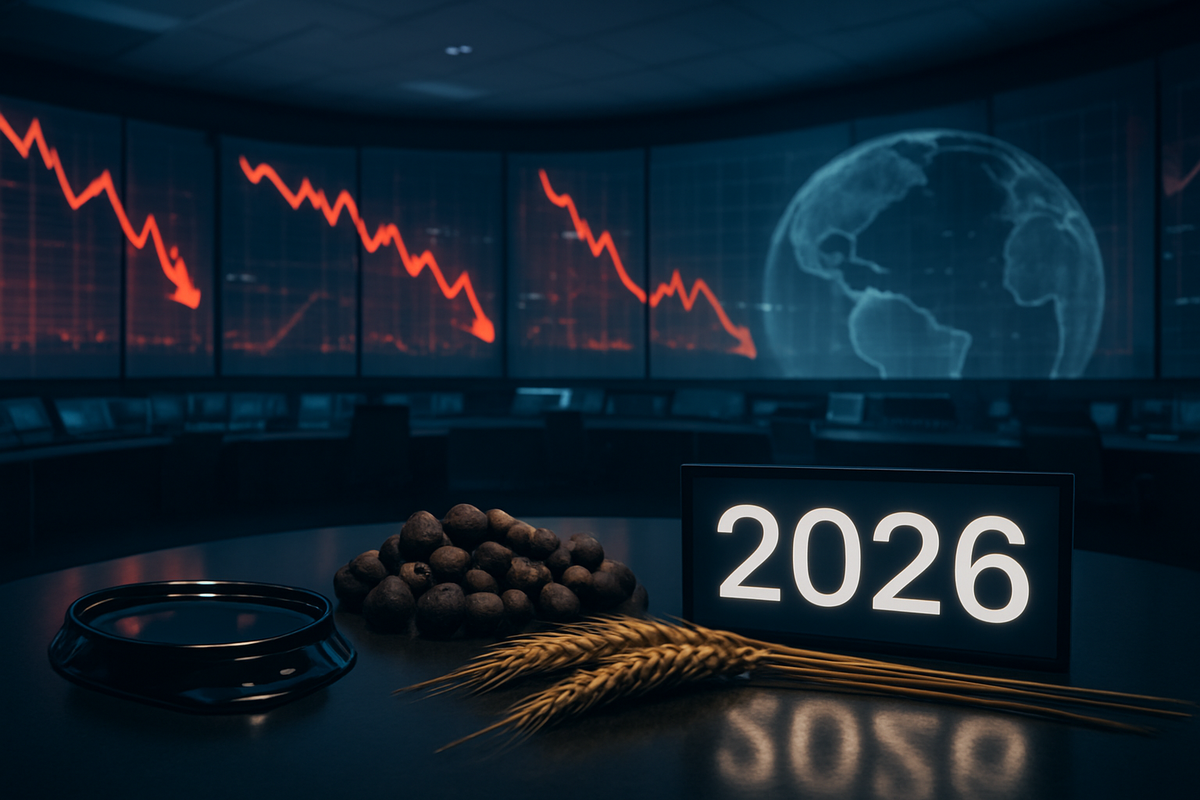
The global commodities market is bracing for a significant downturn as the World Bank’s latest Commodity Markets Outlook warns of a looming 7% price decline in 2026. This projected drop would mark the fourth consecutive year of falling prices, eventually bottoming out at a six-year low. The forecast is primarily driven by a "massive" global oil surplus that is expected to outpace demand by roughly 3 million barrels per day—a glut even larger than the one experienced during the 2020 pandemic lockdowns.
As of early February 2026, the implications for the global economy are twofold. On one hand, the decline offers a much-needed "respite" for global inflation, potentially allowing central banks to pivot more aggressively toward interest rate cuts. On the other hand, the trend signals a persistent cooling of industrial activity and a structural shift in energy consumption, particularly in China. For broad-market investors, this deflationary pressure is already being felt in major commodity benchmarks, with significant volatility hitting diversified exchange-traded funds such as the Invesco DB Commodity Index Tracking Fund (NYSEArca: DBC) and the iShares S&P GSCI Commodity-Indexed Trust (NYSEArca: GSG).
A Bearish Super-Cycle: Drivers of the 2026 Decline
The World Bank’s report, reaffirmed in early 2026, paints a picture of a market grappling with an unprecedented supply-demand imbalance. The primary engine of this decline is the energy sector, which is projected to see a 10% price drop in 2026 alone. Brent crude is forecasted to average just $60 per barrel, its lowest level in five years. This surplus is not merely a result of increased production from non-OPEC+ nations but is also driven by a structural stagnation in demand from China. The rapid adoption of electric vehicles and hybrid technology in the world’s second-largest economy has fundamentally decoupled economic growth from fossil fuel consumption.
The timeline leading to this "bearish super-cycle" began in late 2024, when global manufacturing began to stutter under the weight of high interest rates and escalating trade tensions. Throughout 2025, a wave of new liquefied natural gas (LNG) projects and a steady increase in U.S. shale production began to saturate the market. By the time the World Bank released its updated outlook in October 2025, it was clear that the anticipated "soft landing" for the global economy would be accompanied by a hard landing for commodity prices. Policy uncertainty, specifically regarding new tariffs and the expiration of major trade agreements, has further dampened industrial sentiment as we enter the first quarter of 2026.
Initial market reactions have been swift but stratified. While energy and agricultural markets have slumped, precious metals have staged a defiant rally. Gold, often viewed as a safe haven during periods of policy instability, has seen increased demand from central banks and retail investors alike. However, the aggregate index remains weighed down by the heavy influence of crude oil and industrial metals, leading to a general "risk-off" sentiment for traditional commodity portfolios.
Winners and Losers: Corporate Fallout from the Price Slump
The projected 7% decline creates a stark divide between sectors, with "old energy" giants facing significant headwinds. ExxonMobil (NYSE: XOM) and Chevron (NYSE: CVX) are particularly vulnerable as they navigate the tail end of long-cycle supply projects that are coming online just as prices crater. Analysts at JP Morgan have warned that if WTI crude slips into the $40 range by late 2026, these companies could face substantial earnings revisions and potential share price corrections. Conversely, the transportation and consumer goods sectors are poised to benefit from lower input and fuel costs, providing a silver lining for companies with high logistical overhead.
In the agricultural space, the outlook is equally challenging. Deere & Co (NYSE: DE) is currently managing what experts call the "bottom of the large ag cycle." With corn and wheat prices languishing at pre-2020 levels, farmer income has been decimated, leading to a projected 15-20% decline in demand for large agricultural equipment in 2026. Deere’s net income forecasts have been revised downward to a six-year low, reflecting the broader malaise in the grain markets.
However, not all commodity players are under fire. Mining majors like Rio Tinto (NYSE: RIO) and BHP Group (NYSE: BHP) have shown surprising resilience. While their iron ore segments are pressured by China’s contracting property market, their exposure to "transition metals" like copper and tin is providing a vital buffer. Copper, often referred to as the "King of Metals" in 2026, remains in high demand for green energy infrastructure, allowing these diversified miners to potentially outperform their pure-play energy peers.
Wider Significance and Historical Context
This event marks a pivot point in the post-pandemic economic era. Historically, commodity prices have moved in long "super-cycles" typically lasting a decade or more. The current downturn suggests that the supply-side shocks caused by the COVID-19 pandemic and the invasion of Ukraine have finally been absorbed, replaced by a regime of oversupply and efficiency. The shift in China’s role—from a voracious consumer of raw materials to a leader in EV technology—is perhaps the most significant structural change since the country joined the World Trade Organization in 2001.
The ripple effects of this price decline extend beyond corporate balance sheets to the fiscal health of nations. Commodity-exporting developing countries are being warned to prepare for significant revenue shortfalls. The World Bank has urged these governments to use the current "window of opportunity" to implement fiscal reforms, as the deflationary tailwind from lower energy prices provides a rare moment of low consumer price index (CPI) growth. The situation mirrors the oil price collapse of 2014-2016, though it is now complicated by a much more aggressive global transition toward renewable energy.
Regulatory and policy implications are also coming to the fore. As prices fall, there is an increased risk of protectionist measures as nations seek to shield their domestic industries from cheap imports. The "China Wildcard"—specifically the actions of its Centralized Mineral Resources Group (CMRG)—remains a point of contention, as the group uses its collective bargaining power to force lower prices on Australian and Brazilian miners, potentially disrupting traditional market pricing mechanisms.
The Path Forward: Strategic Pivots in a Low-Price Era
In the short term, investors should expect continued volatility in diversified ETFs. The GSG fund, which is roughly 65-70% weighted toward energy, is likely to underperform the more balanced DBC, which has recently capped its sector exposures to mitigate the impact of the oil surplus. Companies in the energy and agriculture sectors will likely pivot toward "capital discipline," prioritizing share buybacks and debt reduction over new production capacity as they wait for the market to rebalance.
Long-term, the commodity market is expected to bifurcate completely. The "green" metals required for the energy transition will likely enter a separate bull market, while fossil fuels and traditional grains remain in a low-growth, low-price environment. Strategic adaptations are already underway; energy majors are increasingly diversifying into carbon capture and hydrogen, while agricultural firms like Deere are doubling down on "precision ag" technology to help farmers maximize efficiency in a low-margin environment.
The potential for a "Black Swan" event remains the greatest risk to this bearish forecast. While the World Bank’s base case is a 7% decline, an escalation in Middle Eastern geopolitical tensions or a sudden shift in OPEC+ production strategy could quickly erase the projected surplus. However, barring such a disruption, the trend for 2026 is unmistakably downward.
Summary and Investor Outlook
The World Bank’s projection of a six-year low in commodity prices for 2026 underscores a fundamental shift in the global economic landscape. Driven by a 3 million barrel-per-day oil surplus and stagnant industrial demand, the 7% aggregate price drop will likely define the market for the next 24 months. While this is a boon for inflation-weary consumers and transport-heavy industries, it poses a severe challenge for traditional energy and agricultural producers.
Investors should closely monitor the performance of copper and precious metals, which are decoupled from the broader decline. The divergence between the energy-heavy GSG and the more diversified DBC will be a key indicator of where the "floor" for the commodities market truly lies. Moving forward, the focus will remain on China’s industrial recovery and the ability of OPEC+ to manage a surplus that is now larger than any seen in recent history. For the savvy investor, 2026 is not a year to exit commodities entirely, but a year to be exceptionally selective.
This content is intended for informational purposes only and is not financial advice