As of February 2, 2026, The Boeing Company (NYSE: BA) finds itself at a critical juncture in its century-long history. After years of safety scandals, production halts, and leadership churn, the aerospace giant has just reported a pivotal fourth-quarter 2025 earnings result that suggests the "Industrial Reset" led by CEO Kelly Ortberg is finally taking flight. While a massive asset sale provided a one-time boost to the bottom line, the underlying data points to a company that is slowly regaining its footing on the factory floor, stabilizing its debt-heavy balance sheet, and reintegrating its fractured supply chain.
The implications for the broader market are profound. Boeing remains a linchpin of the U.S. economy and a primary driver of the Dow Jones Industrial Average. Its ability to successfully ramp up production of the 737 MAX and 787 Dreamliner while absorbing the massive operations of Spirit AeroSystems is not just a corporate recovery story; it is a test of the American manufacturing sector's resilience. For investors and airlines alike, the question is no longer whether Boeing can survive, but how quickly it can return to its status as a reliable global leader in aviation.
A New Captain and a Reintegrated Fleet
The road to this moment has been paved with turbulence. The crisis reached a fever pitch in January 2024 following the mid-air door plug blowout on an Alaska Airlines flight, which led to intense federal scrutiny and a production cap of 38 aircraft per month on the 737 MAX. Following the departure of Dave Calhoun, Kelly Ortberg took the helm in August 2024, immediately signaling a shift in strategy by moving the CEO’s office back to Seattle to be closer to the production lines. This symbolic and practical move was followed by a massive $21 billion capital raise in late 2024 and the resolution of a damaging labor strike, setting the stage for the current recovery.
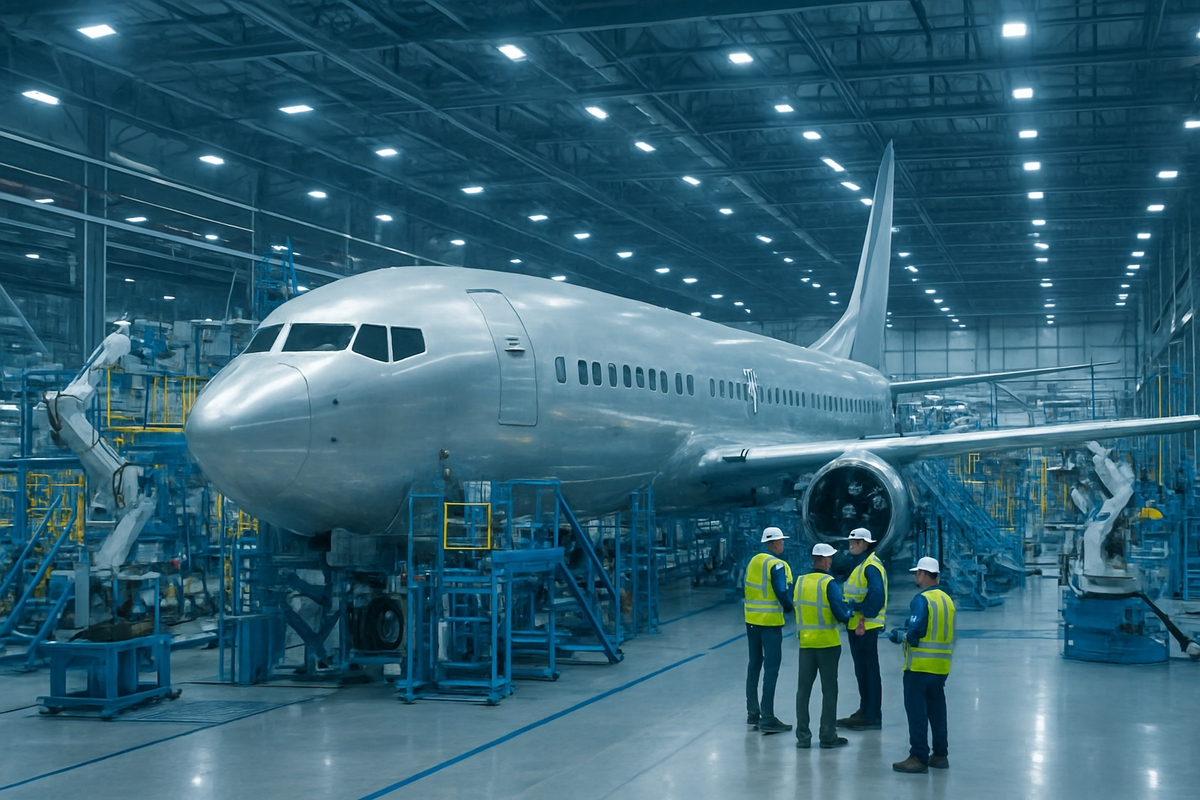
In late 2025, Boeing reached a definitive milestone by completing the $4.7 billion acquisition of its primary fuselage supplier, Spirit AeroSystems. This move effectively reversed a decades-old outsourcing strategy that many analysts blamed for the company's quality control issues. By early 2026, the FAA finally lifted the production caps that had hindered the 737 program, allowing Boeing to stabilize at a rate of 42 aircraft per month, with plans to reach 47 per month by the end of the year. The company’s Q4 2025 earnings report, released on January 27, 2026, showed revenue of $23.95 billion—a 57% increase year-over-year—and a net profit of $8.22 billion, though much of that profit was driven by a $9.6 billion gain from the sale of its Digital Aviation Solutions unit to private equity.
Winners and Losers in the Aerospace Shakeup
The primary beneficiary of Boeing’s stabilization is arguably the company itself, but the ripples extend throughout the industry. The successful reintegration of Spirit AeroSystems has provided a much-needed lifeline to a workforce that had been plagued by uncertainty. However, the consolidation also means that Boeing’s chief rival, Airbus (OTC: EADSY), may face increased competition for supply chain resources as Boeing exerts more direct control over its production. Airbus has dominated the narrow-body market for years, and while it remains the market leader, a disciplined Boeing could prevent further erosion of market share in the lucrative Trans-Atlantic and domestic US corridors.
On the losing side, smaller Tier-2 and Tier-3 suppliers may find themselves under increased pressure as Boeing implements its "Industrial Reset." The company’s focus on simplifying over 5,100 work instruction documents and reducing "traveled work" means suppliers must meet more stringent quality standards or risk being phased out. Major engine manufacturers like General Electric (NYSE: GE), through its GE Aerospace division, and RTX (NYSE: RTX), via Pratt & Whitney, stand to gain significantly from increased delivery volumes, provided Boeing can maintain its production ramp-up without further safety-related pauses.
Broader Industry Trends and the Engineering Pivot
Boeing’s current strategy marks a significant departure from the "financial engineering" era that characterized the company for the past two decades. Under Ortberg, the shift back toward "aerospace engineering" is a trend being watched closely by industrial conglomerates worldwide. The move to prioritize safety and quality over delivery speed is a response to both regulatory pressure and a changing market sentiment that no longer tolerates "fast-track" manufacturing in safety-critical industries. This shift mirrors broader trends in the U.S. toward "onshoring" and vertical integration as a means of ensuring supply chain security.
Historically, Boeing’s recovery can be compared to the post-2001 downturn or the 787 battery crisis of 2013, but the scale of the current challenge is unprecedented. The company is navigating a record $682 billion backlog while managing $54.1 billion in debt. Regulators at the FAA have also signaled a permanent shift in oversight, with more embedded inspectors and a focus on Safety Management Systems (SMS) that will likely become the new standard for all major aerospace manufacturers, including Embraer (NYSE: ERJ) and regional jet makers.
The Horizon: Certification and the Debt Mountain
The next 12 to 24 months will be defined by two key factors: the certification of the 777X and the management of the remaining debt. Short-term, Boeing must prove it can hit its target of 10 Dreamliners per month by the end of 2026. The 777X, already years behind schedule, is nearing the final stages of certification; its entry into service is the "holy grail" for Boeing’s long-haul recovery. If Boeing can avoid further delays, the 777X will provide a high-margin revenue stream that could be used to aggressively pay down the debt incurred during the 2024-2025 crisis years.
However, challenges remain. The global geopolitical climate and trade tensions could still impact delivery schedules to key markets like China. Furthermore, if interest rates remain elevated, the cost of servicing $54 billion in debt will continue to weigh on the company’s ability to invest in the next generation of "clean-sheet" aircraft. Investors will be looking for a sustained period of positive free cash flow, something Boeing only just achieved in Q4 2025 with a modest $0.4 billion.
Final Assessment: A Cautious Ascent
Boeing’s 2026 outlook is more optimistic than it has been in years, but the company is far from "cruising altitude." The Q4 earnings report demonstrated that management is willing to make hard choices—such as selling off non-core assets like the Digital Aviation Solutions business—to protect the balance sheet and focus on the core mission of building planes. The integration of Spirit AeroSystems is the linchpin of this entire strategy; if Boeing can prove that internalizing production improves quality, it will have written a new playbook for modern manufacturing.
For the market, Boeing remains a "show me" story. Investors should watch for monthly delivery numbers and any commentary from the FAA regarding the 777X certification process. While the headline profit of $8.2 billion in the latest quarter is an anomaly due to asset sales, the stabilization of production at 42 units per month for the MAX is the real metric of success. Boeing has successfully navigated the worst of its operational crisis; the task now is to prove that its new culture of safety is as durable as the airframes it builds.
This content is intended for informational purposes only and is not financial advice