

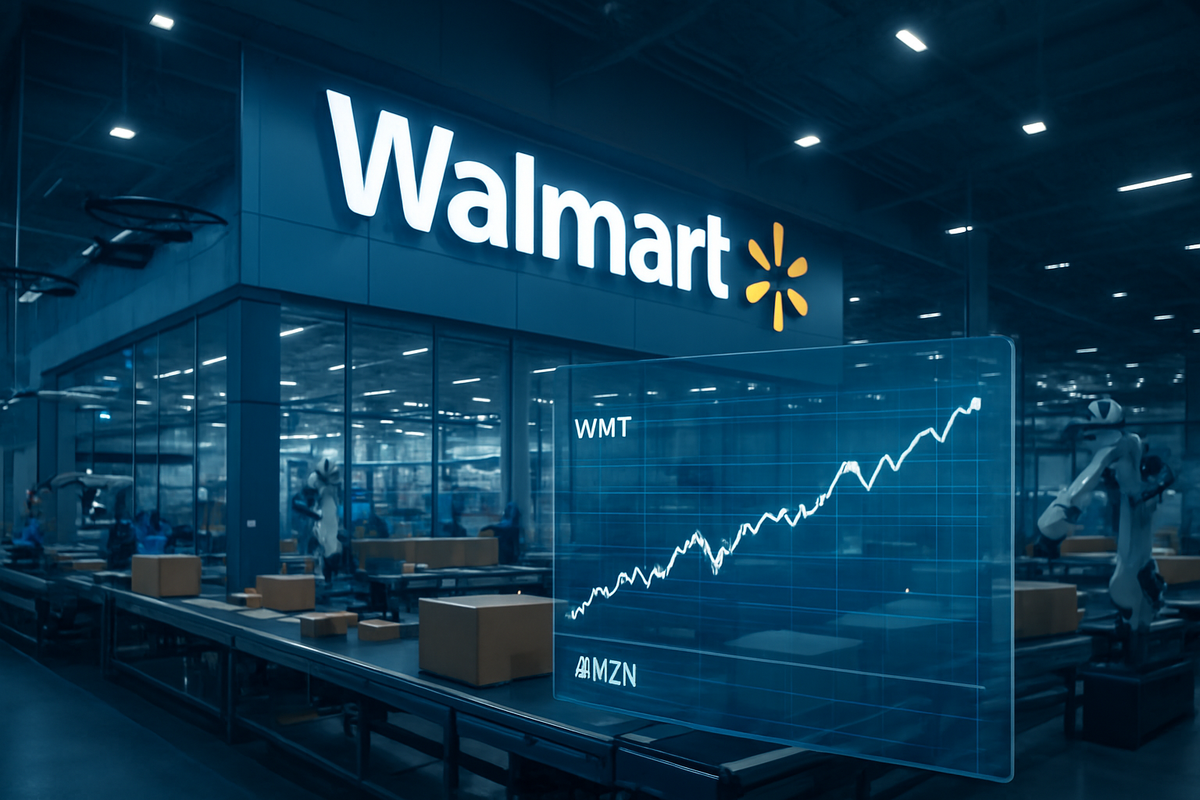
Walmart Inc. (NYSE: WMT) reported a record-breaking fourth quarter for fiscal year 2025 today, surpassing analyst estimates on both the top and bottom lines driven by a surge in holiday spending and a robust e-commerce performance. Despite the revenue beat and the announcement of a massive $30 billion share buyback program, the retail giant’s stock slipped in early trading as management issued a conservative profit forecast for the upcoming 2026 fiscal year that fell short of Wall Street’s expectations.
The mixed results highlight a pivotal moment for the world’s largest brick-and-mortar retailer. While Walmart continues to gain market share in the grocery and essentials categories, it is facing stiffening competition from digital rivals and bracing for a cooling macroeconomic environment characterized by moderating inflation and potential trade volatility.
Record Revenue Meets a $30 Billion Confidence Vote
In its earnings release on February 19, 2026, Walmart reported total revenue of $190.7 billion for the fourth quarter of 2025, representing a 5.6% increase compared to the previous year and edging past the $190.49 billion anticipated by analysts. Adjusted earnings per share (EPS) came in at $0.74, narrowly beating the consensus estimate of $0.73. The strong performance was underpinned by a 24% surge in global e-commerce sales and the continued momentum of "Walmart Connect," the company’s high-margin advertising division, which has become a significant contributor to the bottom line.
To signal long-term confidence, Walmart’s Board of Directors authorized a new $30 billion share repurchase program, effectively replacing a previous $20 billion authorization from 2022. Additionally, the company announced its 53rd consecutive annual dividend increase, raising the payout by 5% to $0.99 per share. However, these shareholder-friendly moves were overshadowed by the company's guidance for the 2026 fiscal year (FY 2027). Walmart projected adjusted EPS between $2.75 and $2.85, significantly lower than the $2.96 analysts had modeled. Following the news, shares of Walmart fell approximately 3% as investors recalibrated their growth expectations.
A Changing Guard: Winners and Losers in the Retail Shift
The report coincides with a historic shift in the retail hierarchy. For the first time in history, Amazon (NASDAQ: AMZN) has officially surpassed Walmart as the world’s largest company by annual revenue, reporting $716.9 billion for the 2025 calendar year compared to Walmart’s $713.2 billion. While Walmart remains the dominant force in physical retail and groceries, Amazon’s relentless expansion in logistics and its high-growth AWS cloud division allowed it to finally seize the revenue crown after 13 years of Walmart’s leadership.
While Walmart grapples with its "silver medal" status in total revenue, it continues to outperform traditional retail peers like Target (NYSE: TGT). Target has struggled throughout late 2025, falling into what some analysts call a "discretionary doom loop" as consumers pull back on home decor and apparel. In contrast, Walmart has successfully attracted higher-income households looking for value, leveraging its "Great Value" private-label brand to capture market share from specialty retailers. Other discount-focused players like Costco Wholesale (NASDAQ: COST) remain resilient, but Walmart’s aggressive push into automated fulfillment and drone delivery has helped it maintain a logistical edge over mid-tier competitors.
Macroeconomic Headwinds and the End of the Inflation Tailwind
The cautious 2026 guidance provided by Walmart CFO John David Rainey points to broader industry trends that could affect the entire retail sector. Rainey cited "tariff uncertainty" and "moderating inflation" as primary factors for the conservative outlook. Over the past two years, high inflation actually helped boost top-line revenue for retailers as prices rose; however, as inflation cools, retailers must rely more heavily on volume growth to drive sales. Walmart is also bracing for potential shifts in trade policy that could increase the cost of imported goods, a significant concern for a company with such a vast global supply chain.
Historically, Walmart has often been viewed as a defensive play during economic uncertainty. In 2025, consumer spending growth slowed to 3.7% from 5.7% the previous year, leading shoppers to become more deliberate and research-oriented. This "Value-Plus" shopping trend—prioritizing both low price and extreme convenience—fits Walmart's current strategy, but the company’s massive capital expenditures in AI and warehouse automation suggest it is preparing for a future where labor costs and operational efficiency will be the primary battlegrounds rather than just shelf pricing.
Strategic Pivots: The Road to 2026 and Beyond
Looking ahead, Walmart appears to be doubling down on technology to offset the projected earnings gap. The company is in the midst of a multi-year transformation, shifting from a traditional retailer to a diversified platform business that includes advertising, data analytics, and healthcare services. Investors will be closely watching the "Walmart Connect" advertising arm, which offers much higher margins than selling milk or electronics. If this segment can continue its double-digit growth, it may provide the buffer needed to exceed the cautious EPS guidance issued today.
In the short term, Walmart must navigate a delicate balance between maintaining its value proposition and protecting its margins. The strategic pivot toward automation is expected to reach a tipping point in 2026, with a significant portion of its fulfillment centers scheduled to be fully automated by the end of the year. This transition is essential for Walmart to compete with Amazon's logistics machine, but it requires heavy upfront investment that may continue to weigh on near-term earnings.
Conclusion: A Giant in Transition
Walmart’s Q4 2025 report serves as a stark reminder of the challenges facing even the most successful traditional retailers. While the company achieved record revenue of $190.7 billion and remains a cash-generating powerhouse capable of a $30 billion buyback, the "Amazon Flipping" and the soft 2026 guidance suggest that the path forward is increasingly complex. The retail landscape is no longer just about who has the most stores, but who can best integrate digital convenience with physical scale while navigating a volatile global economy.
For investors, the coming months will be defined by Walmart's ability to manage costs and sustain its e-commerce momentum. While the stock's immediate dip reflects disappointment in the 2026 outlook, the company’s dominant position in the essential goods market provides a solid floor. The market will be watching for signs that the investments in AI and automation are beginning to yield the promised efficiency gains, which will be the ultimate factor in determining whether Walmart can reclaim its momentum in the back half of 2026.
This content is intended for informational purposes only and is not financial advice.