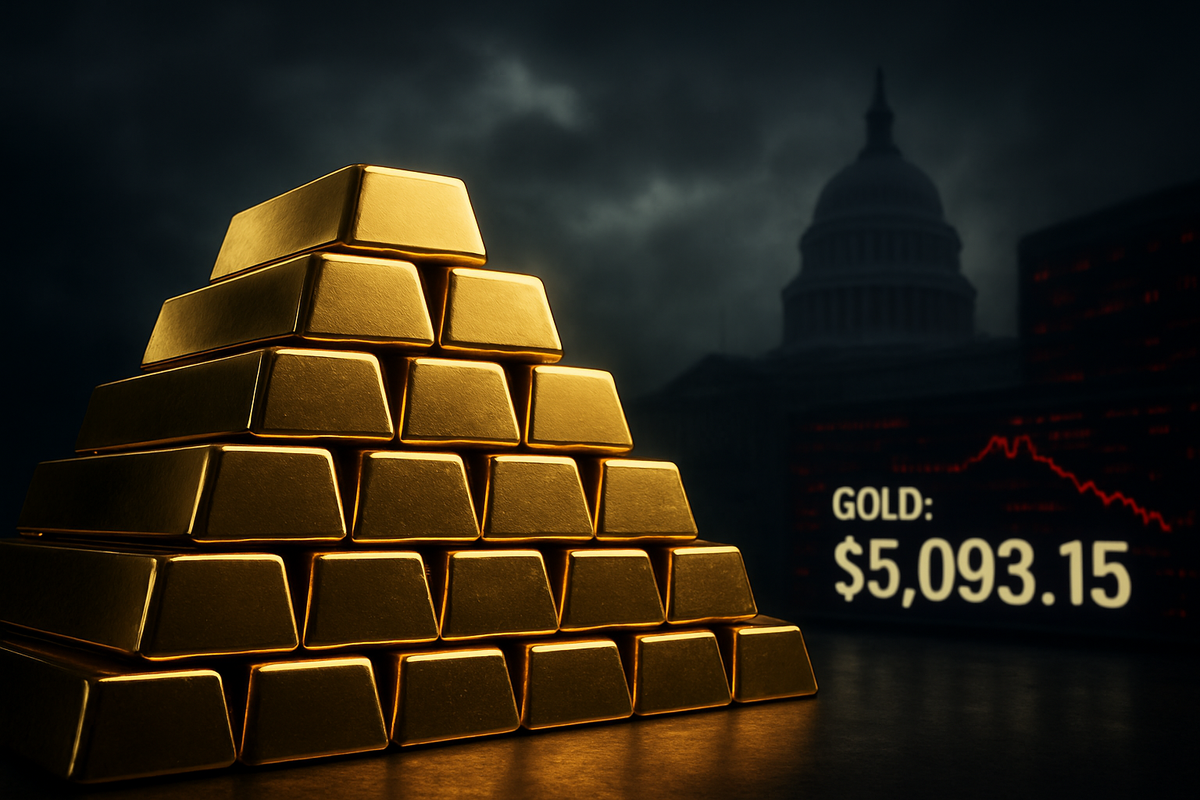
The global financial landscape underwent a seismic shift on Monday, January 26, 2026, as gold prices surged past the once-unthinkable $5,000 per ounce barrier. Spot gold hit an all-time high of $5,093.15 per ounce, fueled by a perfect storm of domestic political paralysis and an increasingly aggressive U.S. foreign trade policy. This historic rally represents more than just a price spike; it is a clear signal from global markets that trust in the U.S. dollar and the stability of the current administration is reaching a critical breaking point.
Investors have flooded into the safety of precious metals as the probability of a federal government shutdown by the January 31 deadline surged to over 80%. The standoff in Washington, combined with threats of unprecedented 100% tariffs on key allies like Canada, has left institutional investors scrambling for a "safe haven" amid what many are calling a period of "erratic decision-making" that threatens to decouple the U.S. from the global economic order.
A Perfect Storm: How Gold Breached the $5,000 Barrier
The journey to $5,093.15 per ounce was accelerated by a weekend of intense domestic and diplomatic friction. The primary catalyst was a hardening of positions in the U.S. Senate, where Democrats have vowed to block funding for the Department of Homeland Security. This legislative stalemate follows the tragic shooting of Alex Jeffrey Pretti, a Minneapolis nurse, by federal immigration agents—an event that has sparked nationwide unrest and paralyzed the budget process. Prediction markets like Kalshi and Polymarket now place the odds of a government shutdown at a staggering 93%, up from 60% just a week ago.
Simultaneously, the administration’s foreign policy has sent shockwaves through international trade. The White House recently threatened a 100% tariff on all Canadian imports should Ottawa proceed with a trade deal with China involving electric vehicles. This "scorched earth" approach to trade extended to the European Union, where 10% tariffs were threatened against Denmark and Norway over their refusal to support the administration’s controversial push to annex Greenland.
The market reaction was immediate. On Monday alone, gold prices jumped 2.2%, capping a 15% rally since the start of the year. Silver followed suit, hitting a record $110.56 per ounce. "What we are seeing is not a speculative bubble," noted one senior strategist at First Eagle Investment Management. "It is a structural re-rating of gold as the ultimate insurance policy against a U.S. policy environment that has become fundamentally unpredictable."
Winners and Losers in the New Gold Era
The unprecedented surge in gold prices has created a stark divide between beneficiaries in the mining sector and broader market volatility. Major gold producers have seen their valuations skyrocket as their margins expand to record levels. Newmont Corporation (NYSE: NEM), the world’s largest gold miner, saw its shares surge as investors bet on record-breaking quarterly profits. Similarly, Barrick Gold Corporation (NYSE: GOLD) has benefited significantly, with analysts upgrading the stock on the expectation of sustained high-price environments.
Streaming and royalty companies are also emerging as major winners. Firms like Franco-Nevada Corporation (NYSE: FNV) and Wheaton Precious Metals Corp. (NYSE: WPM), which hold rights to purchase gold at fixed prices, are capturing the full upside of the $5,000+ spot price without the direct operational risks of mining. For retail and institutional investors unable to hold physical bullion, the SPDR Gold Shares (NYSE: GLD) has seen record-breaking inflows, cementing its position as the primary vehicle for gold exposure.
Conversely, the "losers" in this scenario include U.S.-based manufacturers and retailers who rely on stable trade relations with Canada and the EU. The threat of 100% tariffs on Canadian goods would be catastrophic for the automotive and energy sectors, potentially leading to a sharp spike in domestic inflation. Financial institutions heavily weighted in U.S. Treasuries are also feeling the pinch as the "Sell America" trade gains momentum, with the U.S. dollar hitting a four-month low against a basket of currencies including the Japanese yen and the Swiss franc.
Broader Significance: The Weaponization of Trade and the Erosion of Trust
The break above $5,000 is a watershed moment that highlights a deeper trend: the perceived "weaponization" of the U.S. dollar and trade policy. For decades, the dollar’s status as the world’s reserve currency was underpinned by the predictability of U.S. institutions. However, the current administration’s use of massive tariffs as a primary negotiating tool—even against long-standing allies—has forced central banks in emerging markets to diversify their reserves. Central bank gold buying has quadrupled since 2022, providing a massive floor for prices.
The Greenland dispute and the China-Canada trade tensions serve as historical precedents for how geopolitical goals are now being prioritized over economic stability. This shift mirrors the volatility seen during the 1970s stagflation era, yet the scale of today’s political polarization is without modern comparison. The criminal investigation into Federal Reserve Chair Jerome Powell, which began earlier this month, has further eroded confidence, leading many to wonder if the central bank can remain insulated from the "erratic decision-making" currently dominating the executive branch.
Furthermore, the capture of Nicolás Maduro in Venezuela and renewed tensions with Iran have added a geopolitical risk premium to every asset class. In this environment, gold is no longer just a "doomsday asset"—it has become a necessary component of a diversified portfolio for even the most conservative institutional funds.
The Road Ahead: $6,000 Gold and Beyond?
As we look toward the remainder of 2026, the short-term outlook depends heavily on the outcome of the January 31 shutdown deadline. If the government does indeed shutter, gold could easily test the $5,500 level within weeks. A resolution, however, seems unlikely given the "crisis of confidence" surrounding the administration’s DHS policies. Long-term, analysts at Capital.com suggest gold could average $5,375 for the year, with potential peaks near $6,400 if the tariff threats against Canada and the EU are fully implemented.
Strategic pivots are already underway. Multi-national corporations are likely to begin restructuring supply chains to bypass U.S. ports if the trade war escalates further. Investors should also watch for a potential shift in Federal Reserve policy during the Jan 27–28 meeting. Any hint that the Fed is succumbing to political pressure or is unable to manage the inflationary pressures of new tariffs will likely act as a secondary booster for gold prices.
Summary: A New Financial Reality
The historic break of $5,000 gold marks the end of an era of dollar-centric stability. The "crisis of confidence" in Washington, fueled by a looming government shutdown and aggressive tariff threats against allies over Greenland and China trade deals, has fundamentally altered the risk-reward calculus for global investors.
Key takeaways for the market include:
- The $5,000 Floor: Gold is likely to maintain its new high-water mark as long as U.S. policy remains volatile.
- Institutional Shift: Gold has transitioned from a speculative hedge to a primary strategic asset for central banks and large-scale funds.
- Geopolitical Risk: The unpredictability of trade policy toward Canada and the EU will continue to drive safe-haven demand.
As we move forward, investors must keep a close eye on the January 31 budget deadline and the ongoing rhetoric regarding the annexation of Greenland. In a world where the "rules-based order" is being rewritten daily, gold remains the only asset that requires no counterparty trust—a quality that has never been more valuable than it is today.
This content is intended for informational purposes only and is not financial advice.