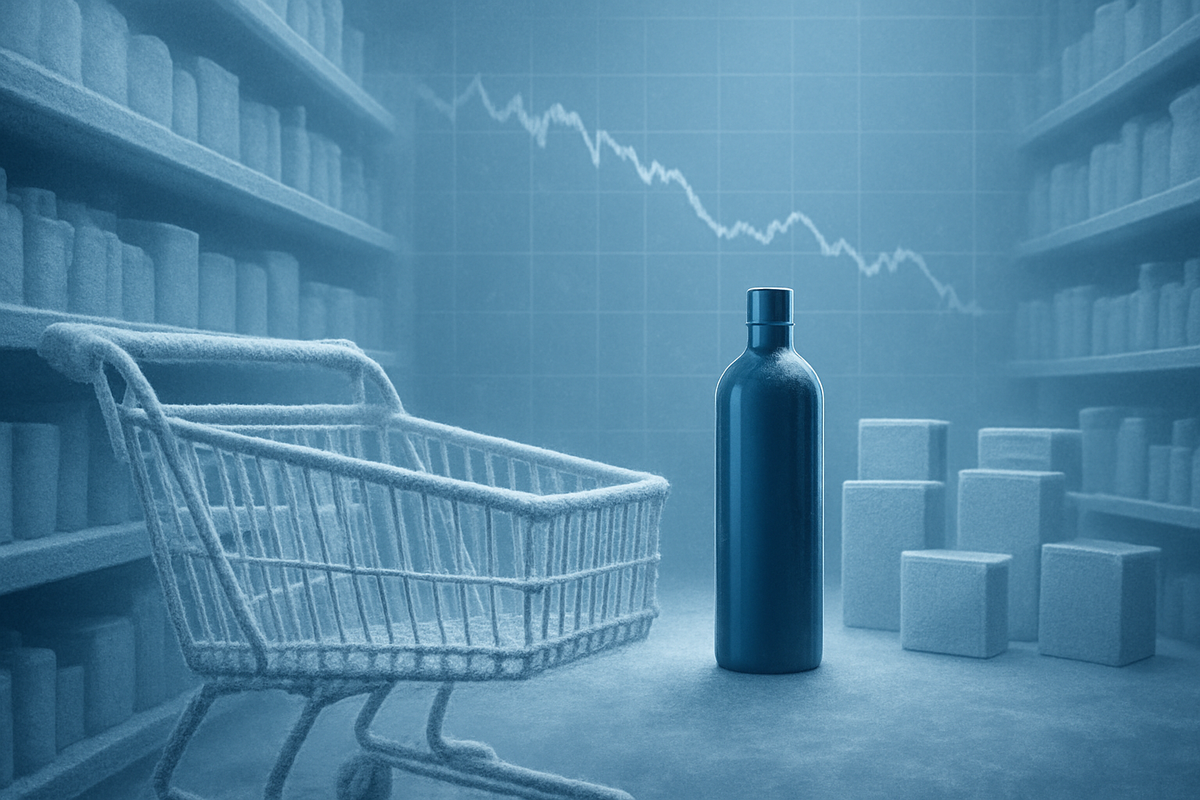
In a financial landscape increasingly defined by a cautious consumer base and a "cooling" macroeconomic climate, consumer staples behemoth Procter & Gamble (NYSE: PG) reported a second-quarter fiscal 2026 performance that has left investors questioning the durability of the "pricing power" strategy. On January 22, 2026, the company revealed a set of results characterized by analysts as "frigid," featuring flat organic growth and a concerning dip in unit volume. The report serves as a stark barometer for the broader retail sector, suggesting that even the most essential of household goods are no longer immune to the "double squeeze" of high household debt and persistent, albeit slowing, inflation.
The immediate implications for P&G are a tightening of the belt and a pivot toward internal efficiency. While the company maintained its full-year guidance, the market's reaction was one of measured skepticism. As of January 23, 2026, shares have faced pressure as the reality of a "volume-negative" environment sinks in. For the public, these results signal a shift in the power dynamic between legacy brands and the budget-conscious shopper, highlighting a market where "premium" is becoming a harder sell than "practical."
The Chill Within: P&G’s Q2 FY2026 Earnings Deep Dive
Procter & Gamble’s (NYSE: PG) fiscal 2026 second-quarter results, released yesterday, painted a picture of a giant standing still in a moving market. The company reported net sales of $22.2 billion, a modest 1% increase over the previous year, but the underlying "organic" growth—which strips out the effects of acquisitions and currency fluctuations—was a flat 0%. This stagnation was the result of a delicate and ultimately failing balancing act: a 1% gain from price increases was completely neutralized by a 1% decline in shipment volumes. In simpler terms, P&G is charging more but selling less.
The timeline leading to this "frigid" quarter began in late 2025, when retail sales in December showed a surprising contraction. Throughout the quarter, P&G President and CEO Shailesh Jejurikar noted a "challenging consumer and geopolitical environment" that hit the company's most price-sensitive segments. While the Beauty segment (led by high-end brands like SK-II) and Health Care saw organic growth of 4% and 3% respectively, the Baby, Feminine & Family Care division plummeted by 4%, with Family Care volumes dropping nearly 10% against tough year-over-year comparisons.
Market reaction was swift, with analysts from Morningstar noting that while the results "don't suggest cracks in P&G's standing," they certainly indicate a "chilly" reception for further price hikes. To counter the margin compression—core operating margins fell by 70 basis points—P&G leaned heavily on its productivity programs, which delivered a staggering 270 basis points of savings. This internal efficiency is currently the only thing keeping the company's Core EPS steady at $1.88, unchanged from the prior year.
Winners and Losers in the Volume War
The divergence in the consumer staples sector has become a primary narrative of early 2026. While P&G struggles with volume, competitors with broader "value" portfolios are finding a foothold. Church & Dwight (NYSE: CHD), known for its Arm & Hammer brand, has emerged as a clear winner, posting a 4% volume growth in its most recent reporting cycle. Similarly, Kimberly-Clark (NYSE: KMB) has managed to maintain a "volume-plus-mix" growth strategy for seven consecutive quarters, proving that personal care and hygiene segments can still grow if the price-to-value ratio is perceived as fair by the consumer.
The most significant "winner," however, isn't a single corporation but the entire category of Private Labels. Store brands have seen their market share climb past 21% in the U.S. as of January 2026. These "premium dupes"—store-branded versions of high-end products—are growing at four times the rate of national brands. Retailers like Kroger and ALDI are using AI-driven innovation to launch private label products in weeks, capturing high-income households (earning over $150,000) that are increasingly opting for "data-driven premium" store brands over P&G’s legacy offerings.
On the losing end, P&G's high-margin "premium-only" segments are under fire. The Baby and Family Care segments are the primary victims, as parents trade down to generic diapers and paper towels. Unilever (NYSE: UL), while performing better than P&G with a 1.5% volume growth, is also watching the "premiumization" trend carefully, as the ceiling for what consumers are willing to pay for a "Power Brand" appears to have been reached in early 2026.
A Structural Shift: The End of the Pricing Era
The "frigid" sales growth at P&G is not just a seasonal fluke; it signifies a broader industry trend where the "pricing era" of 2022–2025 has officially ended. For the past three years, consumer staples companies successfully passed on nearly all inflationary costs to the consumer. However, the data from January 2026 confirms that price elasticity has returned with a vengeance. This event fits into a historical precedent similar to the post-2008 financial crisis period, where "frugality" became a permanent consumer trait rather than a temporary fix.
The ripple effects are reaching beyond just the products on the shelves. Retail partners are gaining more leverage over manufacturers like P&G. With their own private labels performing so well, retailers are less inclined to grant prime shelf space to national brands that aren't driving volume. Furthermore, the mention of "potential tariff impacts" during P&G’s analyst call suggests that regulatory and trade policy uncertainty in 2026 could further pressure supply chains, making P&G’s productivity-led margin strategy even more critical.
The Road Ahead: Pivots and Scenarios
In the short term, P&G must survive what it calls the "low point" of the fiscal year. Management has expressed confidence that the second half of 2026 will see "stronger results," likely banking on a stabilization of consumer sentiment and the lapping of easier year-over-year comparisons. However, a strategic pivot may be required. Investors should look for P&G to potentially expand its "value-tier" offerings or double down on "un-dupeable" innovation—products so technologically superior that they cannot be easily mimicked by store brands.
The long-term challenge for P&G will be reclaiming the "middle-class" consumer who has moved to private labels. Two scenarios emerge for the remainder of 2026: in the "Bull Case," P&G’s massive marketing spend (which increased this quarter) successfully re-establishes brand superiority, leading to a volume recovery by Q4. In the "Bear Case," the cooling economy turns into a prolonged stagnation, forcing P&G to choose between losing more market share or engaging in a margin-eroding "price war" with store brands.
Final Outlook for Investors
The takeaway from P&G’s recent earnings is clear: resilience is currently being defined by internal efficiency rather than market expansion. P&G remains a defensive fortress for any portfolio, but its growth engine is currently idling. The company’s ability to generate $22.2 billion in a "frigid" environment is a testament to its scale, but the 0% organic growth is a warning that the "easy money" from price hikes is over.
Moving forward, the market will be watching one metric above all others: Volume. For P&G to regain its luster, it must prove it can move more boxes, not just charge more for them. Investors should keep a close eye on the performance of the Baby Care segment and the success of SK-II in the volatile China market over the coming months. As we navigate the cooling economy of early 2026, P&G stands as a sentinel of the staples sector—sturdy, but currently standing still in the cold.
This content is intended for informational purposes only and is not financial advice.