As of January 15, 2026, the global financial markets are witnessing a capital expenditure cycle of unprecedented proportions. While traditional market skeptics have spent the last eighteen months warning of an impending "AI bubble" similar to the dot-com crash of 2000, the world’s largest technology firms are responding with a different strategy: doubling down. New financial projections for the current fiscal year indicate that the "Big Five" hyperscalers—Amazon.com, Inc. (NASDAQ: AMZN), Microsoft Corp. (NASDAQ: MSFT), Alphabet Inc. (NASDAQ: GOOGL), Meta Platforms, Inc. (NASDAQ: META), and Oracle Corp. (NYSE: ORCL)—are on track to spend a combined $602 billion on infrastructure, with over 75% of that capital earmarked specifically for artificial intelligence.
This massive surge in spending is no longer just about the "fear of missing out." It represents a fundamental shift in the global economy's architecture. The immediate implications are clear: the scarcity of high-end chips has evolved into a localized scarcity of power, leading to a "nuclear renaissance" in the private sector. As these companies pivot from the experimental training of Large Language Models (LLMs) to the massive deployment of "agentic AI" workflows, the demand for data center capacity continues to outstrip supply, despite the staggering sums being poured into the ground.
The Half-Trillion Dollar Bet: Execution Over Expectations
The opening weeks of 2026 have been defined by a series of earnings previews and capital allocation announcements that have stunned even the most bullish analysts. Amazon leads the pack with a projected capital expenditure of over $150 billion for the year, much of it directed toward its AWS "Trainium3" custom silicon and massive new liquid-cooled data centers. Meta, following the successful release of its Llama 5 model late last year, has committed $100 billion to expand its "Prometheus" clusters. This spending spree is not merely a 2026 phenomenon; it is the culmination of a three-year timeline that began with the release of GPT-4 and accelerated through the supply chain bottlenecks of 2024 and 2025.
Industry leaders are now prioritizing "sovereign compute" and "energy independence." At the Consumer Electronics Show (CES) earlier this month, NVIDIA Corp. (NASDAQ: NVDA) CEO Jensen Huang unveiled the "Rubin" architecture (R100/R200), featuring the new Vera CPU. While the previous Blackwell architecture remains the mature workhorse of the industry, the Rubin chips are already pre-sold through the end of 2027. The initial market reaction has been a mixture of awe and caution, as the shift from self-funded buildouts to heavy debt financing—over $100 billion in AI-linked bonds issued in 2025 alone—signals that the stakes have reached a level where failure is no longer an option for the C-suite.
Winners and Losers in the Infrastructure Arms Race
In this environment, the clear winners are those who sit at the intersection of compute and power. NVIDIA (NASDAQ: NVDA) continues to hold a near 90% market share in the GPU space, but the "infrastructure trade" has widened significantly. Companies like Vertiv Holdings Co (NYSE: VRT) and Eaton Corp PLC (NYSE: ETN), which provide the essential thermal management and power distribution systems for high-density AI racks, have seen their backlogs swell to record levels. Furthermore, the "power-to-compute" trade has turned energy providers like Constellation Energy Corp (NASDAQ: CEG) and Vistra Corp (NYSE: VST) into tech-adjacent darlings, following their multi-billion dollar deals to provide dedicated nuclear power to Microsoft and Meta.
Conversely, the "losers" in this cycle are becoming increasingly apparent. Legacy software-as-a-service (SaaS) companies that failed to integrate agentic AI capabilities early on are facing a "valuation desert." These firms are struggling to justify their pricing models in an era where AI agents can automate tasks that previously required expensive software seats. Additionally, companies reliant on the aging public power grid are finding themselves at a competitive disadvantage, as data center "wait times" for grid connectivity in Northern Virginia and parts of Europe now stretch into the late 2020s.
Breaking the Power Wall: The Significance of the Nuclear Pivot
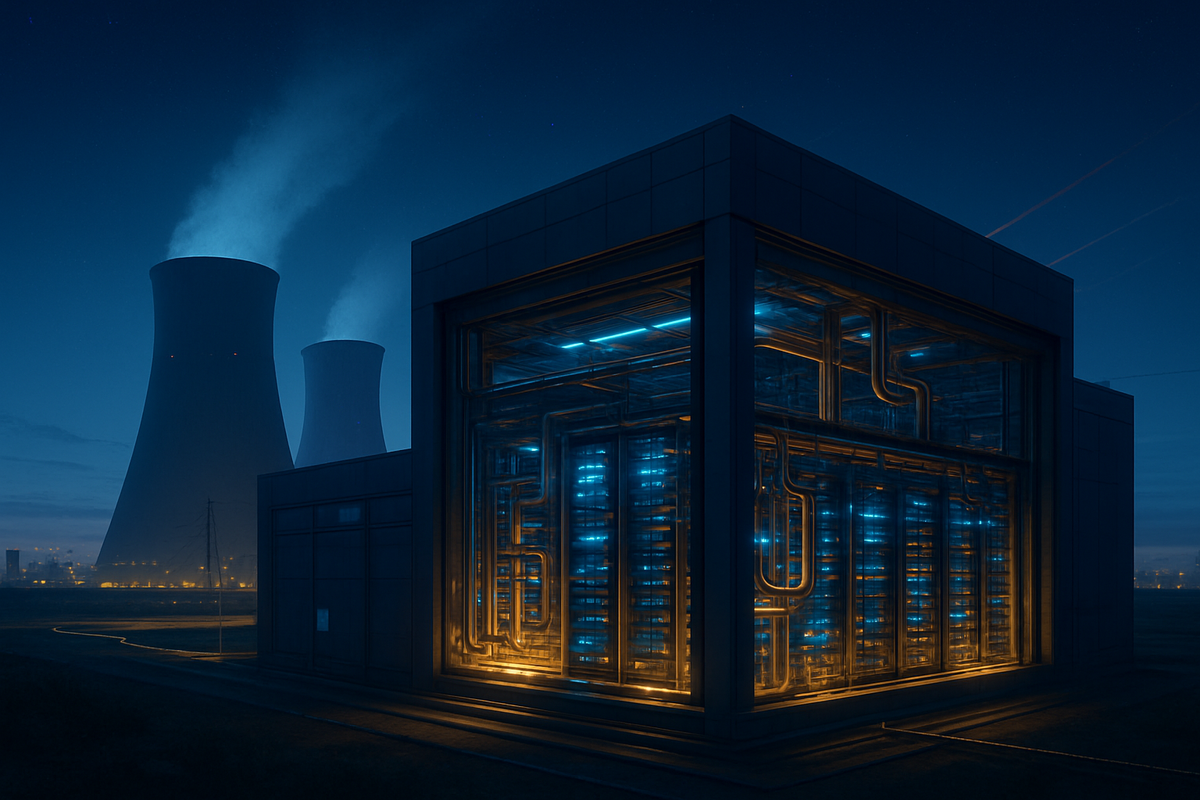
The current infrastructure surge is more than just a chip story; it is a global energy story. For decades, data centers were considered significant but manageable power consumers. In 2026, however, the industry has hit what is colloquially known as the "Power Wall." The realization that the existing grid cannot support the gigawatt-scale requirements of Rubin-class clusters has forced a historic pivot to nuclear energy. Microsoft’s 20-year agreement to restart the Three Mile Island site—now the Crane Clean Energy Center—has served as a blueprint for the industry.
This trend toward "behind-the-meter" power represents a major shift in regulatory and policy implications. Tech giants are effectively becoming private utility companies, investing in Small Modular Reactors (SMRs) from firms like Oklo Inc (NYSE: OKLO) and TerraPower. This is a significant departure from the fiber-optic boom of the 1990s; while fiber could be laid relatively quickly, nuclear and grid-scale energy projects take years of permitting and construction. This "energy moat" may eventually be what protects the current leaders from upstart competitors, as the barrier to entry is no longer just code, but the ability to secure a gigawatt of carbon-free electricity.
What Lies Ahead: From Training to Inference
As we look toward the remainder of 2026 and into 2027, the focus of AI spending is expected to shift from "Training" (building models) to "Inference" (running them). This shift is critical for the "bubble" debate. Inference revenue—the money earned from users actually using AI services—has finally begun to show up on balance sheets in a meaningful way. Alphabet (NASDAQ: GOOGL) reported over $15 billion in AI-driven revenue in 2025, and Microsoft (NASDAQ: MSFT) is seeing Azure AI revenue grow at a rate that suggests it will soon rival its core cloud business.
However, challenges remain. The supply of High-Bandwidth Memory (HBM4) remains the primary hardware constraint, with SK Hynix and Micron Technology Inc (NASDAQ: MU) pre-selling their entire 2027 capacity. Furthermore, as sovereign nations begin to build their own "National AI Clouds," we may see a fragmentation of the global compute market, leading to new geopolitical tensions over where data centers are located and who has access to the most efficient chips.
Final Assessment: A Structural Boom, Not a Transient Hype
The narrative of an "AI bubble" will likely persist as long as valuations remain high, but the sheer scale of the 2026 CapEx plans suggests that the world’s most sophisticated companies see AI not as a feature, but as the new foundational layer of the global economy. The transition from the Blackwell architecture to Rubin, combined with the desperate search for nuclear baseload power, highlights a demand-supply gap that shows no signs of closing in the near term.
For investors, the coming months will be about monitoring "CapEx efficiency." The market is no longer satisfied with just seeing high spending; it wants to see the conversion of that spend into high-margin AI services revenue. Watch for the progress of SMR deployments and the stabilization of HBM4 supply chains as leading indicators of the next phase of this cycle. The forge is hot, and while the costs are astronomical, the digital infrastructure of the 21st century is being hammered out in real-time.
This content is intended for informational purposes only and is not financial advice.