
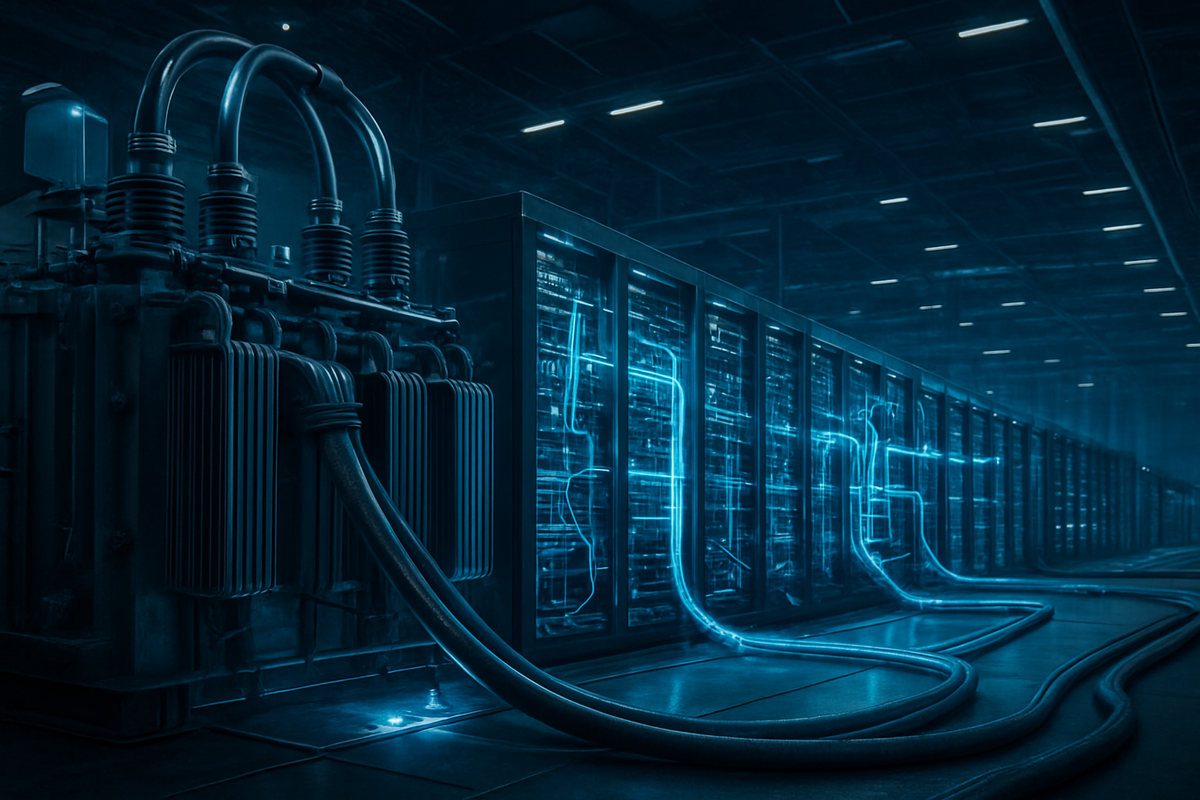
As of January 13, 2026, the global obsession with artificial intelligence has transitioned from a race for digital supremacy into a grueling battle for physical resources. While the initial years of the AI boom were defined by a desperate scramble for high-end semiconductors, the narrative has shifted fundamentally. Today, the most valuable assets in the AI ecosystem aren't just the chips themselves, but the transformers, cooling systems, and high-voltage cables that keep them from melting. For investors in the U.S. industrial sector, the “picks and shovels” of the 21st century have arrived in the form of heavy electrical equipment and grid infrastructure.
The immediate implications of this shift are reflected in the record-shattering earnings and multi-year backlogs of legacy industrial giants. The market has realized that an AI model is only as good as the electricity that feeds it, and currently, that electricity is in short supply. As data center vacancy rates hover near historic lows of under 2%, the companies capable of building the electrical and physical backbone for these "AI factories" are seeing their valuations decouple from traditional industrial cycles, morphing instead into high-growth tech proxies.
The Gridlock: From Silicon Scarcity to Power Poverty
The transition to this current state began in earnest during the latter half of 2024, when the primary bottleneck for AI expansion shifted from GPU lead times to utility interconnect queues. By 2025, the wait time to connect a new hyperscale data center to the U.S. power grid in major hubs like Northern Virginia or Columbus, Ohio, stretched to five years or more. This scarcity turned the ability to manage power—regulating it, cooling the heat it generates, and transporting it across aging lines—into the most lucrative trade on Wall Street.
Key players like Vertiv Holdings Co (NYSE: VRT) and Eaton Corp PLC (NYSE: ETN) have spent the last 24 months operating at maximum capacity. The timeline leading to January 2026 was marked by a series of massive capacity expansions and strategic acquisitions. In late 2025, Eaton completed its landmark $9.5 billion acquisition of Boyd Thermal, a move that signaled the end of air-cooling dominance and the birth of a liquid-cooling standard. The initial market reaction was one of skepticism regarding the high premiums paid for these businesses, but as 2026 begins, those premiums look like bargains in the face of triple-digit demand growth for high-density power management.
The Infrastructure Winners: Backlogs Measured in Years, Not Months
The clear winners in this environment are the companies that provide the "nervous system" of the data center. Vertiv Holdings Co (NYSE: VRT) has emerged as the premier pure-play in this space. Entering 2026, the company reported a record-breaking $9.5 billion backlog with a book-to-bill ratio of 1.4x. Their specialized focus on thermal management has made them indispensable as rack densities have climbed from 10kW to over 100kW to accommodate the latest Blackwell-class clusters.
On the construction and grid modernization side, Quanta Services Inc (NYSE: PWR) and Comfort Systems USA Inc (NYSE: FIX) are seeing unprecedented demand. Quanta, which specializes in high-voltage transmission, is currently working through a $39.2 billion backlog, largely driven by the need to "harden" the U.S. grid against the massive new loads required by AI. Meanwhile, Comfort Systems has seen its stock price soar as its exposure to data center mechanical and electrical work now accounts for over 30% of its total revenue. Conversely, traditional commercial construction firms that failed to pivot to the specialized requirements of high-density computing are finding themselves sidelined in a market that demands extreme technical expertise.
A Supercycle in the Making: Trends and Regulation
This phenomenon fits into a broader global trend of "re-industrialization." The AI infrastructure boom is occurring simultaneously with the electrification of the automotive sector and the "reshoring" of semiconductor manufacturing through the CHIPS Act. This "triple threat" of demand has created a secular supercycle for electrical equipment that mirrors the electrification of the United States in the early 20th century. However, unlike previous cycles, the current one is constrained by a fragile and aging national grid.
Regulatory and policy implications are now coming to the forefront in early 2026. State and federal regulators are grappling with how to allocate grid costs between AI hyperscalers and residential ratepayers. This has prompted companies like Schneider Electric SE (OTC:SBGSY) to market "microgrid-in-a-box" solutions, allowing data centers to generate their own power on-site using natural gas turbines or early-stage small modular reactors (SMRs). The historical precedent here is not the dot-com bubble, but rather the mid-19th century railroad boom, where the underlying infrastructure created the platform for a century of economic expansion.
The Road Ahead: Speed to Power as the New Currency
Looking toward the remainder of 2026 and beyond, the most critical metric for the industry will be "Speed to Power." Location is no longer the primary driver for data center development; the availability of a 500-megawatt connection is. This will force a strategic pivot toward "Edge Intelligence," where smaller data centers are distributed closer to power sources rather than concentrated in traditional hubs. We expect to see more partnerships between big tech and industrial firms to fund private power generation projects, bypassing the public utility queues entirely.
The market challenges will center on supply chain resilience and labor. While the backlog for companies like nVent Electric plc (NYSE: NVT) and Modine Manufacturing Co (NYSE: MOD) is a sign of strength, it also represents a liability if they cannot find the skilled electrical engineers and technicians required to install this equipment. Potential scenarios include a shift toward modular, prefabricated data center units that can be "plugged in" with minimal on-site labor—a trend that would further benefit integrated manufacturers like Caterpillar Inc (NYSE: CAT) and Cummins Inc (NYSE: CMI).
Closing Thoughts for the Industrial Investor
The transformation of the industrial sector into the backbone of the AI era is the defining market story of early 2026. What was once seen as a cyclical, boring corner of the market has become the most critical component of the global technology stack. Investors should recognize that while the "software layer" of AI may be subject to hype and rapid turnover, the "physical layer" consists of long-cycle assets with massive barriers to entry and high switching costs.
Moving forward, the market will be watching backlog "burn rates" closely. The primary risk is no longer a lack of demand, but the potential for project delays caused by regulatory hurdles or power shortages. For the US industrial sector investor, the message is clear: the AI revolution is no longer just a digital phenomenon; it is a heavy-industry reality. Watch the power management and grid services sectors as they continue to redefine what it means to be a "growth stock" in the 2020s.
This content is intended for informational purposes only and is not financial advice.