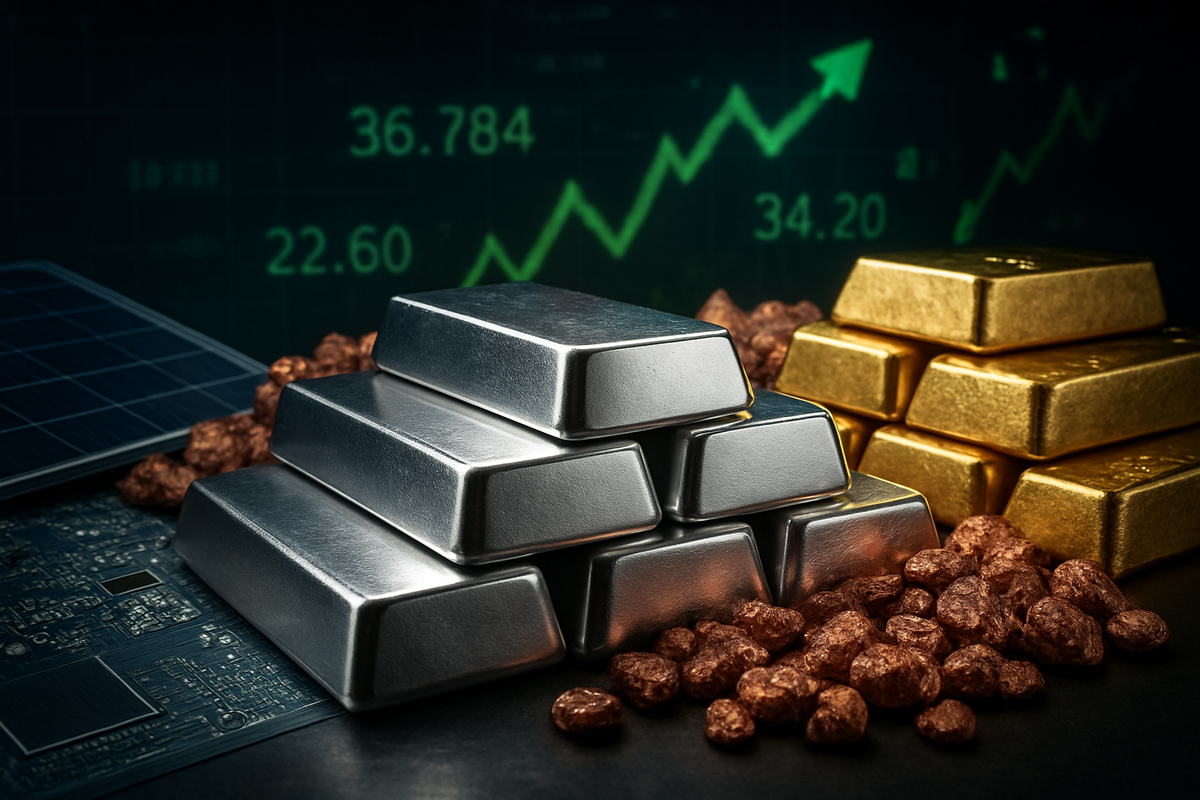
The global metals market reached a historic milestone on January 13, 2026, as silver futures settled at a staggering $85.877 per ounce. This monumental surge marks a definitive transition for silver, moving it from a speculative precious metal to a critical industrial-monetary hybrid asset. The rally is not an isolated event; it is the crowning achievement of a broader bull market in metals that has seen gold shatter the $4,600 mark and copper trade at all-time highs above $6.00 per pound.
The immediate implications are profound for global industry. As silver becomes more expensive, the cost of manufacturing everything from high-efficiency solar panels to electric vehicle (EV) components and artificial intelligence (AI) server motherboards is being squeezed. Simultaneously, the rally is acting as a loud alarm for the broader economy, signaling that long-term inflation fears and a "crisis of trust" in fiat currencies are driving institutional capital away from traditional paper assets and into the safety of tangible commodities.
The Road to $85: A Perfect Storm of Scarcity and Demand
The journey to $85.877 was paved by a relentless structural deficit that has plagued the silver market for six consecutive years. Leading up to today’s settlement, the market was rattled by news that China, a dominant force in refined metal production, implemented strict export curbs on silver effective January 1, 2026. This move, echoing previous restrictions on rare earth elements, effectively cut off a significant portion of the Western world’s physical supply just as industrial demand reached its zenith.
Throughout 2025, the narrative around silver shifted from "undervalued gold alternative" to "essential energy transition component." The rapid adoption of TOPCon solar cells, which require significantly more silver per megawatt than older technologies, and the expansion of the EV sector have created price-inelastic demand. Manufacturers are forced to bid higher for dwindling stockpiles, as silver often represents a small but irreplaceable fraction of their product’s utility. This "squeeze" was exacerbated by a decline in exchange-held stocks at the COMEX and LBMA, which hit multi-decade lows in late 2025, leaving little cushion for the current demand spike.
Key stakeholders, including central banks and institutional wealth managers, have also played a pivotal role. As U.S. national debt climbed past $38 trillion and core inflation remained stubbornly above targets despite high interest rates, a mass rotation into "hard assets" occurred. The Gold/Silver ratio, which traditionally sits near 60:1, compressed significantly as silver outperformed its yellow cousin on a percentage basis, driven by its unique dual role as both a store of value and an industrial necessity.
Winners and Losers in the Great Metals Re-Rating
The explosive price action has created a stark divide in the corporate world. Among the primary beneficiaries is Pan American Silver (NASDAQ: PAAS). Having successfully completed the acquisition of a greater stake in the high-grade Juanicipio project in late 2025, the company is now perfectly positioned to capitalize on $85 silver. Their 2026 production guidance, which exceeded 25 million ounces of silver, makes them a primary vehicle for investors seeking direct exposure to the metal's price appreciation.
Conversely, the copper giant Freeport-McMoRan (NYSE: FCX) has faced a more turbulent start to 2026. While copper prices are at record highs, Freeport has struggled with production setbacks at its flagship Grasberg mine in Indonesia following a severe mudslide in late 2025. With 2026 production forecasts revised downward by nearly 35%, the company is finding it difficult to fully harvest the windfall from high copper prices, even as they race toward a phased restart in the second quarter.
In the gold sector, Newmont (NYSE: NEM) remains the steady giant. While its production is currently at the lower end of its historical range due to mine sequencing, its newly commissioned Ahafo North project in Ghana provides a critical growth catalyst. For investors wary of the volatility of pure-play miners, royalty and streaming companies like Wheaton Precious Metals (NYSE: WPM) are emerging as massive winners. By locking in silver and gold prices at a fraction of today's spot rates years ago, WPM is seeing record-breaking margins that are attracting "blue-chip" investors into the precious metals space.
Wider Significance: AI, Infrastructure, and the Fiat Crisis
The current metals rally is a reflection of a deeper shift in the global economy—the convergence of the "Green Transition" and the "Digital Revolution." Copper's rise to $6.00/lb is increasingly driven by the expansion of AI data centers. These facilities require massive amounts of copper for power distribution and cooling systems, effectively putting the tech sector in direct competition with the green energy grid for the same limited supply of metal. This competition is creating a "commodity floor" that makes a return to lower prices increasingly unlikely.
Historically, such rallies have occurred during periods of intense geopolitical realignment. The current situation draws comparisons to the 1970s, but with an added layer of industrial complexity. Unlike the speculative Hunt Brothers silver bubble of 1980, the $85 price point in 2026 is supported by genuine, non-speculative industrial consumption. Furthermore, the regulatory environment is shifting; governments are now viewing silver and copper as "strategic minerals," leading to discussions about national stockpiles and domestic mining subsidies to ensure national security.
This event also highlights the potential ripple effects on the broader market. As raw material costs rise, inflationary pressures are likely to persist, complicating the Federal Reserve’s efforts to manage the economy. If silver and gold continue their upward trajectory, it may lead to a more permanent devaluation of the dollar against a basket of commodities, forcing a total re-evaluation of how institutional portfolios are constructed for the late 2020s.
The Path Forward: Can Silver Sustain This High?
Looking ahead, the question for 2026 is whether $85 silver is a peak or a new plateau. Short-term volatility is almost certain, as some investors will look to take profits after such a historic run. However, the long-term outlook remains bullish due to the lack of new mine supply. It typically takes 10 to 15 years to bring a new silver or copper mine from discovery to production, meaning the current supply deficit cannot be solved overnight.
Strategic pivots are already underway. Solar manufacturers are desperately researching silver-free "copper paste" technologies, though these remain years away from large-scale commercial viability. In the meantime, the market may see a rise in "urban mining" or recycling programs as the value of silver in discarded electronics now justifies the cost of recovery. For the metals sector, the challenge will be managing the extreme price volatility while meeting the urgent needs of the energy transition.
Final Assessment: A Golden Era for the White Metal
The settlement of silver at $85.877 per ounce on January 13, 2026, will likely be remembered as the moment the commodity supercycle reached its full intensity. The rally across the metals complex—led by gold, silver, and copper—underscores a global economy that is simultaneously hungry for industrial materials and fearful of monetary instability. The move signals that the era of "cheap stuff" is over, replaced by a reality where physical assets are the ultimate arbiter of value.
For investors, the key takeaways are clear: the supply-demand imbalance in strategic metals is structural, not cyclical. Moving forward, the market will be hyper-focused on mine production reports and geopolitical developments in major producing nations. As we progress through 2026, the focus should shift toward companies with established, high-grade reserves and those capable of navigating a high-cost environment. The "metals age" has arrived, and its impact on global finance and industry is only beginning to be felt.
This content is intended for informational purposes only and is not financial advice