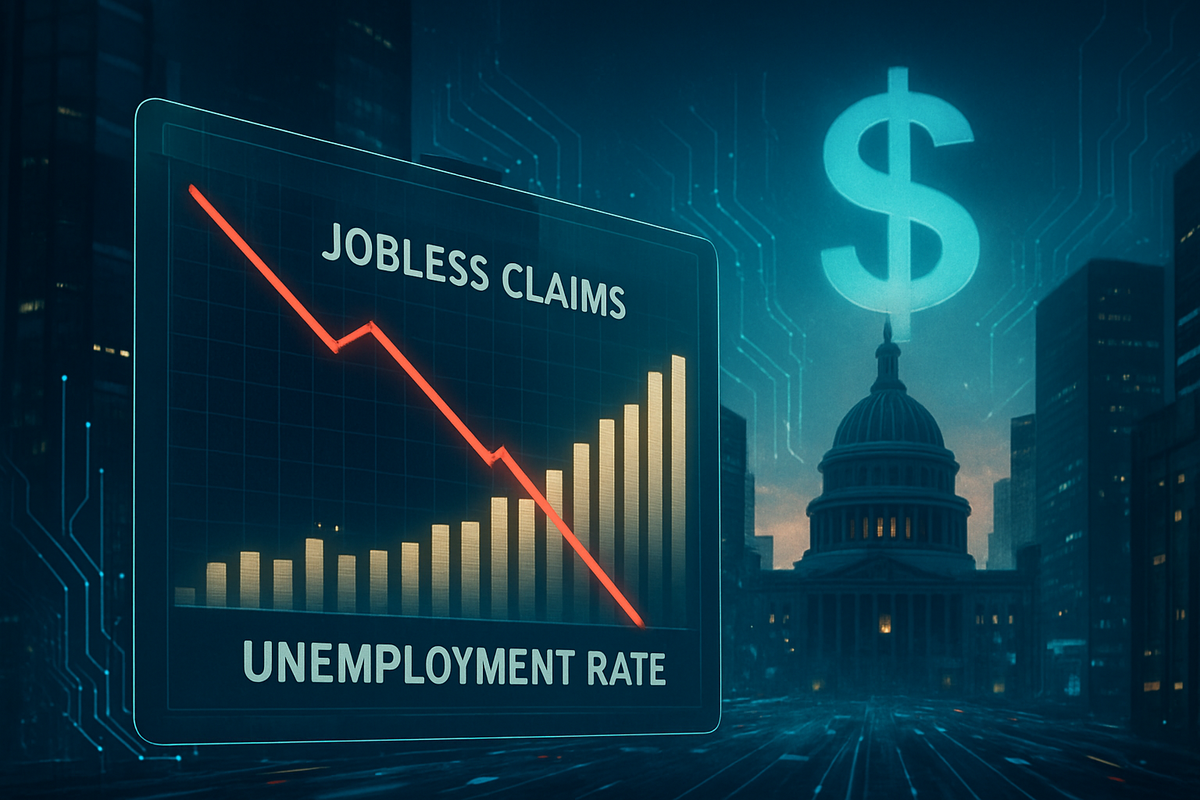
As the final trading bell of 2025 approaches, the U.S. labor market has delivered a confounding year-end gift to investors. Initial jobless claims for the week ending December 27 plummeted to a staggering 199,000, a level not seen in nearly half a century. This sharp decline in new filings for unemployment benefits has sent the U.S. Dollar Index (DXY) to a 14-month high, as currency traders bet on a "higher-for-longer" yield environment compared to global peers. However, the headline strength masks a complex internal rot: the broader unemployment rate has simultaneously climbed to 4.6%, driven by a massive reorganization of the federal workforce and a "white-collar recession" in the technology and retail sectors.
The immediate implication for Wall Street is a "good news is bad news" conundrum. While the low jobless claims suggest that private-sector layoffs remain historically rare, the resilience of the labor market is providing the Federal Reserve with the cover it needs to slow its pace of interest rate cuts. This has bolstered the Greenback but tightened the screws on multinational corporations that are already battling the headwinds of a resurgent tariff regime. As 2025 draws to a close, the market sentiment is one of "fragile optimism," where the sheer momentum of the American consumer is being weighed against structural shifts in government spending and global trade.
The December Distortion: A Timeline of the 43-Day Shutdown
The path to this week’s surprising labor data was paved by the most volatile fourth quarter in recent history. The primary catalyst was the 43-day government shutdown that paralyzed Washington from October 1 to November 12, 2025. During this period, nearly 900,000 federal employees were furloughed, and a "data blackout" left investors flying blind for over a month. When the government reopened, the backlog of economic reporting created a "whiplash effect," where initial jobless claims appeared artificially high in November before crashing to the current 199,000 low in late December.
Key to this volatility was the Department of Government Efficiency (DOGE), which utilized the shutdown period to implement a sweeping "4-to-1" hiring rule—terminating four federal workers for every one new hire. By the end of December, an estimated 300,000 federal positions had been eliminated. This mass exodus of specialized labor—ranging from data scientists to legal experts—is what pushed the headline unemployment rate to 4.6%, even as the private sector remained reluctant to let go of its own staff. Initial market reactions were polarized: bond yields spiked as the low claims data suggested a "no-landing" scenario, while the S&P 500 saw a rotation out of speculative growth and into defensive "cash-cow" equities.
Corporate Scorecard: Winners and Losers in a High-Dollar Economy
The divergence between low claims and high unemployment has created a bifurcated market for public companies. Large-cap financial institutions have emerged as the primary beneficiaries of the strong dollar and steady rates. JPMorgan Chase & Co. (NYSE: JPM) and Bank of America Corp. (NYSE: BAC) both saw their net interest margins expand in the final weeks of 2025, as the "higher-for-longer" narrative allowed them to maintain elevated loan pricing while their massive deposit bases remained relatively stable. Similarly, Palantir Technologies (NYSE: PLTR) surged toward the end of the year, capitalizing on a fractured geopolitical landscape and a wave of new federal AI contracts designed to automate the roles previously held by the recently laid-off federal workforce.
Conversely, the strength of the U.S. Dollar has become a lead weight for exporters and consumer discretionary brands. Nike (NYSE: NKE) and Lululemon (NASDAQ: LULU) have both faced significant margin compression as their overseas earnings are translated back into a dominant Greenback, coupled with the rising costs of Asian production due to new tariff structures. In the technology sector, the "AI honeymoon" has officially ended for some. Salesforce (NYSE: CRM) saw its shares stumble as investors grew weary of its monetization timeline, while Intel Corporation (NASDAQ: INTC) continued its multi-year slide, dropping further in December after major partners suspended testing of its next-generation process technologies.
Macro Significance: The "Jobless Expansion" and Policy Ripple Effects
The current state of the labor market represents a significant departure from historical precedents. Traditionally, a rise in the unemployment rate to 4.6% would be accompanied by a surge in initial jobless claims, signaling a recession. In 2025, we are witnessing a "jobless expansion," where companies are maintaining their current headcount but have almost entirely frozen new hiring. This trend is being exacerbated by the rapid maturation of AI infrastructure. Companies like NVIDIA (NASDAQ: NVDA), which hit a historic $5 trillion market cap in October 2025, are providing the tools for "labor-light" growth, allowing the private sector to expand productivity without the traditional need for massive recruitment drives.
The regulatory implications of this shift are profound. The Federal Reserve, led by Chairman Jerome Powell, is now navigating "two-sided risks" that were unthinkable a decade ago. The Fed must decide whether to cut rates to address the 4.6% unemployment rate (the "maximum employment" mandate) or keep rates steady to combat the "sticky" inflation generated by a strong consumer and new import duties. This policy tension has created a "volatility floor" for the markets, as every weekly jobless claims report is now scrutinized for any sign that the private sector is finally beginning to follow the government’s lead in downsizing.
The 2026 Outlook: A Pivot to Efficiency
Looking ahead to the first half of 2026, the primary challenge for the market will be the "absorption" of the displaced federal workforce. If these 300,000 workers can be successfully integrated into the private sector, the U.S. could see a "productivity boom" that sustains the current rally. However, if they remain unemployed, the 4.6% rate could quickly climb toward 5%, potentially triggering a consumer spending slowdown. Analysts expect a "strategic pivot" from major tech players like Microsoft (NASDAQ: MSFT), which faced a valuation wall in late December; the focus will shift from massive capital expenditure on AI to demonstrating clear, bottom-line efficiency gains.
Market opportunities in 2026 are likely to emerge in the "energy-for-AI" trade and domestic manufacturing. As the U.S. Dollar remains strong, domestic-focused companies that do not rely on international exports will likely outperform. Investors should also keep a close eye on the "secondary AI" tier—companies like Western Digital (NASDAQ: WDC) and Micron Technology (NASDAQ: MU)—which are benefiting from the insatiable demand for memory and storage required to fuel the automated economy.
Summary of the Year-End Market Landscape
As 2025 concludes, the U.S. economy stands at a historic crossroads. The decline in jobless claims to 199,000 is a testament to the underlying strength of the American private sector, yet the rising unemployment rate serves as a stark reminder of the structural upheavals currently underway. The U.S. Dollar’s dominance has provided a safe haven for global capital, but it has simultaneously created a challenging environment for the nation’s largest multinational exporters.
Moving into 2026, investors should remain vigilant regarding the Federal Reserve’s reaction function. The "soft landing" remains the consensus view, but the margin for error has narrowed significantly. The key metrics to watch in the coming months will be wage growth and the "quits rate"; if workers stop leaving their jobs voluntarily, it could signal that the labor market's "fragile resilience" is finally beginning to crack. For now, the market remains a "stock-picker's paradise," where the winners are defined by their ability to generate cash in a high-rate, high-dollar world.
This content is intended for informational purposes only and is not financial advice.