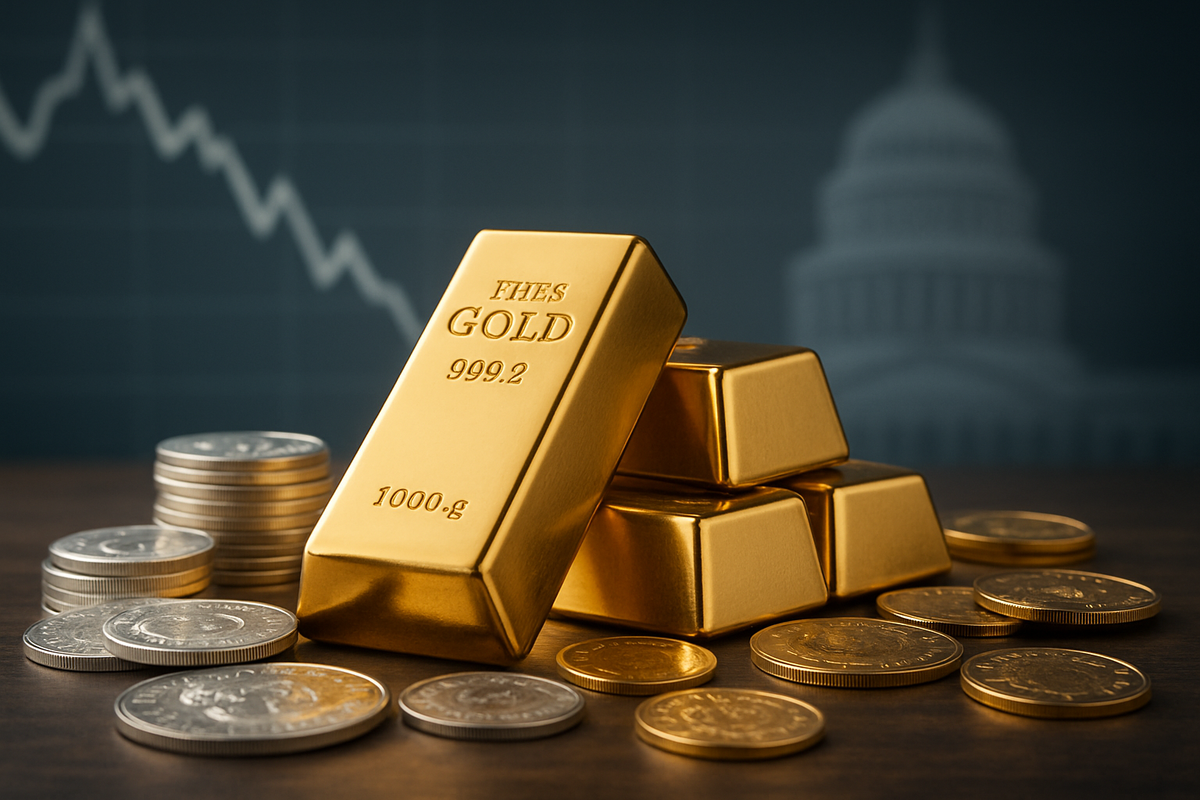
Precious metals markets are experiencing a significant rally, with gold prices nearing $4,200 an ounce and silver hitting a record high around $59 an ounce. This surge is primarily driven by unexpectedly weak private payrolls data, which has solidified market expectations of an imminent U.S. interest rate cut by the Federal Reserve. The confluence of a softening labor market and the prospect of looser monetary policy has ignited a flight to safety and an increased appetite for non-yielding assets, signaling a notable shift in investor sentiment and potentially reshaping the economic outlook.
The immediate implication for the financial markets is a pronounced strengthening of gold and silver, a depreciation of the U.S. dollar, and a retreat in U.S. bond yields. As investors recalibrate their portfolios in anticipation of lower borrowing costs, the appeal of precious metals as a hedge against inflation and economic uncertainty is amplified, setting the stage for potential further volatility and strategic adjustments across various sectors.
Precious Metals Shine Amidst Soft Labor Market and Dovish Fed Signals
The recent rally in gold and silver prices has been directly catalyzed by a series of economic indicators pointing to a cooling U.S. labor market. Most notably, the November ADP employment report revealed an unexpected loss of 32,000 jobs in the private sector. This figure starkly contrasted with market forecasts that had anticipated job gains, sending a clear signal to investors that the U.S. economy might be losing momentum. This weakening employment landscape provides the Federal Reserve with substantial justification to pivot towards a more accommodative monetary policy.
The timeline of events leading to this moment has seen a gradual build-up of dovish sentiment. For months, the market has been keenly watching for signs of economic deceleration that would prompt the Fed to ease its aggressive rate-hiking cycle. The release of softer-than-expected inflation data in previous periods, coupled with cautious statements from various Federal Reserve officials, laid the groundwork for the current expectations. However, it was the definitive weakness in the latest payroll data that truly cemented the market's conviction.
Key players and stakeholders involved in this scenario include the Federal Reserve, whose upcoming monetary policy decisions are paramount; institutional investors and hedge funds, who are actively repositioning their portfolios; and individual investors seeking safe-haven assets. The initial market reaction has been swift and decisive: a significant upward movement in precious metal prices, a weakening of the U.S. Dollar, and a noticeable retreat in U.S. Treasury yields. This indicates that a potential 25 basis point (bps) rate reduction at the Fed's upcoming meeting on December 9-10, 2025, is now largely priced in, with probabilities ranging between 87% and 92%. This meeting, occurring just days after the current date of December 3, 2025, is now the focal point for market participants. The robust central bank demand for gold, with a net purchase of 53 tonnes in October, also continues to provide a strong underlying support for prices.
Corporate Fortunes Tied to Rate Cuts and Precious Metal Performance
The anticipated Federal Reserve interest rate cuts, spurred by weak private payrolls data and the subsequent surge in gold and silver prices, are set to create distinct winners and losers across the corporate landscape. Companies whose business models are sensitive to interest rates and commodity prices will experience the most direct impact.
Mining companies specializing in gold and silver extraction are poised to be significant beneficiaries. As the price of their primary products rises, their revenue and profit margins are likely to expand considerably. Companies such as Barrick Gold Corp. (NYSE: GOLD), Newmont Corporation (NYSE: NEM), and Fresnillo PLC (LSE: FRES) could see their stock valuations appreciate as investor confidence in the precious metals sector grows. Higher metal prices also provide these companies with increased capital for exploration and development, potentially leading to future production growth. Furthermore, lower interest rates could reduce their borrowing costs, further enhancing profitability, especially for those with substantial debt loads or ongoing capital-intensive projects.
Conversely, sectors that thrive in a higher interest rate environment or are negatively impacted by a weaker dollar might face headwinds. Financial institutions, particularly banks, could see their net interest margins (NIM) squeezed as lending rates fall. While lower rates can stimulate borrowing, the immediate impact on profitability for some banks might be negative if their cost of funds does not decrease proportionally. Companies with significant international operations that primarily deal in U.S. dollars might also experience adverse effects from a weakening dollar, as their foreign earnings translate into fewer dollars. However, for companies that export goods, a weaker dollar could make their products more competitive in international markets, potentially boosting sales.
Beyond direct commodity exposure, companies that rely heavily on consumer spending or capital investment could indirectly benefit from lower interest rates. Reduced borrowing costs for consumers and businesses might stimulate economic activity, leading to increased sales for retailers, automakers, and housing-related industries. However, the underlying reason for the rate cut – weak payrolls data – suggests a broader economic slowdown, which could offset some of these potential gains. Therefore, the overall impact will depend on the balance between the stimulative effect of lower rates and the depressive effect of a slowing economy. Investors will be closely watching the upcoming earnings reports of these companies for insights into how they are navigating this evolving economic landscape.
Broader Implications: A Shift Towards Safe Havens and Economic Rebalancing
The current surge in gold and silver prices, catalyzed by weak private payrolls and reinforced expectations of a Federal Reserve rate cut, signifies a broader shift in market dynamics and investor sentiment. This event fits squarely into the ongoing trend of increasing demand for safe-haven assets amidst global economic uncertainties and geopolitical tensions. As traditional growth engines show signs of faltering, particularly in the labor market, investors are increasingly turning to precious metals as a store of value and a hedge against inflation and currency devaluation. This trend is not new, but the current data points provide a strong impetus for its acceleration.
The potential ripple effects on competitors and partners are substantial. In the mining sector, rising gold and silver prices could encourage smaller exploration companies to seek new capital, potentially leading to increased mergers and acquisitions as larger players look to expand their reserves. For industries reliant on these metals, such as jewelry manufacturers or electronics companies (many of which are private, but public companies like Apple Inc. (NASDAQ: AAPL) and Samsung Electronics Co., Ltd. (KRX: 005930) use silver in their products), higher input costs could impact profit margins unless they can pass these costs onto consumers. This could lead to innovation in material science to find cheaper alternatives or a strategic focus on premium products where higher costs are more easily absorbed.
From a regulatory and policy perspective, a sustained period of lower interest rates could lead to renewed debates about fiscal stimulus and government spending. If monetary policy alone proves insufficient to re-ignite economic growth, there could be calls for increased government intervention to support employment and demand. Historically, periods of significant economic slowdown and interest rate cuts have often been followed by such policy shifts. For instance, the responses to the 2008 financial crisis and the COVID-19 pandemic saw unprecedented levels of both monetary and fiscal easing, providing a precedent for potential future actions. The current situation, while not as severe as those crises, suggests a similar underlying concern about economic stability.
Furthermore, the weakening U.S. dollar, a direct consequence of rate cut expectations, has significant international implications. It makes U.S. exports more competitive but also makes imports more expensive, potentially contributing to domestic inflation. For countries holding large reserves of U.S. dollar-denominated assets, a depreciating dollar could impact their national wealth, potentially prompting them to diversify their reserves further into other currencies or assets like gold, thereby reinforcing the current trend in precious metal demand.
Navigating the Path Ahead: Opportunities and Challenges
Looking ahead, the short-term outlook for gold and silver remains bullish, particularly in the immediate aftermath of the anticipated Federal Reserve rate cut on December 9-10, 2025. With a rate reduction largely priced in, the market's reaction will hinge on the accompanying guidance from the Federal Open Market Committee (FOMC). Any signals of further dovishness or a commitment to additional cuts could propel precious metal prices even higher, as the opportunity cost of holding non-yielding assets diminishes further. Conversely, a surprisingly hawkish tone, or a hint that this might be a one-off adjustment, could introduce volatility and temper the rally.
In the long term, the trajectory of gold and silver will be closely tied to the broader economic recovery and inflation outlook. If the rate cuts successfully stimulate the economy and lead to renewed growth without significant inflation, the appeal of safe-haven assets might gradually wane. However, if the economy remains sluggish or if the easing of monetary policy triggers inflationary pressures, precious metals could maintain their elevated status as a hedge against currency debasement. Potential strategic pivots for investors include increasing allocations to gold and silver ETFs (SPDR Gold Shares (NYSEARCA: GLD), iShares Silver Trust (NYSEARCA: SLV)) or direct investments in mining companies, while potentially reducing exposure to interest-rate sensitive sectors that may face margin compression.
Market opportunities may emerge in industries that benefit from lower borrowing costs, such as real estate, certain segments of the technology sector, and infrastructure development, assuming the broader economic slowdown is contained. However, significant challenges remain, primarily the risk of a deeper economic recession if the weak payroll data is a harbinger of more widespread economic weakness. This could lead to a 'stagflationary' environment, where growth is stagnant but inflation persists, a scenario that historically favors precious metals. Investors should closely monitor upcoming economic data, including the delayed September Personal Consumption Expenditures (PCE) Index, for further clues on the Fed's long-term policy direction and the health of the U.S. economy.
Market Recalibration: A New Era for Precious Metals
The recent surge in gold and silver prices, driven by weak private payrolls data and the subsequent reinforcement of Federal Reserve rate cut expectations, marks a pivotal moment in the financial markets. The key takeaway is a clear shift in the Fed's likely focus from aggressive inflation containment to supporting a softening labor market and economic growth. This policy pivot has significantly altered the investment landscape, making non-yielding precious metals considerably more attractive as real interest rates decline.
Moving forward, the market is entering a period of recalibration. Investors are actively unwinding positions in assets that thrived during the higher-for-longer interest rate regime and rotating into those poised to benefit from looser monetary policy. The strong performance of gold and silver is not merely a fleeting reaction but potentially the start of a more sustained trend, particularly if global economic uncertainties persist and central banks continue to diversify their reserves. The record high for silver, in particular, highlights its dual role as both a safe haven and an industrial metal, suggesting robust demand from multiple fronts.
The lasting impact of this event will depend on the duration and extent of the Fed's easing cycle, as well as the broader economic response. What investors should watch for in the coming months includes the actual outcome of the December 9-10 FOMC meeting, subsequent economic data releases (especially employment and inflation figures), and any further guidance from Federal Reserve officials regarding future rate decisions. The interplay between monetary policy, economic performance, and geopolitical stability will ultimately dictate the long-term trajectory of precious metals and the broader financial markets.
This content is intended for informational purposes only and is not financial advice