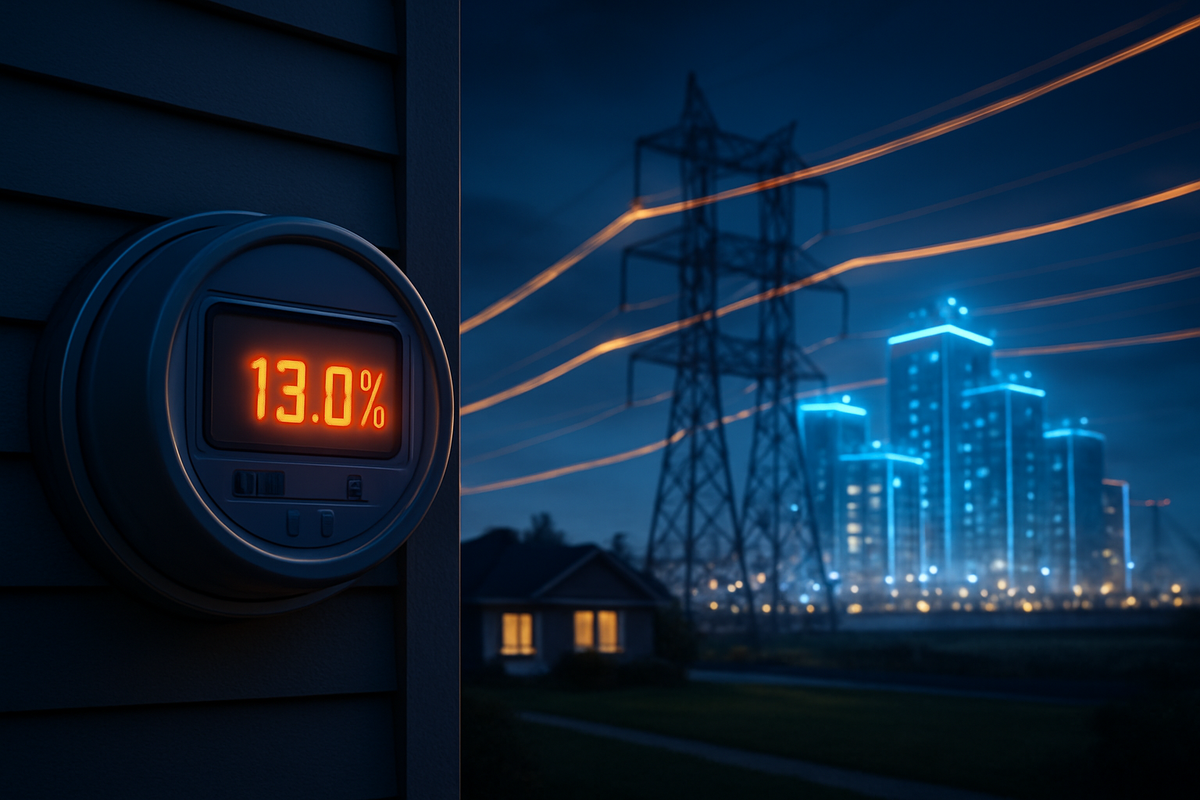
As American households gathered for the 2025 holiday season, many faced an unwelcome guest: a significantly higher monthly electric bill. New data confirms that national residential electricity costs have surged by a staggering 13% over the last twelve months. While this increase has strained consumer budgets, it has simultaneously ignited a historic rally in the utilities sector, transforming these traditionally "boring" stocks into some of the market's top performers.
The divergence between consumer pain and investor gain has never been more pronounced. As of December 25, 2025, the Utilities Select Sector SPDR Fund (NYSEARCA: XLU) and the Vanguard Utilities ETF (NYSEARCA: VPU) have both posted year-to-date gains of nearly 20%, outperforming many high-growth tech sectors. This phenomenon is driven by a fundamental shift in the utility business model, where massive capital investments in the power grid are being directly translated into guaranteed corporate profits.
The Perfect Storm: Infrastructure, AI, and the 13% Spike
The 13% national rise in electric bills throughout 2025 was not the result of a single factor, but rather a "perfect storm" of aging infrastructure, climate-related recovery costs, and an unprecedented surge in demand from the artificial intelligence (AI) revolution. Throughout the year, regional markets—particularly in the Mid-Atlantic and Northeast—saw even more dramatic spikes. In the PJM Interconnection region, which serves 65 million people, capacity prices jumped ten-fold, contributing to a $9.3 billion increase in costs that eventually trickled down to the consumer level.
A primary driver has been the massive build-out of generative AI data centers, which require constant, "firm" power 24/7. To accommodate this, utilities have had to fast-track multi-billion-dollar grid modernization projects. Under the regulated utility model, these companies do not just recover the costs of these projects; they are legally permitted to earn a set "Return on Equity" (ROE) on their "rate base"—the total value of their infrastructure. Consequently, the more a utility spends on upgrading the grid to support AI, the more profit it is authorized to collect from its customers.
The Winners: Companies Charging Ahead
Several key players have emerged as the primary beneficiaries of this capital expenditure cycle. NextEra Energy (NYSE: NEE), the world’s largest renewable energy company, reported a 25% year-over-year increase in net income by mid-2025. Its subsidiary, Florida Power & Light, successfully negotiated a historic rate settlement to fund an $86 billion capital plan, ensuring a steady stream of revenue through the end of the decade. NextEra’s strategic pivot toward nuclear energy, including a 25-year deal with Google to restart the Duane Arnold plant, has further solidified its position as an "AI-ready" utility.
Similarly, Southern Company (NYSE: SO) saw its third-quarter profits soar 11.5% to $1.71 billion. The company’s growth is largely tethered to the "data center alley" expanding across Georgia, where electricity usage from large-scale industrial loads jumped by 17%. To keep pace, Southern Company expanded its five-year capital plan to $76 billion. Meanwhile, Duke Energy (NYSE: DUK) reported nearly $1 billion in quarterly profits by mid-year, driven by a $10 billion partnership with Amazon. In late 2025, Duke sought a 15% rate hike in North Carolina, specifically aimed at increasing its allowed ROE to attract the capital necessary for further expansion.
Analyzing the Shift: AI as a Utility Growth Engine
This event represents a fundamental shift in how the market views the utilities sector. Historically, utilities were treated as "bond proxies"—safe, slow-growing investments that investors held for dividends. However, in 2025, they have been re-rated as "AI infrastructure plays." This trend is likely to have significant ripple effects. As utilities prioritize high-demand data centers, industrial and residential competitors may face higher costs and potential service constraints, leading to a new era of "energy protectionism" at the state level.
The regulatory landscape is also evolving. While many state commissions have historically been lenient with rate hikes to encourage green energy transitions, the 13% spike in 2025 has begun to trigger a "rate-payer revolt." Regulatory bodies are now under intense pressure to balance the financial health of utilities with the affordability of basic services. We are seeing the first signs of this in states like Maryland and New York, where lawmakers are proposing caps on how much of the "AI build-out" cost can be shifted onto residential consumers versus the tech giants themselves.
The Road Ahead: Short-Term Gains vs. Long-Term Risks
Looking toward 2026, the short-term outlook for utility ETFs remains bullish. The massive backlog of data center connections provides a clear "earnings floor" for the next several years. However, the sector faces a potential strategic pivot. If interest rates remain elevated, the cost of financing these multi-billion-dollar projects could eat into profit margins, despite the authorized ROE. Investors should watch for a shift toward "behind-the-meter" solutions, where large tech companies build their own microgrids, potentially bypassing traditional utilities and leaving residential customers to shoulder a larger share of the existing grid’s fixed costs.
Another emerging scenario is the potential for federal intervention. If energy inflation continues to outpace general inflation, the Department of Energy may implement new mandates regarding "equitable rate design." This could force utilities to offer lower rates to low-income households while charging premium "AI surcharges" to data center operators—a move that would please the public but could complicate the predictable earnings models that investors currently enjoy.
Conclusion: A New Era for the Power Sector
The 13% rise in electric bills in 2025 marks a turning point for the American energy landscape. For consumers, it is a period of adjustment to the high costs of a digital and green transition. For investors, it has validated the utilities sector as a cornerstone of the modern "picks and shovels" investment strategy. The success of ETFs like XLU and VPU reflects a market that finally understands that the AI revolution cannot happen without a massive, and expensive, expansion of the power grid.
Moving forward, the key metric for investors will be "Regulatory Lag"—the time it takes for a utility to turn a capital investment into a rate hike. Companies like NextEra Energy and Southern Company that have successfully streamlined this process are likely to continue their outperformance. However, the growing tension between corporate profits and consumer affordability suggests that the "easy money" in utility rate hikes may soon face its toughest challenge yet from regulators and the voting public.
This content is intended for informational purposes only and is not financial advice.