
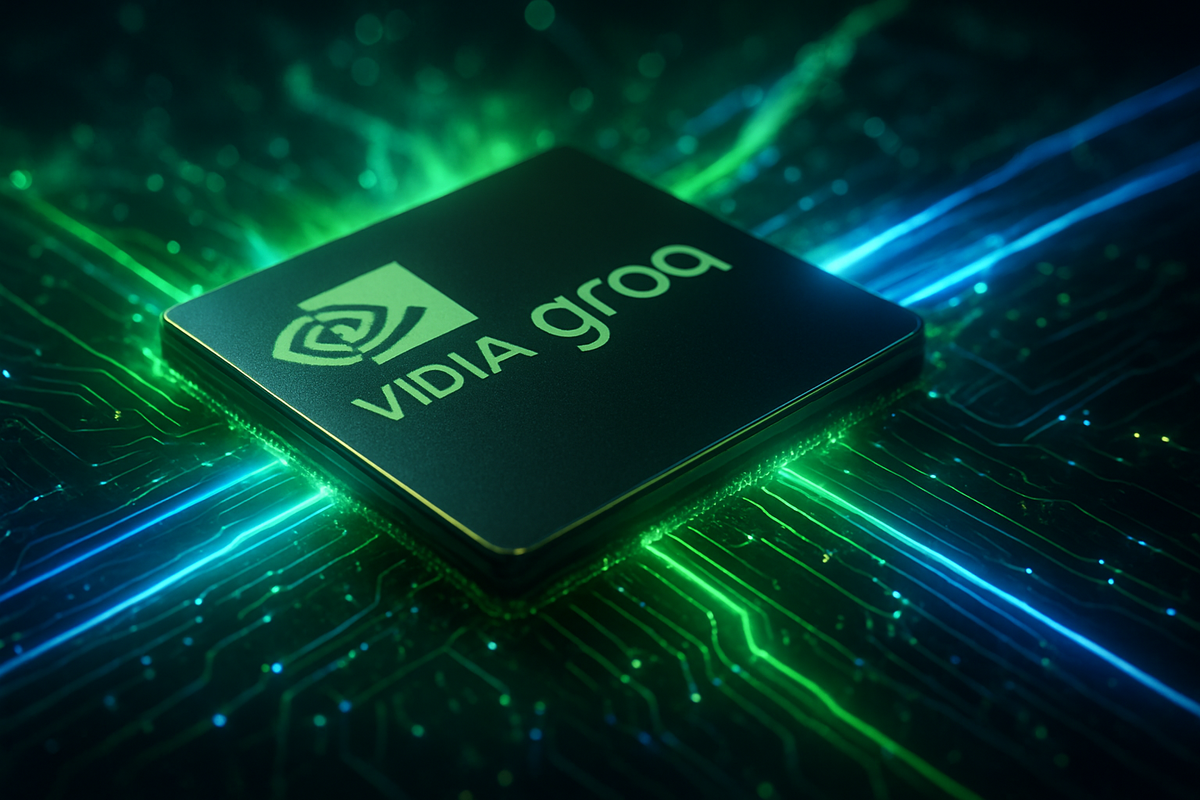
In a move that has sent shockwaves through Silicon Valley and Wall Street alike, Nvidia (NASDAQ: NVDA) announced a landmark $20 billion licensing agreement and strategic "acqui-hire" of AI chip disruptor Groq on December 24, 2025. The deal, finalized just as the market closed for the holiday break, represents the most significant consolidation of AI hardware power since the start of the generative AI boom. By integrating Groq’s high-speed Language Processing Unit (LPU) technology into its own massive ecosystem, Nvidia is positioning itself to dominate the "inference era"—the phase where AI models are deployed at scale rather than just trained.
The immediate implications of this deal are profound. Nvidia is no longer just the king of AI training; it has effectively neutralized its most credible threat in the ultra-low-latency inference market. As the industry pivots toward real-time "agentic" AI and digital humans, the ability to process tokens at lightning speed has become the new gold standard. With this deal, Nvidia has not only secured the intellectual property necessary to maintain its lead but has also absorbed the engineering talent responsible for the world’s fastest inference architecture, setting the stage for a massive showcase at the upcoming CES 2026.
The "Inference Play of the Decade": Inside the $20 Billion Deal
The agreement, valued at roughly $20 billion, is structured as a non-exclusive licensing deal paired with a massive "acqui-hire" of Groq’s core leadership and engineering teams. This complex structure was reportedly chosen to navigate the increasingly treacherous waters of global antitrust regulation. Under the terms, Groq’s founder and CEO Jonathan Ross—a primary architect of the original Google (NASDAQ: GOOGL) TPU—and President Sunny Madra will join Nvidia’s executive ranks. Meanwhile, Groq will continue to operate as an independent entity under new CEO Simon Edwards to maintain its existing cloud service contracts and avoid direct competition with Nvidia’s primary data center customers.
The timeline leading up to this moment was characterized by a quiet but intense bidding war. Throughout late 2025, Groq had seen its valuation soar to nearly $7 billion as its LPU technology consistently outperformed Nvidia’s Blackwell architecture in raw inference speed for large language models (LLMs). Recognizing that the "memory wall" of traditional GPU architectures was becoming a bottleneck for real-time applications, Nvidia CEO Jensen Huang moved decisively to bring Groq’s deterministic Tensor Streaming Processor (TSP) architecture into the fold. The deal was reportedly fast-tracked in November after Groq demonstrated a 10x speed advantage in "prefill" latency for the latest Llama 4 models.
Market reaction has been overwhelmingly bullish, though tinged with awe at Nvidia's aggressive tactics. Analysts have dubbed the move the "Inference Play of the Decade," noting that it effectively closes the gap in Nvidia’s hardware stack. By merging the parallel throughput of GPUs with the sequential speed of LPUs, Nvidia is creating a heterogeneous computing platform that competitors will find nearly impossible to replicate. The timing, just days before the 2026 Consumer Electronics Show (CES), suggests that Nvidia is preparing to unveil a new category of "Inference-First" hardware that could redefine the personal computing and data center markets simultaneously.
Winners and Losers: A New Hierarchy in Silicon
The clear winner in this transaction is Nvidia (NASDAQ: NVDA), which saw its market capitalization hover between $4.6 trillion and $5.1 trillion in the wake of the news. By absorbing Groq’s IP, Nvidia has effectively "locked in" the developer ecosystem, making it difficult for any other hardware provider to offer a more cost-effective or faster alternative for real-time AI. Furthermore, the integration of Groq’s technology into the upcoming "Vera Rubin" architecture ensures that Nvidia’s next generation of chips will be optimized for the types of "agentic" AI workflows that are expected to dominate 2026.
Conversely, the deal is a staggering blow to Advanced Micro Devices (NASDAQ: AMD) and Intel (NASDAQ: INTC). Both companies had spent much of 2025 positioning their respective MI350 and Gaudi 4 chips as "inference-optimized" alternatives to Nvidia’s training-heavy GPUs. With Nvidia now owning the premier inference technology on the market, the competitive "moat" for AMD and Intel has widened significantly. Smaller AI chip startups like Cerebras and Sambanova also face an uphill battle, as the Nvidia-Groq combination sets a performance benchmark that requires massive capital and scale to challenge.
On the software and cloud side, the winners include major Nvidia partners like Microsoft (NASDAQ: MSFT) and Amazon (NASDAQ: AMZN), who will be the first to gain access to the integrated LPU-GPU clusters. These "super-clusters" will allow cloud providers to offer significantly lower costs per token, accelerating the adoption of AI applications across the enterprise. However, some industry observers worry that this consolidation will lead to a "silicon monopoly" that could eventually drive up licensing costs for smaller developers who cannot afford the premium for Nvidia’s top-tier hardware.
Wider Significance: The Shift to Physical and Agentic AI
This event fits into a broader industry trend where the focus of AI investment is shifting from the "training phase" to the "deployment phase." In 2024 and early 2025, the primary challenge was building larger and more capable models. In late 2025 and heading into 2026, the challenge is making those models run fast enough and cheaply enough to be used in everyday devices, from autonomous robots to real-time translation earpieces. Nvidia’s acquisition of LPU technology is a direct response to this shift, acknowledging that the future of AI is "always-on" and "low-latency."
The regulatory implications of the deal are also significant. By choosing a licensing and acqui-hire model rather than a full merger, Nvidia has created a blueprint for how Big Tech can continue to consolidate power without triggering immediate "stop" orders from the FTC or the European Commission. This "stealth acquisition" strategy may become the new norm for market leaders looking to absorb disruptive competitors. Historically, this mirrors the way Cisco or Microsoft expanded their dominance in the 1990s and 2000s, by systematically acquiring the "best-of-breed" technology in emerging niches before they could grow into existential threats.
Furthermore, the deal highlights the critical importance of SRAM and deterministic architecture in the next phase of computing. While High Bandwidth Memory (HBM) has been the darling of the GPU world, Groq’s use of on-chip SRAM to eliminate memory bottlenecks has proven that architectural innovation is just as important as raw transistor count. This move likely signals the end of the "GPU-only" era and the beginning of a more fragmented, specialized hardware landscape—albeit one where Nvidia still owns the most important pieces of the puzzle.
Future Outlook: CES 2026 and the Rubin Era
Looking ahead to CES 2026, all eyes are on Jensen Huang’s keynote scheduled for January 5. The industry expects the formal unveiling of the Rubin R100 platform, which is rumored to feature a new class of processor called the Rubin CPX (Context Processing Unit). This chip is expected to be the first fruit of the Groq deal, leveraging LPU technology to handle the "prefill" phase of AI queries with unprecedented speed. If these rumors hold true, the Rubin CPX could make real-time, human-like interaction with AI assistants a standard feature of every high-end PC and server.
In the short term, Nvidia is also expected to refresh its consumer lineup with the RTX 50 SUPER series. These cards will likely feature expanded GDDR7 memory capacities to handle the larger context windows of 2026-era LLMs. Beyond hardware, the strategic pivot toward "Physical AI"—the integration of AI into robotics and industrial automation—will be a major theme. Nvidia’s "Project GR00T" for humanoid robots is expected to receive a massive boost from Groq’s low-latency tech, as robots require sub-millisecond response times to interact safely and naturally with human environments.
The long-term challenge for Nvidia will be managing its own success. As it becomes the singular gatekeeper for AI hardware, it will face increasing pressure to remain "open" to different software frameworks while simultaneously pushing its proprietary CUDA ecosystem. Market opportunities in sovereign AI—where nations build their own domestic AI infrastructure—remain a massive tailwind, but geopolitical tensions and export controls will continue to be the primary "black swan" risks for the stock’s momentum.
Summary and Investor Takeaways
The Nvidia-Groq deal is a masterstroke of defensive and offensive strategy. By spending $20 billion to secure the future of inference, Nvidia has effectively reset the clock on its competitors, who now find themselves chasing a target that has once again moved out of reach. For investors, the key takeaway is that Nvidia’s growth story is transitioning from "AI hype" to "AI utility." The company is no longer just selling chips; it is selling the fundamental infrastructure of the 21st-century economy.
Moving forward, the market will be watching for the first benchmarks of the integrated Groq-Nvidia hardware and the reception of the Rubin architecture at CES 2026. If Nvidia can successfully "CUDA-fy" Groq’s compilers and provide a seamless experience for developers, the stock’s momentum is likely to carry it toward the $300 mark by mid-2026. However, investors should remain vigilant regarding regulatory pushback and the potential for a "digestion period" in capital expenditures from the big cloud providers. For now, Nvidia remains the undisputed titan of the AI age, with its latest move ensuring that the "Inference Revolution" will be powered by green silicon.
This content is intended for informational purposes only and is not financial advice