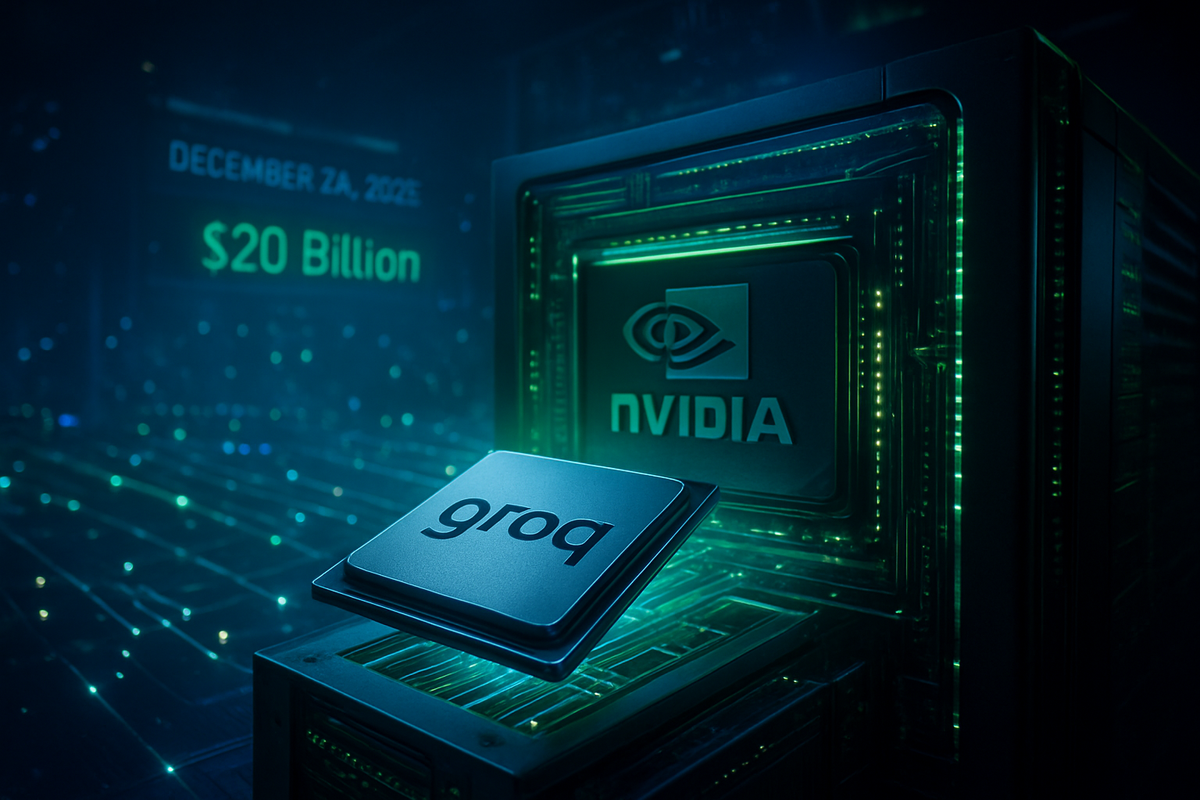
In a move that has sent shockwaves through Silicon Valley and global financial markets on this Christmas Eve, NVIDIA (NASDAQ: NVDA) has reportedly entered into a definitive agreement to acquire the high-performance AI chip startup Groq for a staggering $20 billion. This all-cash transaction marks the largest acquisition in Nvidia’s history, dwarfing its $6.9 billion purchase of Mellanox in 2020 and signaling a ruthless strategic pivot to maintain its iron grip on the rapidly evolving artificial intelligence landscape.
The deal, which leaked early on December 24, 2025, focuses on securing Groq’s proprietary Language Processing Unit (LPU) technology—a specialized architecture that has become the gold standard for AI inference. As the industry shifts from the "build-out" phase of training massive models to the "utilization" phase of real-time deployment, Nvidia’s acquisition is seen as a definitive attempt to neutralize its most potent specialized competitor and integrate ultra-low-latency hardware into its dominant data center portfolio.
The Architecture of a Power Move: Inside the $20 Billion Deal
The acquisition of Groq represents a significant escalation in the "chip wars" of 2025. According to reports, the $20 billion price tag is nearly a 3x premium over Groq’s last private valuation of $6.9 billion recorded just three months ago. While the deal includes all of Groq’s hardware assets, intellectual property, and its elite engineering team, it notably excludes Groq’s nascent cloud business, which will reportedly remain an independent entity. This structural nuance is likely a strategic attempt to avoid direct competition with Nvidia’s largest customers—the hyperscale cloud providers—while still securing the core technology that makes Groq’s chips up to five times faster than traditional GPUs for language tasks.
The timeline leading up to this moment has been one of frantic acceleration. Throughout 2025, Groq emerged as the "inference king," winning massive contracts with enterprises looking to deploy real-time AI agents. While Nvidia’s Blackwell architecture remained the undisputed leader for training, Groq’s LPU offered a deterministic, software-first approach that eliminated the latency bottlenecks inherent in graphics-based hardware. By mid-December, rumors began to swirl that both Amazon (NASDAQ: AMZN) and Google (NASDAQ: GOOGL) were also in talks to acquire Groq to bolster their internal silicon efforts, forcing Nvidia’s CEO Jensen Huang to move decisively with a "pre-emptive strike" offer that Groq’s board ultimately found impossible to refuse.
Initial market reactions have been characterized by a mix of awe and strategic caution. In a shortened holiday trading session, Nvidia’s stock dipped a marginal 0.32% to $188.61, a move analysts attributed to year-end profit-taking rather than skepticism. The broader sentiment among industry insiders is that Nvidia has successfully "bought the future" of inference, closing the only meaningful gap in its product roadmap before competitors could capitalize on it.
The Shifting Leaderboard: Winners and Losers in the Wake of the Deal
The clear winner in this transaction is Nvidia, which now possesses a vertical monopoly on the most critical stages of the AI lifecycle. By integrating Groq’s LPU technology, Nvidia can offer a tiered hardware stack: Blackwell and the upcoming Rubin architectures for massive training clusters, and Groq-powered modules for the ultra-fast inference required by autonomous systems and real-time digital humans. This effectively "locks in" the developer ecosystem, making the transition from training on CUDA to deploying on LPU a seamless, all-Nvidia experience.
Conversely, the acquisition is a significant blow to Advanced Micro Devices (NASDAQ: AMD) and Intel (NASDAQ: INTC). Both companies had spent 2025 positioning their respective MI350 and Gaudi 3 chips as the "inference-optimized" alternatives to Nvidia’s high-cost training GPUs. With Groq’s technology now under Nvidia’s roof, the window for AMD and Intel to claim leadership in the specialized inference market has narrowed considerably. They now face a competitor that not only has the largest scale but also the fastest specialized hardware for the world’s most popular AI models.
Hyperscalers like Alphabet (NASDAQ: GOOGL) and Amazon (NASDAQ: AMZN) also find themselves in a complex position. While they continue to develop their own custom silicon like the TPU v6 and Inferentia3, the Nvidia-Groq merger raises the bar for what "state-of-the-art" inference looks like. These cloud giants may be forced to continue purchasing Nvidia hardware at a premium to satisfy customer demand for the lowest possible latency, further entrenching the "Nvidia tax" they have desperately tried to avoid.
A New Regulatory Reality and the Inference Tipping Point
The significance of this deal extends far beyond corporate balance sheets; it reflects a fundamental shift in the AI market. In 2025, for the first time in history, global revenue from AI inference officially surpassed revenue from AI training. The world has moved from asking "how do we build AI?" to "how do we run AI at scale?" Nvidia’s acquisition of Groq is a recognition that the next decade of growth will be defined by the efficiency and speed of model execution, rather than just the brute force of training.
However, the path to closing this deal is fraught with regulatory landmines. Unlike the failed $40 billion bid for Arm in 2020, Nvidia is navigating a different political climate in late 2025. While the U.S. Federal Trade Commission (FTC) under the current administration has shown a more lenient stance toward domestic mergers that bolster American technological leadership against China, the deal still faces intense scrutiny as a potential "killer acquisition." Regulators in the European Union and China’s State Administration for Market Regulation (SAMR) are expected to be far more hostile, potentially demanding that Nvidia keep Groq’s technology open to competitors or imposing strict behavioral remedies.
Historically, this deal mirrors the consolidation seen in the early days of the microprocessor and networking industries. Just as Cisco (NASDAQ: CSCO) maintained its dominance through a string of strategic acquisitions in the 1990s, Nvidia is using its massive market capitalization to absorb any startup that threatens its perimeter. The "China Factor" also looms large, as Beijing may use its regulatory power to block the deal in retaliation for tightening U.S. export controls on high-end AI silicon.
The Road Ahead: Integration and the Rubin Revolution
In the short term, the industry will be watching how Nvidia integrates Groq’s deterministic architecture into its existing software stack. The immediate challenge will be the "CUDA-fication" of Groq’s compilers. If Nvidia can successfully allow developers to port their models from Blackwell GPUs to Groq LPUs with a single click, they will have created an impenetrable moat. We can expect to see the first "Nvidia-Groq" hybrid systems announced as early as the Computex trade show in mid-2026.
Looking further ahead, the acquisition is likely a foundational piece of Nvidia’s "Vera Rubin" architecture, slated for mass production in late 2025 and early 2026. The Rubin R100 platform is designed to be more than just a chip; it is a rack-level system optimized for Artificial Superintelligence (ASI). By incorporating Groq’s LPU tech into the Rubin ecosystem, Nvidia could potentially deliver a 10x improvement in "time-to-first-token," a metric that is becoming the primary differentiator for agentic AI applications that require human-like responsiveness.
The strategic pivot required by Nvidia’s rivals will be immense. Startups like Cerebras and SambaNova, which remain independent, may now become prime acquisition targets for the likes of Microsoft (NASDAQ: MSFT) or Meta (NASDAQ: META) as they scramble to keep pace with Nvidia’s hardware-software verticalization. The market is no longer just about who has the most HBM4 memory; it is about who can orchestrate the entire data flow from the moment a user asks a question to the millisecond the AI answers.
Conclusion: The Final Piece of the AI Puzzle
Nvidia’s $20 billion acquisition of Groq is more than just a record-breaking financial transaction; it is a declaration of intent. By securing the world’s fastest inference technology on the eve of 2026, Nvidia has effectively declared that it intends to own the "execution layer" of the AI economy just as firmly as it owns the "creation layer." The deal highlights the company’s agility and its willingness to spend aggressively to eliminate even the smallest threats to its dominance.
For the market, the message is clear: the era of specialized AI hardware is being subsumed by the era of the AI platform. Investors should closely monitor the regulatory approval process over the next six months, particularly the response from Chinese and European authorities. Any significant delay or forced divestiture could provide a much-needed opening for competitors. However, if the deal proceeds as planned, Nvidia will enter 2026 with a product portfolio that is arguably the most formidable in the history of the semiconductor industry.
As we move into the new year, the focus for investors will shift from "GPU supply" to "Inference efficiency." The companies that can deliver real-time AI at the lowest cost-per-token will be the victors of the next phase of the AI revolution. With Groq in its stable, Nvidia has just placed a $20 billion bet that it will be the one leading the charge.
This content is intended for informational purposes only and is not financial advice.