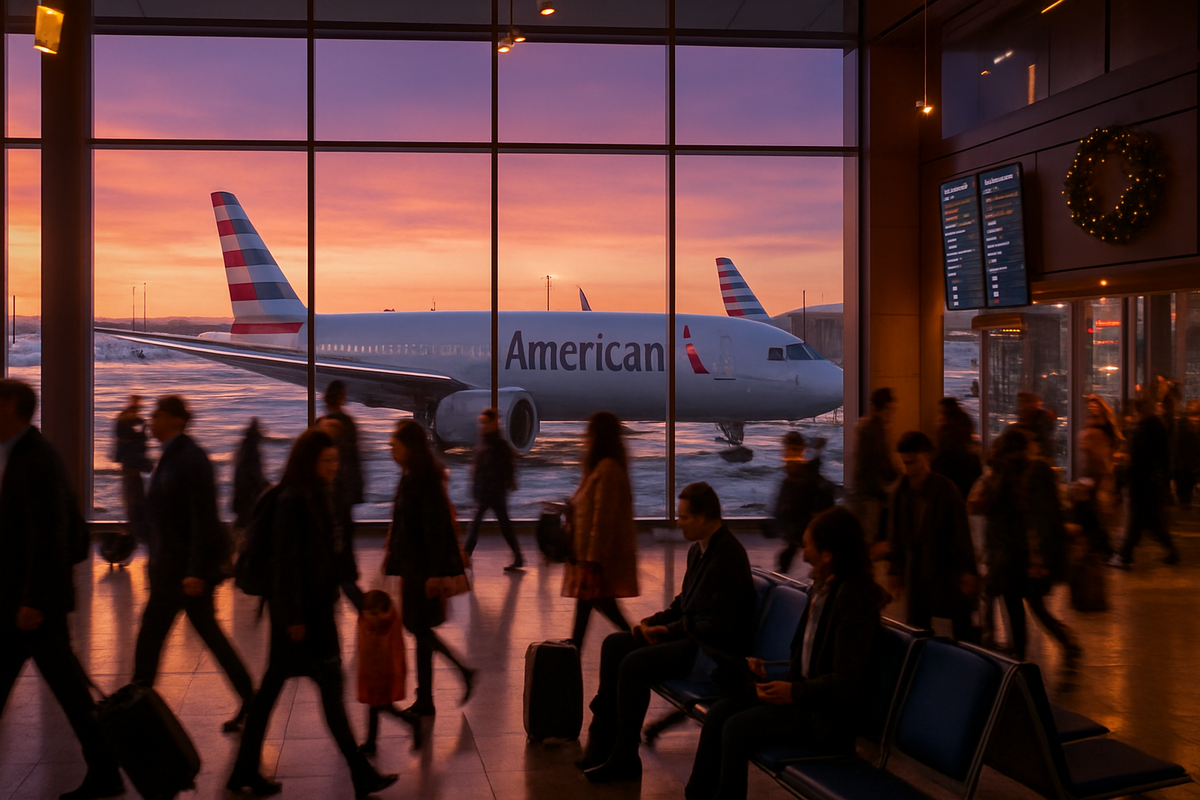
As millions of travelers converge on airports for the 2025 winter holiday season, the aviation industry is witnessing a historic surge in demand that is testing the limits of infrastructure and operational resilience. On this Christmas Eve, December 24, 2025, the skies are more crowded than ever, with American Airlines (NASDAQ: AAL) finding itself at a critical crossroads. While the carrier is successfully moving record volumes of passengers, it continues to grapple with a persistent profitability gap compared to its primary rivals, setting the stage for a high-stakes strategic pivot as the calendar turns to 2026.
The current holiday window, spanning from December 19, 2025, to January 5, 2026, is projected to see a staggering 52.6 million passengers take to the skies on U.S. carriers. For American Airlines, the scale of the operation is immense; the airline expects to carry approximately 12.7 million passengers during this 18-day period. On the peak travel day of December 22, American reported having over 1,000 aircraft in the air simultaneously, a feat of logistics that highlights the sheer magnitude of the world’s largest airline by fleet size.
Operational Hurdles and the "Bronze Medal" Financial Reality
The road to this year’s holiday peak was not without its turbulence. In late November 2025, American Airlines faced a brief but intense operational scare following a software recall affecting its Airbus A320 fleet. While the issue was resolved within days, it served as a reminder of the technical vulnerabilities inherent in modern aviation. Furthermore, a severe winter storm on November 30 disrupted major hubs in Dallas/Fort Worth, Charlotte, and Chicago, forcing the airline into a massive recovery effort just as the December rush began. Despite these challenges, American has maintained a high completion rate, though it continues to trail Delta Air Lines (NYSE: DAL) in key on-time performance metrics.
Financially, the narrative for American Airlines in 2025 has been one of "Bronze Medal Syndrome." While the industry as a whole is seeing record revenue, the profits have been disproportionately concentrated at the top. In the third quarter of 2025, while Delta and United Airlines (NASDAQ: UAL) reported multi-billion dollar profits, American posted a surprising net loss of $114 million. This disparity has weighed heavily on the company's stock, which traded near $16.26 in late December, down roughly 6% year-to-date, contrasting sharply with the double-digit gains seen by its peers.
The Widening Gap: Winners and Losers in the Premium Era
The 2025 holiday season has solidified a clear hierarchy within the U.S. airline sector. The "winners" of the current cycle are undeniably Delta and United, which have successfully captured the high-yield "premium leisure" market. Delta, in particular, has seen premium seating grow to account for 43% of its total passenger revenue. These carriers have leveraged their superior balance sheets to invest in lounge infrastructure and cabin upgrades, creating a virtuous cycle of high margins and customer loyalty.
On the other hand, American Airlines and several Low-Cost Carriers (LCCs) have found themselves squeezed. American’s heavy debt load—currently standing at approximately $36.8 billion—has limited its ability to match the aggressive capital expenditures of its rivals. However, the airline has made strides in debt reduction, paying down $1.2 billion in Q3 2025 alone. The "losers" in the current environment are those failing to adapt to the shifting consumer preference for comfort over base fare price, a trend that has forced American to announce a major "customer reimagination" plan for 2026.
Industry Trends and the 2026 Outlook
The broader significance of this holiday season lies in the structural shifts affecting the entire industry. The "premiumization" of air travel is no longer a temporary post-pandemic fad but a permanent industry fixture. Furthermore, the industry is facing a persistent pilot shortage, projected to reach a shortfall of 24,000 aviators by 2026, which is keeping capacity constrained and fares relatively high despite fluctuating fuel prices. In 2025, jet fuel prices stabilized between $2.00 and $2.34 per gallon, providing some relief, but analysts warn that any geopolitical instability in 2026 could quickly erase these gains.
Labor dynamics also remain a critical factor. American Airlines entered this holiday season with a newly ratified five-year contract for its 28,000 flight attendants, which included a historic "pay for boarding" provision. This has provided American with a level of labor stability that its competitor, United Airlines, currently lacks. United’s flight attendants recently rejected a tentative agreement, leading to renewed labor unrest that could impact their operations in the coming year.
Looking Ahead: Strategic Pivots and Market Opportunities
As we look toward 2026, American Airlines is betting heavily on a fleet and product refresh to close the margin gap. The airline is awaiting the delivery of new Airbus A321XLR and Boeing (NYSE: BA) 787-9 aircraft, which will feature high-density lie-flat suites. This move into premium seating is seen by many on Wall Street as a "must-win" initiative. UBS recently upgraded AAL to a "Buy" rating, suggesting that the market has undervalued American’s potential to capitalize on its younger fleet and optimized network once these new cabin configurations are deployed.
The short-term focus for investors will remain on the airline’s ability to hit its debt reduction target of under $35 billion by 2027. If American can successfully navigate the remainder of the winter season without significant operational meltdowns and demonstrate that its premium pivot is gaining traction in early 2026 bookings, the stock could see a significant re-rating. However, the looming pilot shortage and potential supply chain delays from aircraft manufacturers remain the primary risks to this recovery thesis.
Conclusion: A Season of Resilience and Re-evaluation
The 2025 holiday travel peak has proven that the appetite for air travel remains insatiable, with record-breaking passenger volumes across the board. For American Airlines, the season has been a testament to its operational scale and the resilience of its workforce. Yet, the financial data reveals an airline still in the midst of a difficult transformation, working to shed the weight of its debt while chasing the high-margin standards set by its competitors.
Moving into 2026, investors should keep a close eye on American’s "premium" rollout and its progress in narrowing the profitability gap with Delta and United. The airline industry is entering an "extended mid-cycle" phase where efficiency and revenue quality will trump raw capacity growth. For American Airlines, the goal for 2026 is clear: transition from being the largest airline to being one of the most profitable. Whether it can achieve this pivot in a landscape of rising costs and intense competition remains the defining question for the year ahead.
This content is intended for informational purposes only and is not financial advice.