

More Than Background: The Role of AI Music in Advertising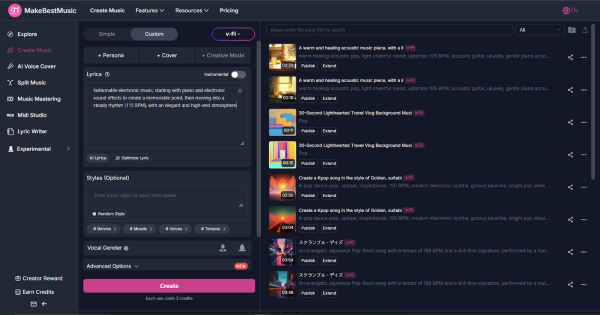
In an era of information overload, competition in advertising is no longer just a battle for visual attention—it is also a fight for auditory engagement. Compared with visuals and copy, sound often resonates emotionally sooner and leaves a deeper impression on audiences. More and more brands have come to realize that well-chosen music can be more memorable and shareable than a carefully crafted slogan.
With the rapid advancement of AI music generators, tools such as MakeBestMusic are breaking down the barriers of traditional music production. High-quality customized music is no longer exclusive to professional teams; it has become a marketing skill that ordinary creators can easily master. This article will systematically break down how to use MakeBestMusic to create custom music and effectively boost advertising conversion rates.
Stop Misusing Background Music: Master Every Ad Scene Precisely with MakeBestMusic
Short‑Video Ads: Users Swipe Away If You Fail to Hook Them in 3 Seconds
On short-video platforms (such as TikTok and YouTube Shorts), advertising competition is extremely fierce. Users make their judgment almost in a single swipe: keep watching or scroll past immediately. Therefore, the key to short-video ads is not how complete the information is, but whether you can successfully hook users within the first 3 seconds. Once this window is missed, it will be difficult to regain attention, no matter how excellent the rest of the content is. And within those few short seconds, music often triggers emotions faster than visuals. An impactful rhythm or sound effect may be exactly what makes users stop. This also means that the music for short-video ads must have a strong ear-catching ability.
Music Requirements
Bright & upbeat rhythm: quickly engage viewers
Ear-catching in the first 3 seconds: the opening must have memorable points (sound effects/drum beats / rising melody)
Full of emotion: rapidly amplify emotions in a short time
Natural loop: supports seamless playback, suitable for repeated use
How to Create with MakeBestMusic
Step 1: Define emotion and tempo
First, set the emotional tone according to your product type.
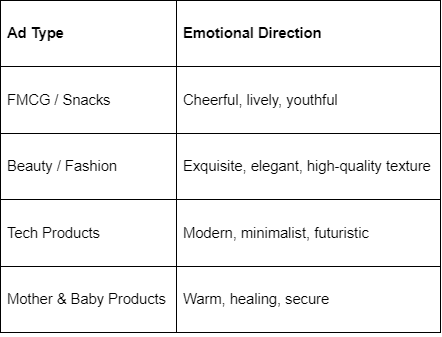
Recommended tempo: 110–130 BPM (light and brisk without being too rushed)
Step 2: Write clear and structured prompts
Compared with vague descriptions, a more specific structure makes it easier to generate usable music:
Example for snack ads: cheerful electronic music, with the first 3 seconds featuring rising synthesizers and catchy clapping sound effects, followed by upbeat drum beats and bass, overall 120 BPM, suitable for looping playback
Example for beauty ads: fashionable electronic music, starting with piano and electronic sound effects to create a memorable point, then moving into a steady rhythm (115 BPM), with an elegant and high-end atmosphere
Feed Ads: Gentle Guidance, Subtle Influence
On feed platforms such as WeChat Moments, Weibo, and Xiaohongshu (RED), the biggest challenge for advertising is not attracting clicks, but avoiding being recognized as a commercial. Users on these platforms are scrolling through content streams. If the music sounds overly commercial or has an exaggerated rhythm, it will be easily identified and skipped quickly.
Therefore, the music strategy for feed ads differs from that of short-video ads — it emphasizes naturalness, restraint, and emotional guidance.
Music Requirements
Gentle & unobtrusive: complements visuals and copy without stealing the spotlight
Progressive emotional buildup: transitions smoothly from calm to emotional peak
No obvious ad-style effects: avoids exaggerated drum beats or overly commercial elements
How to Create with MakeBestMusic
Step 1:Analyze the emotion of the copy
Feed ads usually follow a narrative structure, so the music should match the rhythm of the copy. The recommended structure is as follows:
Opening: soft and gentle, without interrupting user browsing
Middle: gradually builds intensity, aligned with core selling points
End: reaches emotional peak, supporting the call-to-action (CTA)
This progressive structure allows music to drive emotion naturally, without feeling abrupt.
Step 2:Generate music with precise emotion tags
In your prompts, specify not only the style but also the emotional direction and structure.
Example for mother & baby product ads: Warm acoustic music, beginning with gentle single-note acoustic guitar to create a friendly atmosphere, adding piano and strings in the middle to gradually enhance the emotion, ending with a warm climax, conveying a sense of protection and care
Example for workplace training courses: Light and uplifting motivational music, with a simple piano introduction to convey a sense of professionalism. In the middle section, add light drum beats and strings. The emotion transitions from calm to a sense of hope. The rhythm is steady (95 BPM), conveying an atmosphere of growth and breakthrough
Step 4: Add Exclusive Brand Sound Effects to Strengthen Memory
For companies with established brand equity, they can upgrade their music strategy in a simpler and more direct way: use MakeBestMusic to create exclusive brand music, and apply it consistently across all advertisements. Simply include brand keywords and usage scenarios in the prompt, and let AI generate short but highly recognizable music clips.
For example:
Sports brand ad: energetic and punchy electronic sound, strong drum hit with rising synth, conveying power and motivation, suitable for short video opening
Then fix this short music clip at the beginning or end of your advertisements to reinforce user memory repeatedly. This approach is simpler, more efficient, and easier for most teams to implement. With consistent use, users will gradually develop a conditioned reflex to this sound, unconsciously forming stable brand associations and achieving low-cost, long-term accumulation of brand memory.
Native Content Ads: Using Music to Tell Stories
Native content ads (such as brand story videos and product experience Vlogs) are content-focused and highly narrative. Unlike short-video ads, such content usually has a longer duration, and users are willing to watch it in depth. Therefore, music is no longer just a rhythmic embellishment – it must participate in the narrative structure and help build immersion and emotional layers. In this scenario, music requires a more complete structural design, richer emotional changes, and higher production quality.
Music Requirements
Complete structure: with clear Intro, Bridge, and Outro
Matches narrative rhythm: follows the beginning, development, climax, and ending of the story
Rich emotional layers: avoids using a single emotion throughout; gradual changes are needed
How to Create with MakeBestMusic
Step 1: Plan the music section structure
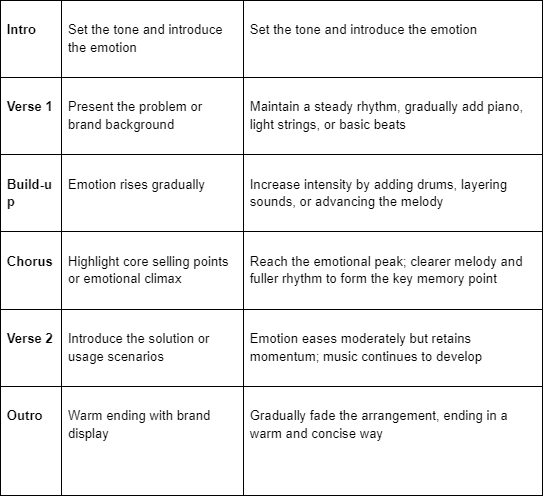
For native content ads, the music structure should align with the video structure. For example:
Step 2: Describe the prompt using complete musical language
Unlike short videos, the prompts for native content ads should be more comprehensive and clearly structured.
Example for new energy vehicle brand stories:
Complete soundtrack, with an overall style combining a sense of technology and humanistic care, using a clear narrative structure: The Intro uses simple electronic sound effects and ambient sounds to create a futuristic atmosphere and establish the overall tone; Verse 1 adds piano and strings to convey the brand concept and background story, with emotions unfolding steadily; Build-up gradually enhances the rhythm and layers of sound, driving emotional rise, in coordination with the product reveal; Chorus reaches the emotional climax, adding strong electronic drum beats and uplifting melodies, highlighting the core selling points and performance expression; Verse 2 returns to warm piano and strings, presenting user stories and real-life scenarios, with emotions continuing without being overly exaggerated; Outro naturally concludes with single piano notes and ambient sounds, forming a complete loop and brand memory point
Step 3: Use the AI Lyric Writing Feature to Strengthen Brand Expression
In native content ads, lyrics play a vital role in conveying brand messages and emotions, making them particularly important. MakeBestMusic offers an AI Lyric Write feature that can automatically generate scene‑appropriate lyrics tailored to your brand's needs. Here is how to use it:
First, on the Create Music page, select the Custom mode and locate the AI Lyrics function. Next, enter your brand information, including core product selling points, target audience, advertising scenarios, and the emotional tone you want to convey.You may then add keywords or brand slogans to guide the AI in writing around these themes. Finally, after generating the lyrics, you can fine‑tune them as needed to ensure the tone aligns with your brand identity.
For native ads, it is recommended that lyrics focus on brand philosophy, product value, user experience, or core emotions, so that lyrics evolve in sync with the musical structure. In this way, lyrics become more than just decoration—they form part of the narrative, and work together with visuals and soundtrack to create a complete, cohesive expression.
Those Who Use AI for Music Are Quietly Boosting Ad ROI
Those Who Use AI for Music Are Quietly Boosting Ad ROI
In the traditional advertising production process, music often requires hiring composers, purchasing copyrights, or multiple rounds of revisions, resulting in high costs and long cycles. In today’s landscape of frequent content updates and fast‑paced delivery, brands need an efficient, low‑cost, and scalable music solution.
With MakeBestMusic, creators can use AI to complete full production from soundtrack to lyrics, with no professional music theory background or expensive studio resources required. Simply enter your brand positioning, advertising scenario, and desired emotional tone, and you can generate original music that matches your narrative structure, enabling true creation from scratch.
The advantages of this approach are:
Controllable costs, ideal for small and medium‑sized brands and independent creators
High creative efficiency, allowing fast iteration of different ad versions
High originality, eliminating copyright risks
By using AI to create original advertising materials, brands no longer rely on generic template music. Instead, they can customize exclusive audio assets for different placement scenarios, making music an integral part of brand communication rather than mere background decoration.
Build Your Brand Music DNA
Major global brands all have their own sonic identity: Mercedes‑Benz commercials are elegant and grand, Nike music is inspiring, and Apple music is minimalist and restrained. This consistency allows consumers to associate a sound with a brand as soon as they hear it. Small and medium‑sized enterprises can also build their own brand music DNA with MakeBestMusic:
Step 1: Define your brand music keywords
Extract 3–5 core emotional words from your brand positioning to serve as the foundation for music creation.
Step 2: Create a music style template
In MakeBestMusic, save prompts containing these keywords as standard templates, clearly defining style, emotion, tempo, and structure to ensure consistent standards for future creation.
Step 3: Generate music in the same style at scale
Produce music for all advertising materials based on this template. While maintaining creative diversity, you ensure a unified overall style and strengthen brand recognition.
Conclusion
In an era of content overload, the real difference lies not in who delivers more information, but in who connects emotionally and builds memory faster. Music is the most easily overlooked yet most powerful variable. From the 3‑second hook in short‑video ads, to the subtle guidance in feed ads, to emotional storytelling in native content ads, you will find that music does more than shape viewing experience — it directly impacts retention, emotional engagement, and even final conversion rates.
The value of MakeBestMusic is that it turns a traditionally high‑barrier skill into something every creator can master: you can quickly generate original music, precisely match different advertising scenes, test multiple styles at scale, and gradually build your own unique brand music DNA.
If you are engaged in ad placement, content creation, or want to strengthen your brand expression, start exploring MakeBestMusic today.