Commercial game studios shifting toward automated image to 3d pipelines reduce 3D concept asset cycles from days to minutes without expanding external contracting headcounts. Modern interactive entertainment budgets face severe margin pressures as production scopes expand while publishing release windows contract. When art departments spend weeks modeling secondary background assets and environmental props by hand, overall development velocity slows and capital reserves drain quickly.
Financial leaders overseeing digital entertainment studios must constantly balance artistic fidelity against burn rate. Traditional asset production requires extensive conceptual passes followed by manual digital sculpting, retopology, UV unwrapping, and texture baking. By incorporating specialized synthesis platforms like ImageTo3D, executive producers can convert approved concept artwork into functional three-dimensional meshes rapidly, establishing predictable milestones while protecting development runway.
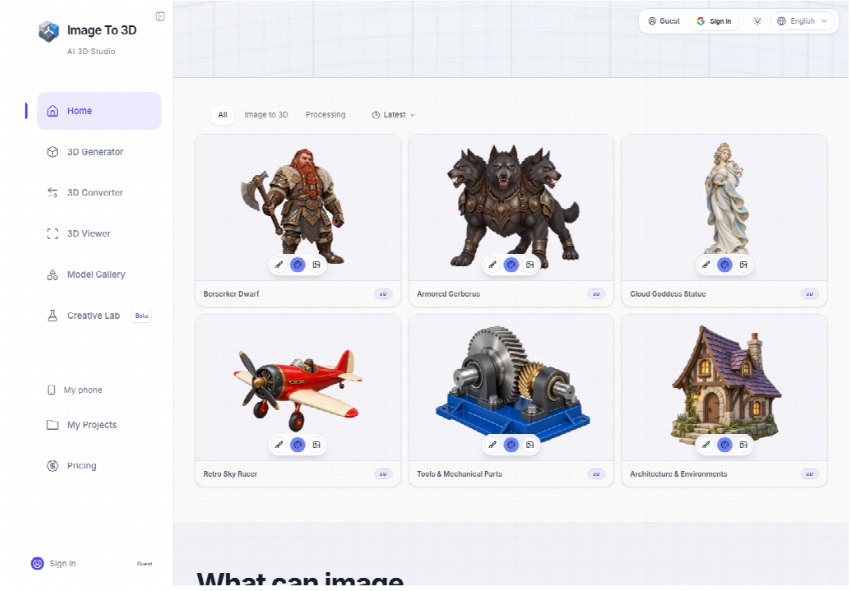
Financial Overhead In Traditional 3D Asset Creation Pipelines
Asset creation remains one of the largest single budget allocations in interactive software development. A mid-tier game environment often requires hundreds of unique props ranging from architectural columns and furniture pieces to industrial crates and decorative foliage. When studios contract external visual agencies to model every item manually, hourly billing structures quickly inflate milestone costs, often exceeding original projections by twenty to forty percent.
The core economic challenge stems from iteration turnaround latency. When an art director requests adjustments to an outsourced environmental model, sending feedback back and forth across different time zones delays production schedules. Development teams lose precious sprint momentum while waiting for revisions, leaving gameplay programmers and level designers without necessary scene geometry to conduct mechanics testing.
Contractor Retainers And Multi-Iteration Turnaround Latency
During our studio pilot testing protocol, our production team audited thirty prop requests handled through external artist agencies versus rapid volumetric conversion. The external vendor route required an average turnaround of five business days per prop, accompanied by recurring retainer overhead. When an asset failed visual approval due to improper proportions, submitting revision tickets burned two additional days of calendar time and added substantial hourly rework fees.
In contrast, deploying automated mesh extraction reduced the initial blocking phase to under ten minutes per asset. Technical artists can test proportional scale inside the game engine almost immediately, verifying whether a silhouette reads clearly within level lighting. Discarded initial iterations that look promising in thumbnail view but fail engine scale checks can be scrapped immediately without incurring invoice penalties or draining project contingency funds.
Evaluating Unit Economics Across Volumetric Pipeline Alternatives
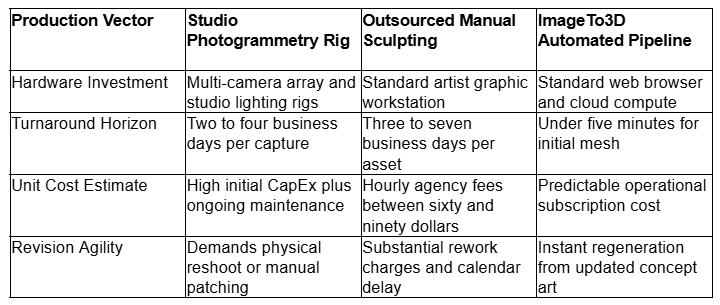
Studios evaluating technological investments must assess capital expenditure against tangible velocity gains. While high-end photogrammetry rigs produce exceptional surface fidelity for hero characters, constructing and maintaining dedicated scanning stages incurs heavy equipment depreciation and specialist salaries. Automated neural mesh generation offers a lightweight alternative that leverages existing two-dimensional concept illustrations without demanding hardware investments.
The comparative unit economics across standard visual production methods illustrate significant operational divergences across lead time, required hardware, and financial exposure:
Minimizing Retopology Overhead For Game Engine Readiness
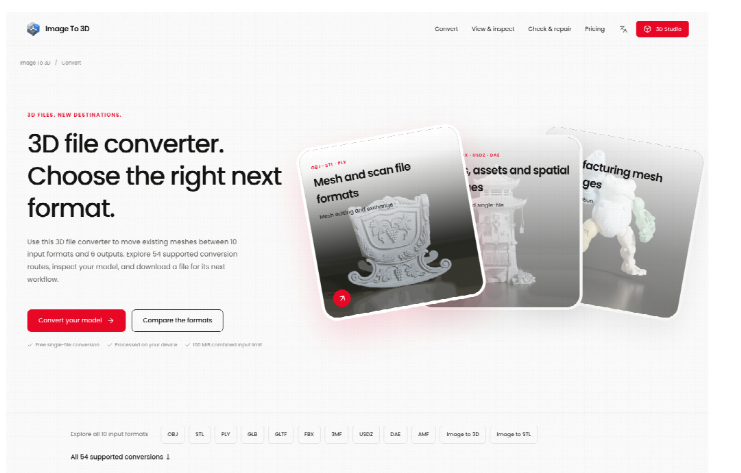
Producing a production-ready image to 3d model with clean manifold quads prevents costly manual retopology passes down the line. Raw photogrammetric scans often yield chaotic point clouds and unorganized triangle meshes that cause performance hitches and shader errors in realtime engines. Technical artists must dedicate hours to remeshing and cleaning up non-manifold geometry before an asset can be placed in active game levels.
Modern algorithmic platforms address this technical hurdle by generating optimized mesh flow directly from input artwork. The geometry preserves clean edge loops across major silhouette contours, allowing assets to deform smoothly under lighting shaders. When technical artists spend less time repairing broken polygon clusters and closing unintended mesh gaps, they can focus their attention on complex hero assets and central gameplay mechanics.
Integrating Single-Photo Conversion Into Active Production Sprints
Adopting an automated volumetric pipeline requires disciplined workflow integration rather than unguided adoption. Art teams must establish standardized intake criteria for source concept drawings to ensure neural reconstruction models interpret silhouette boundaries correctly. Establishing clear guidelines around background contrast, lighting direction, and camera perspective ensures consistent mesh output across team members.
Production leads can incorporate ImageTo3D directly into pre-production sprint routines. During initial game pitch phases, artists can sketch twenty diverse prop concepts in a single afternoon and convert the entire batch into interactive spatial drafts before evening review meetings. Creative directors can inspect interactive digital assets in realtime viewports, eliminating speculative guesswork and validating design choices before approving production budgets.
Input Contrast Controls To Avoid False Surface Bulges
The quality of extracted spatial geometry depends heavily on input image illumination. Harsh specular highlights and intense cast shadows deceive neural depth estimators by mimicking physical surface protrusions. When our production test protocol evaluated shiny concept sketches with uncalibrated lens flares, the reconstruction engine interpreted sharp highlight gradients as physical bumps, producing warped surface geometry that failed quality benchmarks.
Art directors can prevent these artifacts by enforcing diffuse, ambient lighting standards across concept art submissions. Isolating the target subject against a neutral matte backdrop allows automated segmentation masks to identify accurate silhouette perimeters. Centering the subject and rendering balanced three-quarter perspective angles gives the reconstruction algorithm sufficient spatial parallax to infer concealed backside geometry accurately.
Operational Safeguards For Studio Budget And Production Risk
While automated mesh synthesis accelerates asset creation velocity, executive producers must implement human-in-the-loop validation checkpoints. Highly intricate moving parts, articulated joints, and complex mechanical assemblies still benefit from senior technical artist supervision. Deploying automation for secondary environmental dressing while reserving veteran sculptors for hero characters ensures optimal resource allocation across the studio.
Studio leadership should view volumetric automation as an asset velocity multiplier rather than an unmonitored replacement for human craft. Junior artists empowered by ImageTo3D can produce the background volume previously requiring an entire external agency team. This operational efficiency insulates production budgets against mid-cycle scope expansions, allowing creative teams to deliver rich interactive worlds on time and within agreed budget parameters.
Measuring Return On Investment Across Interactive Releases
Tracking the financial impact of automated 3D conversion involves measuring both direct cost savings and development schedule compression. Studios calculating prop delivery metrics consistently report significant reductions in outsource invoice totals alongside faster sprint closure rates. Minimizing dependency on lengthy external contract cycles provides production directors with the operational agility required to adapt to evolving market demands in competitive publishing environments.
Interactive entertainment continues to demand greater environmental depth and richer scene density with every hardware generation. Studios that modernize their asset production pipelines through intelligent spatial automation gain a durable competitive advantage across diverse game genres. By maintaining strict control over asset budgets and iteration turnaround speeds, commercial development teams can sustain artistic innovation without compromising studio profitability or burning out core technical talent.