
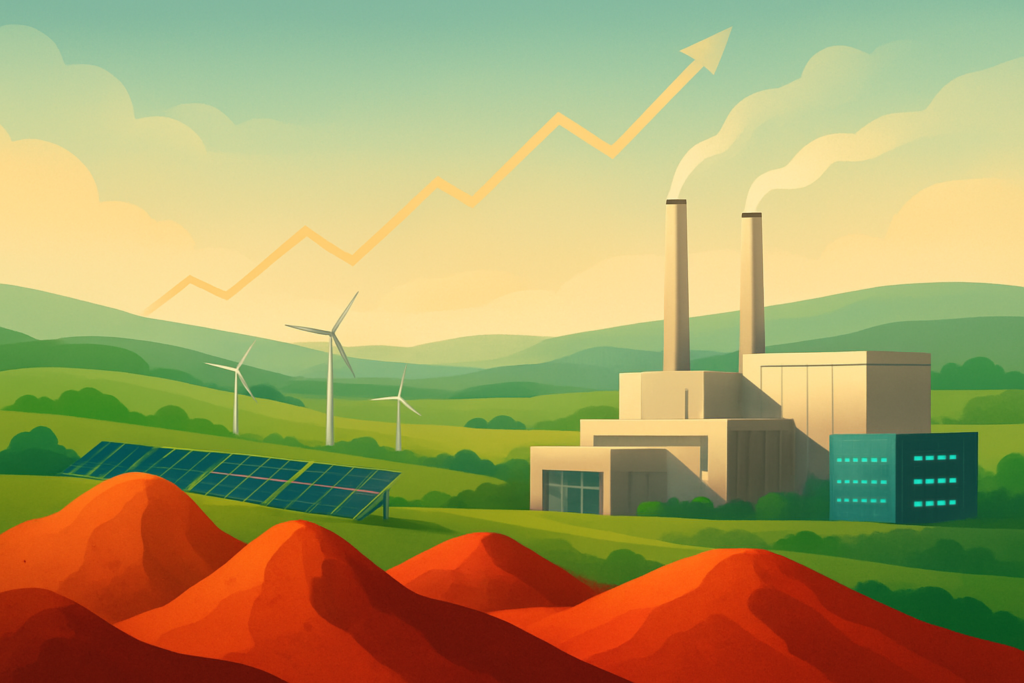
As of March 30, 2026, Alcoa Corp. (NYSE: AA) has emerged as a central figure in the global industrial transition, standing at the intersection of a volatile commodity super-cycle and the accelerating demand for "green" infrastructure. Long considered a bellwether for the global economy, the Pittsburgh-based aluminum giant is currently navigating a period of significant valuation rerating.
The company is in focus today due to a perfect storm of supply-side constraints—most notably the February 2026 closure of the Strait of Hormuz, which sidelined nearly 10% of global aluminum supply—and a strategic pivot toward monetizing its vast industrial land holdings for AI data center development. With aluminum prices testing decade highs above $3,400 per metric ton, Alcoa’s recent full integration of Alumina Limited has positioned it as the world’s premier pure-play upstream aluminum producer.
Historical Background
The story of Alcoa is the story of modern aluminum. In 1886, a 22-year-old Oberlin College graduate named Charles Martin Hall discovered the electrolytic process for producing aluminum in his family's shed. Two years later, in 1888, with the backing of Alfred E. Hunt, the Pittsburgh Reduction Company was born.
Renamed the Aluminum Company of America (Alcoa) in 1907, the firm spent the 20th century as a vertically integrated titan, controlling every stage of production from bauxite mining to finished foil. However, its dominance led to a landmark 1945 antitrust ruling that forced the divestiture of its Canadian operations (which became Alcan, now part of Rio Tinto [NYSE: RIO]).
The most defining moment in recent history occurred on November 1, 2016, when the company split into two entities. The "upstream" assets—mining, refining, and smelting—retained the Alcoa name (NYSE: AA), while the high-value "downstream" aerospace and automotive components business became Arconic. This split was designed to let Alcoa focus on its core commodity strengths, a strategy that has culminated in the 2024–2025 consolidation of its global alumina joint ventures.
Business Model
Alcoa’s business model is concentrated on three primary segments: Bauxite, Alumina, and Aluminum. Unlike diversified miners, Alcoa is a "pure-play" entity, meaning its earnings are highly leveraged to the price of aluminum on the London Metal Exchange (LME).
- Bauxite Mining: Alcoa operates one of the world’s largest bauxite mining portfolios, with major operations in Australia, Brazil, and Guinea.
- Alumina Refining: Following the 2024 acquisition of Alumina Limited, Alcoa now owns 100% of the Alcoa World Alumina and Chemicals (AWAC) venture. This makes Alcoa the largest third-party seller of alumina globally, providing a critical hedge against price volatility in the finished metal.
- Aluminum Smelting: The company operates a global network of smelters, with a strategic focus on locations powered by renewable energy (hydro and wind) to lower its carbon footprint and operational costs.
The company’s customer base spans the automotive, packaging, construction, and electrical industries, with an increasing shift toward long-term contracts for "green-certified" metal.
Stock Performance Overview
Over the past year, Alcoa (NYSE: AA) has been one of the top-performing industrial stocks, delivering a 1-year total return of approximately 90.8%. This rally was fueled by the 2026 aluminum price spike and the successful integration of its Alumina Limited acquisition.
In the medium term, the 5-year performance shows a total return of 82.2%. This reflects a volatile recovery path from the post-pandemic highs of 2022, followed by a mid-decade slump caused by high energy costs in Europe, and the current 2025–2026 resurgence.
Since its inception as a standalone entity in late 2016, Alcoa has delivered a 10-year return of approximately 172%. While the stock remains cyclical and subject to wild swings based on LME prices, its current valuation reflects a fundamental shift toward a more efficient, higher-margin producer compared to its 2016 form.
Financial Performance
For the full year 2025, Alcoa reported Revenue of $12.83 billion, an 8% increase over 2024. This growth was underpinned by realized aluminum prices that averaged $2,850/mt throughout the year, before the early 2026 spike.
Key Financial Metrics (as of Q4 2025):
- Net Income: $1.17 billion ($4.42 per share), marking a robust turnaround from the marginal profitability of the previous two years.
- Free Cash Flow: Alcoa generated significant cash in late 2025, ending the year with $1.6 billion in cash and cash equivalents.
- Balance Sheet: Adjusted net debt was reduced to $1.5 billion, a level that has allowed management to consider aggressive asset buybacks or special dividends in 2026.
- Valuation: As of March 2026, the stock trades at a Forward P/E of 13.2x, which many analysts consider a discount given the current supply-starved market environment.
Leadership and Management
CEO William Oplinger, who took the helm in late 2023, has been credited with a "no-nonsense" approach to portfolio management. His strategy has centered on three pillars: Operational Excellence, Portfolio Transformation, and Sustainability.
Under Oplinger’s leadership, the company has shown a willingness to make difficult decisions, such as the permanent closure of the high-cost Kwinana refinery in Australia and the aggressive push to restart the San Ciprián smelter in Spain only when profitable terms were met. The management team is currently viewed as highly disciplined, prioritizing "value over volume"—a mantra that has resonated with institutional investors wary of the commodity industry's past tendency toward overproduction.
Products, Services, and Innovations
Alcoa has moved beyond being a producer of "generic" metal to a provider of specialized, low-carbon materials through its Sustana line:
line:
- EcoLum: Aluminum produced with less than 4.0 metric tons of CO2e per ton of metal—three times better than the global average.
- EcoSource: The world's first and only low-carbon alumina brand.
- ELYSIS Joint Venture: In partnership with Rio Tinto (NYSE: RIO) and the Canadian government, Alcoa is developing the ELYSIS technology, which eliminates all direct greenhouse gases from the traditional smelting process, emitting oxygen instead. In late 2025, the venture successfully activated its first commercial-scale 450kA cell.
Perhaps the most surprising "innovation" in 2026 is Alcoa's Data Center Land Strategy. The company has identified 10 idled industrial sites with high-voltage grid connections that are being sold or leased to AI data center operators, potentially generating up to $1 billion in non-core proceeds.
Competitive Landscape
Alcoa competes in a global market dominated by state-backed Chinese firms and diversified giants.
- Rio Tinto (NYSE: RIO): Rio holds a superior cost position in smelting due to its vast Canadian hydroelectric assets. However, Alcoa’s recent acquisition of Alumina Limited gives it a stronger position in the third-party alumina market.
- Norsk Hydro (OTCMKTS: NHYDY): Hydro remains Alcoa’s most direct rival in the "green aluminum" space. Hydro currently enjoys a lower cost curve in its Brazilian refining operations but lacks Alcoa’s scale in North American bauxite sourcing.
- Chalco (HKG: 2600): While Chalco (Aluminum Corp of China) has more volume, Alcoa’s focus on Western ESG standards and carbon-free technology gives it a competitive edge with European and North American automotive OEMs (Original Equipment Manufacturers).
Industry and Market Trends
The aluminum market in 2026 is defined by Scarcity and Sustainability.
- China's 45-Million-Ton Cap: China has largely reached its domestic production ceiling, ending decades of oversupply that suppressed global prices.
- Energy Transition: Aluminum is the "metal of the energy transition," essential for EV battery enclosures, solar panel frames, and wind turbine components. Demand from these sectors is projected to grow at a 5-6% CAGR through 2030.
- Supply Chain Resilience: Following the 2026 Hormuz crisis, "friend-shoring" has become a priority. Alcoa's assets in stable jurisdictions (Australia, Canada, USA, Norway) now command a "security premium" in the eyes of many investors.
Risks and Challenges
Despite the current rally, Alcoa faces several significant hurdles:
- Regulatory Permits in Australia: The company is currently awaiting critical "Part IV" environmental approvals for its Huntly and Willowdale mines in Western Australia. Delays beyond late 2026 could jeopardize bauxite supply to its Pinjarra and Wagerup refineries.
- Geopolitical Volatility in Guinea: As the world's leading bauxite exporter, Guinea's recent implementation of export quotas to prop up prices has added significant cost pressure to Alcoa’s refining segment.
- Energy Costs: While Alcoa has pivoted to renewables, its remaining coal- or gas-powered assets in certain regions remain vulnerable to energy price shocks, particularly in Europe.
Opportunities and Catalysts
- Asset Monetization: The sale of idled sites for AI data centers is a massive near-term catalyst. These transactions are expected to be finalized by mid-2026, providing a "wall of cash" for debt reduction or dividends.
- San Ciprián Restart: The full return to production of the Spanish smelter (targeted for June 2026) is expected to add 228,000 metric tons of annual capacity just as prices are peaking.
- Green Premium: If the EU’s Carbon Border Adjustment Mechanism (CBAM) continues to tighten, Alcoa’s EcoLum product could command an even higher price premium over high-carbon Chinese or Indian metal.
Investor Sentiment and Analyst Coverage
Wall Street sentiment on Alcoa is currently "Cautiously Bullish." The consensus rating sits at a Hold/Buy, with a median 12-month price target of $69.00.
Hedge fund activity increased significantly in Q4 2025, as institutional investors sought "inflation-protected" assets. The narrative has shifted from Alcoa being a "troubled commodity play" to an "AI-adjacent infrastructure and energy transition" play. However, some analysts remain wary that any resolution to Middle Eastern geopolitical tensions could lead to a rapid correction in LME prices, taking Alcoa’s stock down with it.
Regulatory, Policy, and Geopolitical Factors
The geopolitical landscape is currently Alcoa’s greatest tailwind. The U.S. and EU have intensified tariffs on high-carbon and Russian-origin aluminum, effectively creating a "Western-only" market where Alcoa is a dominant supplier.
Domestically, the U.S. Department of Energy has awarded Alcoa several grants for decarbonization research, viewing the company as a critical component of national security and the domestic supply chain. In Australia, the government is balancing its "Green Energy Superpower" ambitions with local environmental concerns, making the upcoming 2026 mining permit decisions a pivotal moment for both the company and the state of Western Australia.
Conclusion
As of March 30, 2026, Alcoa Corp. (NYSE: AA) has successfully transformed its balance sheet and refined its strategic focus. By integrating Alumina Limited and pivoting toward high-value land monetization for the AI sector, the company has created multiple pathways for value creation beyond the simple fluctuations of the LME.
Investors should maintain a balanced perspective. While the current $3,400/mt aluminum price environment and the "AI land grab" are powerful catalysts, Alcoa remains at the mercy of regulatory approvals in Australia and the inherent cyclicality of global industrial demand. For those looking to play the long-term themes of decarbonization and supply chain security, Alcoa stands as a leaner, smarter, and more strategically positioned giant than at any time in its 138-year history.
This content is intended for informational purposes only and is not financial advice.