- The U.S fell three places to 24th this year and is down 10 places over the past decade; its Finances in Retirement ranking fell eight places this year
- 76% of U.S. investors expect rising public debt to reduce future retirement benefits, while 41% say inflation is killing their retirement dreams
- Advisors identify unrealistic return expectations, inflation and tax planning as key retirement risks, while seeing opportunities to expand the investment toolkit available to retirement savers
The United States fell to 24th in this year’s Global Retirement Index (GRI) from Natixis Investment Managers (Natixis IM), down from 21st in 2025 and 14th a decade ago. The U.S. lost ground across three of the four factors measured by the Index, including an eight-place decline in Finances in Retirement to 18th.
This press release features multimedia. View the full release here: https://www.businesswire.com/news/home/20260922153549/en/
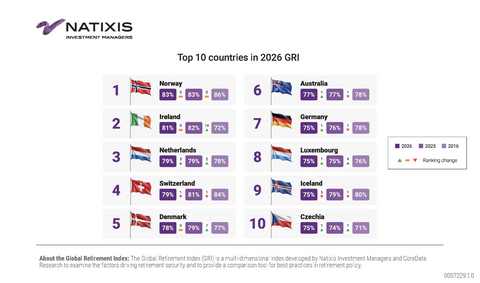
Top 10 countries in 2026 GRI
The decline comes as the traditional three-pillar retirement model – government benefits, employer-sponsored plans and personal savings – faces growing pressure from an aging population, changing employment patterns, inflation and public debt. Through these pressures, individuals increasingly recognize that more of the responsibility for retirement will fall on them. According to Natixis IM’s Individual Investor Survey*, 81% of American investors saying it is increasingly their responsibility to fund retirement themselves, up from 63% a decade ago.
“Workers are confronting the reality that the current retirement system was built for a different era,” said Dave Goodsell, Executive Director of Natixis IM’s Center for Investor Insight. “An aging population is putting greater strain on public retirement systems, debt levels are adding pressure to future benefits, and inflation is making it harder for individuals to save. The system needs to evolve for the realities of how people work, save and retire today.”
Developed with CoreData Research, the Global Retirement Index evaluates retirement security across 44 countries using 18 indicators grouped into four sub-indices: Finances in Retirement, Material Wellbeing, Health and Quality of Life.
Traditional sources of retirement security are under pressure
The U.S. decline is being driven in part by renewed financial pressures. Its Finances in Retirement ranking fell eight places to 18th as renewed price pressures weigh on inflation and government indebtedness remained entrenched. Three-quarters (76%) of U.S. investors believe mounting public debt will ultimately result in reduced retirement benefits, while 77% expect growing deficits to translate into higher taxes.
Inflation is simultaneously making it harder for individuals to fill the gap themselves. Forty-one percent of U.S. investors say inflation is killing their retirement dreams, while financial advisors identify underestimating inflation as one of the most significant risks to retirement security.
Access to employer-sponsored savings also remains uneven as employment patterns move away from the stable, full-time careers around which many retirement systems were designed. According to Pew, more than 56 million U.S. private-sector workers lack access to a workplace retirement plan, with workers at small businesses particularly likely to be uncovered.1
Healthcare adds another major source of uncertainty. The U.S. spends more per person on healthcare than any other country in the Index yet ranks just 25th in the Health sub-index. Thirty-five percent of U.S. investors fear going broke paying for healthcare and long-term care costs in retirement, compared with 24% globally.
For some Americans, those costs are beginning to change not only how they retire but where. More than 700,000 Americans now receive Social Security benefits abroad, up more than 60% from 431,000 two decades ago.2
Bringing retirement planning and policy into the 21st century
As individuals assume more responsibility for retirement, both financial planning and retirement policy are being forced to adapt. Advisors see clear gaps between investor expectations and what long-term planning may require, while policymakers are focused on expanding access, increasing participation and helping individuals build sufficient assets over time.
One of the biggest retirement-planning mistakes is unrealistic expectations, cited by 52% of advisors in Natixis IM’s Financial Professional Survey.** Advisors say their clients expect long-term returns of 8.9% above inflation on average, compared with the 7.4% advisors say is realistic. Advisors also point to underestimating inflation (34%) and not understanding the tax implications of investments (39%) as key risks. Those concerns come as 41% of U.S. investors say inflation is already threatening their dreams of retirement and 77% worry growing government deficits will ultimately lead to higher taxes.
At the same time, policymakers are trying to improve the foundation on which individuals save. The GRI report identifies access, automation and accumulation as three priorities for modernizing retirement systems. In the U.S., SECURE 2.0 has expanded eligibility for certain long-term part-time workers and introduced automatic enrollment and escalation provisions for certain new plans, while more than 20 states have enacted or implemented automated retirement savings programs, reaching 1.19 million funded accounts and $2.89 billion in assets by early 2026.3
The next challenge is helping individuals make those assets work harder. Almost half (46%) of U.S. advisors say people who approach retirement are underappreciating opportunities private assets present for income, while 43% see their long-term nature makes them a good fit for retirement saving. Sixty percent also expect a pathway to open for defined contribution plans to incorporate private assets over the next 12 months. Yet 71% of U.S. investors say private markets are riskier than public markets, highlighting a gap between how advisors see the retirement investment toolkit evolving and how investors perceive the asset class.
“Modernizing retirement means giving individuals a better chance to succeed,” said Liana Magner, Head of Institutional and Retirement in the US at Natixis Investment Managers. “That means expanding access, making it easier to save consistently and helping investors build realistic expectations around the returns, risks and income they will need over a longer retirement.”
View and download a full copy of the report: https://im.natixis.com/en-us/insights/investor-sentiment/2026/global-retirement-index
* Natixis Investment Managers’ 2025 Global Individual Investor Survey was conducted by CoreData Research in February and March 2025. The survey included 7,050 individual investors in 21 countries across Asia, Europe, Latin America, and North America.
** Natixis Investment Managers surveyed 2,950 investment professionals across 23 countries. Data was gathered in March-May 2026 by the research firm CoreData with additional analysis conducted by the Natixis Center for Investor Insights.
1 Pew, Workers Without Access to Retirement Benefits Struggle to Build Wealth, June 2025.
2 SSA, Annual Statistical Supplement 2005 (Table 5.J) and 2025 (Table 5.J), beneficiaries in foreign countries
3 Pew, States With Automated Retirement Savings Programs See Growth in New Private Plans, April 2026.
Methodology
The Global Retirement Index (GRI) is a multi-dimensional index developed by Natixis Investment Managers and CoreData Research to examine the factors driving retirement security and to provide a comparison tool for best practices in retirement policy. The index includes International Monetary Fund (IMF) advanced economies, members of the Organization for Economic Cooperation and Development (OECD) and the BRIC countries (Brazil, Russia, India and China). The researchers calculated a mean score in each category and combined the category scores for a final overall ranking of the 44 nations studied. The GRI analysis was carried out between March to May 2026.
About the Natixis Center for Investor Insight
The Natixis Center for Investor Insight is a global research initiative focused on the critical issues shaping today’s investment landscape. The Center examines sentiment and behavior, market outlooks and trends, and risk perceptions of institutional investors, financial professionals and individuals around the world. Our goal is to fuel a more substantive discussion of issues with a 360° view of markets and insightful analysis of investment trends.
About Natixis Investment Managers
Natixis Investment Managers’ multi-affiliate approach connects clients to the independent thinking and focused expertise of more than 15 active managers. Ranked among the world’s largest asset managers4 with more than $1.5 trillion assets under management5 (€1.3 trillion), Natixis Investment Managers specializes in high-conviction active investment strategies, insurance and pension solutions, and private assets, and delivers a diverse offering across asset classes, styles, and vehicles. The firm partners with clients in order to understand their unique needs and provide insights and investment solutions tailored to their long-term goals.
Headquartered in Paris and Boston, Natixis Investment Managers is part of Groupe BPCE, the second-largest banking group in France through the Banque Populaire and Caisse d’Epargne retail networks. Natixis Investment Managers’ affiliated investment management firms include AEW; DNCA Investments;6 Flexstone Partners; Gateway Investment Advisers; Harris | Oakmark; Investors Mutual Limited; Loomis, Sayles & Company; Mirova; Naxicap Partners; Ossiam; Ostrum Asset Management; Seventure Partners; Vauban Infrastructure Partners; Vaughan Nelson Investment Management; VEGA Investment Solutions and WCM Investment Management. Additionally, investment solutions are offered through Natixis Investment Managers Solutions and Natixis Advisors, LLC. Not all offerings are available in all jurisdictions. For additional information, please visit Natixis Investment Managers’ website at im.natixis.com | LinkedIn: linkedin.com/company/natixis-investment-managers.
Natixis Investment Managers’ distribution and service groups include Natixis Distribution, LLC, a limited purpose broker-dealer and the distributor of various U.S. registered investment companies for which advisory services are provided by affiliated firms of Natixis Investment Managers, Natixis Investment Managers International (France), and their affiliated distribution and service entities in Europe and Asia.
4 Survey respondents and publicly available data ranked by Investment & Pensions Europe/Top 500 Asset Managers 2026 ranked Natixis Investment Managers as the 21st largest asset manager in the world based on assets under management as of December 31, 2025.
5 Assets under management (AUM) of affiliated entities measured as of June 30, 2026, are $1,525.1 billion (€1,334.0 billion). AUM, as reported, may include notional assets, assets serviced, gross assets, assets of minority-owned affiliated entities and other types of nonregulatory AUM managed or serviced by firms affiliated with Natixis Investment Managers.
6 A brand of DNCA Finance.
All investing involves risk, including the risk of loss. Investment risk exists with equity, fixed-income, and alternative investments. There is no assurance that any investment will meet its performance objectives or that losses will be avoided.
The views and opinions expressed may change based on market and other conditions. This material is provided for informational purposes only and should not be construed as investment advice. There can be no assurance that developments will transpire as forecasted. Actual results may vary.
NIM-09162026-c3dvtrsl
View source version on businesswire.com: https://www.businesswire.com/news/home/20260922153549/en/
Contacts
Press contact
Kelly Cameron
+ 1 617-449-2543
Kelly.Cameron@natixis.com