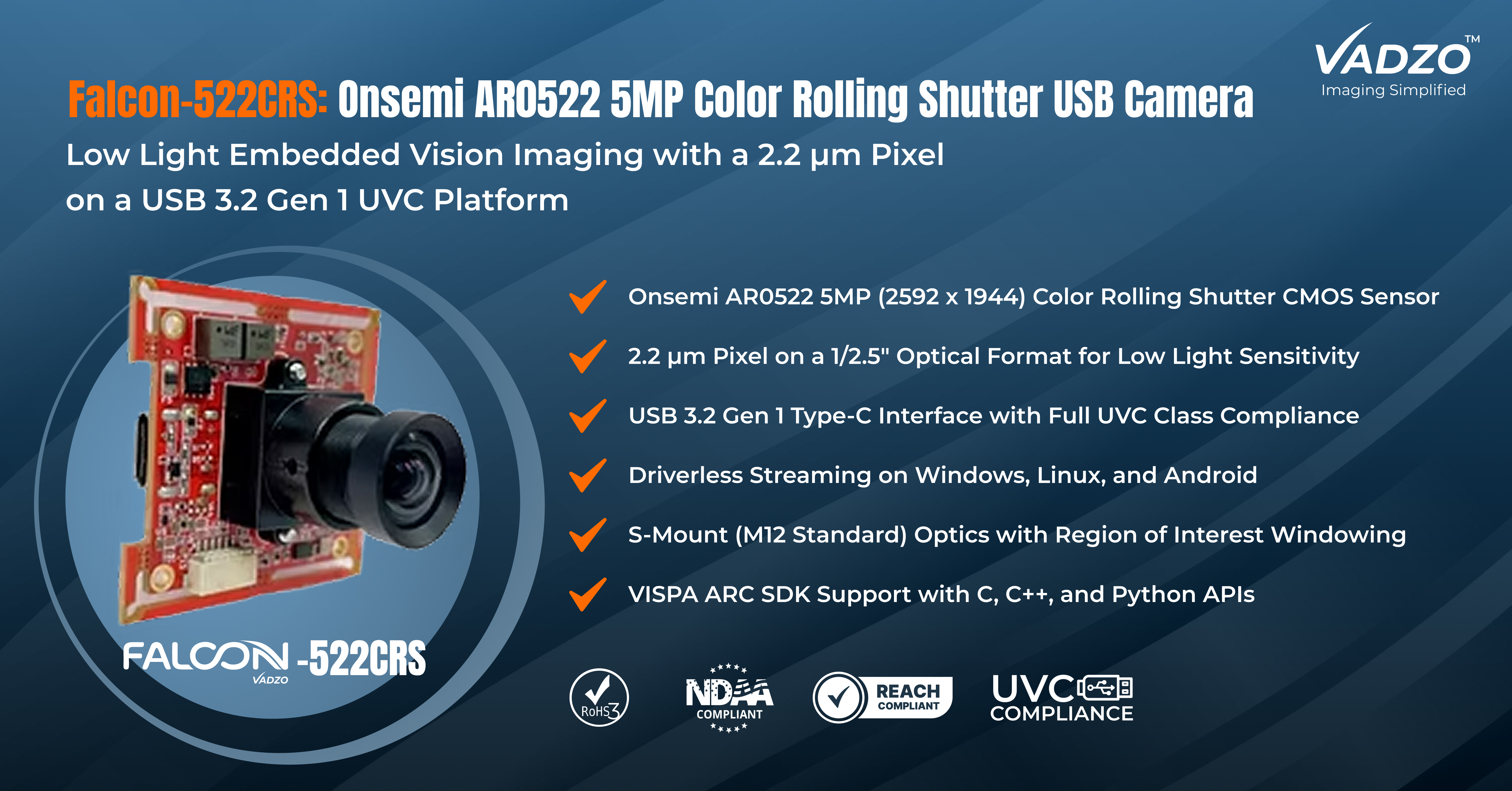
Vadzo Imaging has released the Falcon-522CRS, a AR0522 5MP color USB camera built on the Onsemi AR0522 image sensor with a 2.2 µm pixel architecture selected for low-light imaging. The module delivers 2592 x 1944 resolution over a USB 3.2 Gen 1 Type-C interface with full UVC class compliance, giving OEM engineers, system integrators, and embedded vision developers a 5MP low light USB camera that streams on Windows, Linux, and Android without custom driver development.
IRVINE, CA / ACCESS Newswire / August 14, 2026 / Vadzo Imaging, a developer of OEM embedded camera products for industrial and embedded vision systems, today announced the Falcon-522CRS. The module is an AR0522 low-light USB camera engineered for deployments where scene illuminance falls below the level at which small pixel sensors retain usable detail. Built on the Onsemi AR0522 image sensor with a 1/2.5" optical format and a 2.2 µm pixel pitch, the Falcon-522CRS targets machine vision professionals and technical decision makers who need 5MP spatial resolution and low light sensitivity from a single compact USB module rather than from a lighting redesign.
Why Low Light Performance Determines Embedded Vision System Reliability
Vision system failures in the field are frequently attributed to model accuracy when the actual origin is the sensor. Once scene illuminance drops toward the single-digit lux range, the number of photons arriving at each photodiode within an exposure window falls far enough that photon shot noise becomes the dominant noise term in the signal chain. The image still renders, and the histogram still fills. What has already been lost at the point of capture is the fine texture that classifiers, optical character recognition engines, and feature matching algorithms depend on.
This constraint applies to most of the environments where embedded vision is actually deployed. Perimeter and access control nodes operate through dusk transitions and overnight periods under sparse artificial lighting. Warehouse robotics platforms work under high bay fixtures that leave aisles and pallet faces in shadow. Medical and laboratory instruments limit illumination to protect samples and patients. In each case, the system designer cannot raise scene brightness, so the burden shifts to the sensor and the optical path. A Low-Light Embedded Vision Camera is not a specialized variant in these deployments. It is the baseline requirement.
The measurable quantity behind all of this is the signal-to-noise ratio. Engineers evaluating an Industrial Low Light Camera should treat SNR at a defined illuminance as the primary acceptance criterion rather than a headline megapixel count. Vadzo Imaging has published a detailed technical explanation of signal to noise ratio that describes how read noise, dark current, and photon shot noise combine across the imaging chain and why the ratio degrades faster than illuminance itself.
Pixel Size, Resolution, and the Exposure Trade-Offs Behind Low Light Design
Low light capability at the sensor level reduces how much charge each pixel can collect and how cleanly that charge can be read out. A larger pixel presents a larger photodiode area to the incoming photon flux and holds more electrons before saturation. The AR0522 Image Sensor uses a 2.2 µm pixel on a 1/2.5" optical format, which places it well above the 1.1 µm and 1.4 µm pixel pitches common in higher megapixel embedded sensors. At equal exposure time and equal aperture, the sensor therefore collects more signal per pixel meaningfully, and that raises SNR in exactly the shadow regions where detection algorithms fail first.
Resolution and sensitivity pull in opposite directions on a fixed die area. Pushing the same optical format to 8MP or 13MP shrinks the pixel and reduces per-pixel photon capture. The Onsemi Low Light Image Sensor approach taken with the AR0522 holds resolution at 5MP, so the pixel stays large enough for usable low-light output while still resolving the detail required for license plate characters, printed date codes, instrument edges, and small surface defects. For a large share of embedded workloads, 5MP at high SNR produces better inference results than 13MP at low SNR.
The second design lever is exposure control. Extending integration time raises signal linearly while raising analog gain amplifies signal and noise together. Correct low light tuning therefore extends exposure to the limit imposed by scene motion before gain is applied. The Vadzo Imaging technical article on exposure compensation explains how that balance is managed in embedded deployments and why automatic exposure behavior needs to be constrained rather than left fully open in machine vision contexts.
Shutter architecture is the third variable. A global shutter sensor exposes every pixel simultaneously and eliminates spatial distortion on fast-moving subjects, but the additional in-pixel storage node reduces the light-sensitive area of each pixel. A rolling shutter sensor devotes the full pixel area to photon collection instead. For scenes with moderate subject velocity, a 5MP rolling shutter USB camera delivers the better low-light result, and the AR0522 rolling shutter USB camera sits precisely at that point in the design space. Where subject velocity is high enough to introduce visible line skew, a global shutter module from the Vadzo USB 3 UVC camera portfolio remains the correct selection.
Falcon-522CRS: AR0522 5MP Low Light Color USB Camera
The Falcon-522CRS is Vadzo Imaging's AR0522 5MP low light USB camera supplied as a board-level module for direct OEM integration. This 5MP USB Camera pairs the Onsemi AR0522 image sensor with a USB 3.2 Gen 1 Type-C interface and an S-Mount (M12 Standard) lens holder in a compact footprint intended to drop into production hardware without mechanical redesign.
As a 5MP color USB camera, the module outputs 2592 x 1944 through a color filter array, preserving the chroma information required for color-coded marker detection, product identification, garment and packaging inspection, and forensic review of recorded footage. Full UVC class compliance means the AR0522 5MP USB UVC camera enumerates as a standard video device on connection and streams immediately without vendor driver installation.
Key specs: 5MP (2592 x 1944) | Onsemi AR0522 |Up to 60 fps | 1/2.5" 2.2 µm Pixel Back Side Illuminated Pixel |Near Infra-Red Enhancement| Rolling Shutter | Color | USB 3.2 Gen 1 Type-C | S-Mount (M12 Standard) | UVC, RoHS 3, REACH
Key Capabilities of the Falcon-522CRS Onsemi AR0522 Camera
2.2 µm Pixel Architecture for Low Light Signal Integrity: The defining specification of this AR0522 low-light color USB camera is its pixel. At 2.2 µm on a 1/2.5" optical format, each photodiode presents roughly four times the collection area of a 1.1 µm pixel used in high-count mobile-derived sensors. Photon shot noise scales with the square root of collected signal, so a larger collected charge produces a higher signal-to-noise ratio at the same illuminance. In practical terms, the module holds usable detail at exposure settings where smaller pixel modules require aggressive analog gain and return grain instead of texture. Combined with disciplined exposure compensation, the AR0522 USB 3.2 Gen 1 Camera extends the operating envelope of a vision system into illumination conditions that would otherwise require supplemental lighting hardware.
Back Side Illuminated Pixel Design for Additional Sensitivity: Beyond its 2.2 µm size, the AR0522 pixel uses a back-side illuminated structure, which places the sensor's wiring layer behind the photodiode instead of in front of it. Removing wiring from the light path increases the share of each pixel available to collect incoming photons, adding sensitivity gains on top of what pixel size alone provides. Paired with a rolling shutter readout that keeps the full pixel area active during exposure, the BSI structure is a second, independent contributor to the low-light result the Falcon-522CRS delivers.
5MP Resolution Sized for Detail Without the Small Pixel Penalty: Resolution requirements in embedded vision are driven by the smallest feature the system must resolve rather than by a headline number. At (2592 x 1944), this 5MP low light color USB camera resolves license plate characters at practical standoff distances, printed labels and expiry codes on packaging lines, fine structures in bench top medical instruments, and small surface defects on inspection conveyors. Holding the sensor at 5MP rather than pushing higher on a comparable die keeps the pixel large. Engineers evaluating the Vadzo 5MP high resolution USB camera module range can therefore select spatial resolution and low-light sensitivity together instead of trading one against the other.
USB 3.2 Gen 1 Type-C with Full UVC Class Compliance: The Falcon-522CRS connects over USB 3.2 Gen 1 Type-C with backward compatibility to earlier USB generations. The available bandwidth carries full resolution frames without the heavy compression that corrupts fine detail on bandwidth-limited links, which matters here because compression noise and low-light noise are difficult to separate once they reach the analytics layer. As a UVC USB camera the module registers as a standard video class device integration teams work through V4L2 on embedded Linux, DirectShow and Media Foundation on Windows, and the native camera stack on Android. For OEM programs, this removes driver development from the project scope entirely and removes driver compatibility risk from every future operating system update.
S-Mount Optics and Region of Interest Windowing: The module uses an S-Mount (M12 Standard) lens holder, giving system designers access to a broad selection of industrial optics from wide area coverage to narrow field inspection. Lens choice has a direct effect on low-light results because aperture governs photon flux at the sensor plane. Region of Interest windowing allows the host to read out a cropped sensor region instead of the full array, reducing transferred data and raising achievable frame rate on hosts with constrained memory bandwidth.
Production Ready Module with OEM Customization Support: The AR0522 5MP USB 3.2 camera is supplied as a board-level module conforming to UVC, RoHS 3, and REACH requirements. Vadzo Imaging supports the AR0522 5MP NIR USB camera across the full product lifecycle, including firmware maintenance, ISP tuning against customer-defined scene conditions, and supply continuity aligned to OEM production programs. Board redesign, custom form factor work, lens holder modification, illumination board integration, and enclosure design are available where the standard module does not fit the mechanical envelope of the host product.
Falcon-522CRS Product Specifications
Model |
Falcon-522CRS |
Image Sensor |
Onsemi AR0522 CMOS Image Sensor |
Optical Format |
1/2.5" |
Maximum Resolution |
5.1MP (2592 x 1944) |
Pixel Size |
2.2 µm x 2.2 µm |
Shutter Type |
Rolling Shutter |
Output Format |
Color |
Interface |
USB 3.2 Gen 1 Type-C |
Class Compliance |
UVC |
Lens Mount |
S-Mount (M12 Standard) |
Operating Systems |
Windows, Linux, Android |
SDK |
VISPA ARC SDK |
Standard Drivers |
UVC, V4L2, DirectShow |
Operating Temperature |
-30°C to 70°C |
Compliance |
UVC, RoHS 3, REACH |
"Low light is where most embedded vision programs discover the limits of the sensor they selected. The AR0522 is a deliberate engineering answer to that problem. A 2.2 µm pixel at 5MP gives our customers the photon collection they need without surrendering the spatial resolution their algorithms depend on. With the Falcon-522CRS, we wanted OEM teams to be able to close a low-light requirement by changing the camera module rather than by redesigning the lighting for an entire installation."- Alwin Vincent, Product Manager, Vadzo Imaging
Target Applications for the AR0522 Embedded Vision USB Camera
Security, Surveillance, and Access Control: Perimeter monitoring, entrance control, and vehicle capture run through the full diurnal cycle, and the hours that matter most for incident review are the hours with the least available light. A Surveillance Low Light Camera has to hold identifiable facial and vehicle detail under sodium and LED street lighting at illuminance levels far below daylight. The 2.2 µm pixel raises the SNR floor at those levels, and the 5MP output supports digital zoom into a region of interest without collapsing into interpolated pixels. Across security and surveillance deployments, the same module also serves as an Access Control Low Light Camera at doorways and turnstiles where face capture must succeed under uncontrolled and frequently backlit entry lighting.
Smart City Infrastructure and Traffic Monitoring: Roadside and intersection nodes combine wide fields of view with low ambient illumination and high contrast between headlights and unlit roadway. Character height on a license plate at a given standoff distance sets the minimum sensor resolution, and 5MP provides usable margin for plate reading, vehicle classification, and pedestrian counting from a single mounting position. For smart city solutions, the color output additionally supports vehicle color attribution and signal state confirmation, both of which are lost on monochrome sensors.
Medical Devices and Patient Care Imaging: Clinical and laboratory imaging operates under illumination that is deliberately limited to protect tissue and light-sensitive samples, which makes sensor sensitivity a clinical parameter rather than a convenience. In medical device and patient care platforms, the AR0522 5MP color USB camera provide the color fidelity required for tissue and stain differentiation together with the low-light headroom needed under restricted illumination. UVC class operation also simplifies validation because the imaging path uses operating system-supplied drivers rather than vendor kernel modules.
Industrial Automation, Robotics, and Machine Vision: Factory and warehouse lighting is rarely uniform, and a mobile platform passes continuously between bright aisles and shadowed racking. A Machine Vision Low-Light Camera has to maintain consistent exposure behavior across that transition without dropping frames or hunting gain. In automation and robotics deployments, the Falcon-522CRS serves as a Robotics Vision Camera for pick verification, fiducial detection, and bin picking guidance, and as an Industrial Low-Light Camera for inline inspection of printed marks and surface finish. Rolling shutter readout is appropriate here because inspection stations and controlled velocity handling keep subject motion inside the exposure window.
Kiosk, Digital Signage, and Retail Automation: Self-service terminals and unattended retail fixtures face strong backlighting from storefront glazing during the day and dim ambient light after hours. A 5MP rolling shutter color USB camera holds document, barcode, and face capture accuracy across both conditions from a single fixed installation. For kiosk and digital signage applications, the USB-powered design removes external regulators from the enclosure and simplifies cable routing. In retail automation systems, the same module supports planogram verification, shelf gap detection, and checkout item recognition where product packaging carries fine printed detail that lower resolution modules cannot resolve reliably.
Telematics and Fleet Management: In-vehicle imaging combines constant motion with the widest dynamic range of any embedded application, from direct sun to unlit rural road. For telematics and fleet management deployments, the 5MP low-light rolling shutter USB camera captures forward road scene detail and cabin activity at night without supplemental visible illumination that would distract the driver. The compact board-level format suits installation alongside existing telematics compute units, and the standard UVC path allows the recording application to run without kernel-level driver maintenance across fleet software updates
VISPA ARC SDK and Platform Support
Every Falcon series module, including this Embedded Vision USB Camera, is supported by the Vadzo VISPA ARC SDK, which provides programmatic control over streaming, exposure, analog gain, white balance, Region of Interest configuration, and firmware update management. The SDK exposes C, C++, and Python APIs across Windows, Linux, and Android, allowing embedded vision developers to script exposure policies that are matched to their own scene conditions rather than relying on generic automatic behavior. For teams working with standard frameworks, the module operates natively under UVC, V4L2, and DirectShow with no proprietary driver dependency, which is the same integration model used across the wider Falcon USB camera series from Vadzo Imaging.
Host platform coverage extends across standard x86 industrial computers and embedded ARM boards running mainline Linux. Because enumeration happens through the video class driver already present in the kernel, bringing up on a new single-board computer is a matter of connecting the module and opening the device node.
Frequently Asked Questions
Q: What makes a AR0522 5MP USB Camera suitable for low light imaging?
A: Low light performance is governed by how many photons each pixel can collect during an exposure and how much noise is added during readout, not by resolution alone. A 5MP sensor built on a 1/2.5" optical format carries a pixel of around 2.2 µm, which is significantly larger than the 1.1 µm and 1.4 µm pixels found on higher resolution sensors of similar die size. Larger pixels collect more electrons, and because photon shot noise scales with the square root of signal, a larger collected charge yields a higher signal to noise ratio at the same illuminance. The practical result is that shadow regions retain texture instead of dissolving into grain, which determines whether a detection or recognition model still functions after dark.
Q: How does pixel size affect image quality compared to raw megapixel count?
A: The megapixel count describes how finely a scene is sampled, while pixel size describes how much light each sample collects. On a fixed optical format, the two are inversely related, so raising resolution shrinks the pixel and lowers per-pixel sensitivity. In bright industrial lighting, the higher resolution sensor wins in detail. The larger pixel usually wins, because the higher resolution sensor is only delivering more samples of a noisier signal. Vadzo Imaging's Falcon-522CRS is positioned at 5MP specifically to keep the pixel at 2.2 µm, which is why it is specified for surveillance, access control, and clinical imaging where the illumination cannot be increased to suit the sensor.
Q: Is a rolling shutter camera acceptable for machine vision applications?
A: It depends entirely on subject velocity relative to sensor readout time. Rolling shutter reads the array line by line, so a subject that moves significantly during readout appears skewed. Global shutter avoids that but adds a storage node inside each pixel that reduces light-sensitive area and therefore low light sensitivity. For inspection stations, kiosk and access control capture, controlled velocity conveyors, and most surveillance work, rolling shutter is correct and delivers the better low-light result. For high-speed motion, Vadzo Imaging offers global shutter modules within its USB camera portfolio, so the choice can be made against the actual motion profile of the application rather than a general preference.
Q: What does UVC compliance mean for embedded vision integration?
A: UVC is the USB Video Class specification, a standardized protocol that operating systems already implement natively. A UVC-compliant module enumerates as a generic video device at the moment it is connected, streaming through V4L2 on Linux, DirectShow and Media Foundation on Windows, and the standard camera framework on Android with no vendor driver installed. For OEM teams, this removes an entire development workstream, eliminates the risk of a kernel update breaking a proprietary driver, and shortens the qualification cycle for regulated products. Every module in the Vadzo Imaging UVC USB camera range follows this model, with the VISPA ARC SDK layered on top for the controls that fall outside the UVC specification.
Q: Can a low-light USB camera module be customized for volume OEM production?
A: Yes. Vadzo Imaging supports full OEM customization across its Falcon camera series, covering board redesign and form factor modification, firmware development for custom feature sets, NIR and visible LED illumination board design and integration, lens holder modification and optical filter selection, and enclosure design in IP-rated and non-IP-rated configurations. Evaluation units of the AR0522 5MP low light USB camera are available with no minimum order requirement so that engineering teams can validate performance in the target environment before committing to a design.
Availability and Customization
The Falcon-522CRS Onsemi AR0522 Color USB Camera is available now for evaluation, pre-production sampling, and volume OEM supply. Engineering teams can order evaluation units through the Vadzo Imaging online store or through the AR0522 5MP color USB camera listing, with no minimum order requirement for evaluation quantities.
Customization services include board redesign and form factor modification, firmware development and custom feature integration, NIR and color LED array board design and integration, lens holder modification and electromechanical filter control, and full enclosure design in IP-rated and non-IP-rated configurations. Technical documentation, lens recommendations, and integration support are available directly from the Vadzo engineering team through the contact support page or at support@vadzoimaging.com.
About Vadzo Imaging
Vadzo Imaging develops embedded and machine vision camera products for OEMs and system integrators, building production-ready vision systems across industrial automation, robotics, healthcare, smart infrastructure, and edge AI. The company's camera portfolio spans USB, MIPI CSI-2, GigE, Wi-Fi, and SerDes interfaces, supporting the full range of embedded deployment architectures from compact onboard modules to distributed networked systems. Beyond hardware, Vadzo provides end-to-end imaging support including sensor integration, ISP tuning, firmware development, and SDK frameworks, giving engineering teams a single partner from initial evaluation through production lifecycle management. Learn more at www.vadzoimaging.com.
Media Contact
Alwin Vincent
Vadzo Imaging
Email: alwin@vadzoimaging.com
LinkedIn: Vadzo Imaging
YouTube: Vadzo Imaging
X: Vadzo Imaging
SOURCE: Vadzo Imaging
View the original press release on ACCESS Newswire