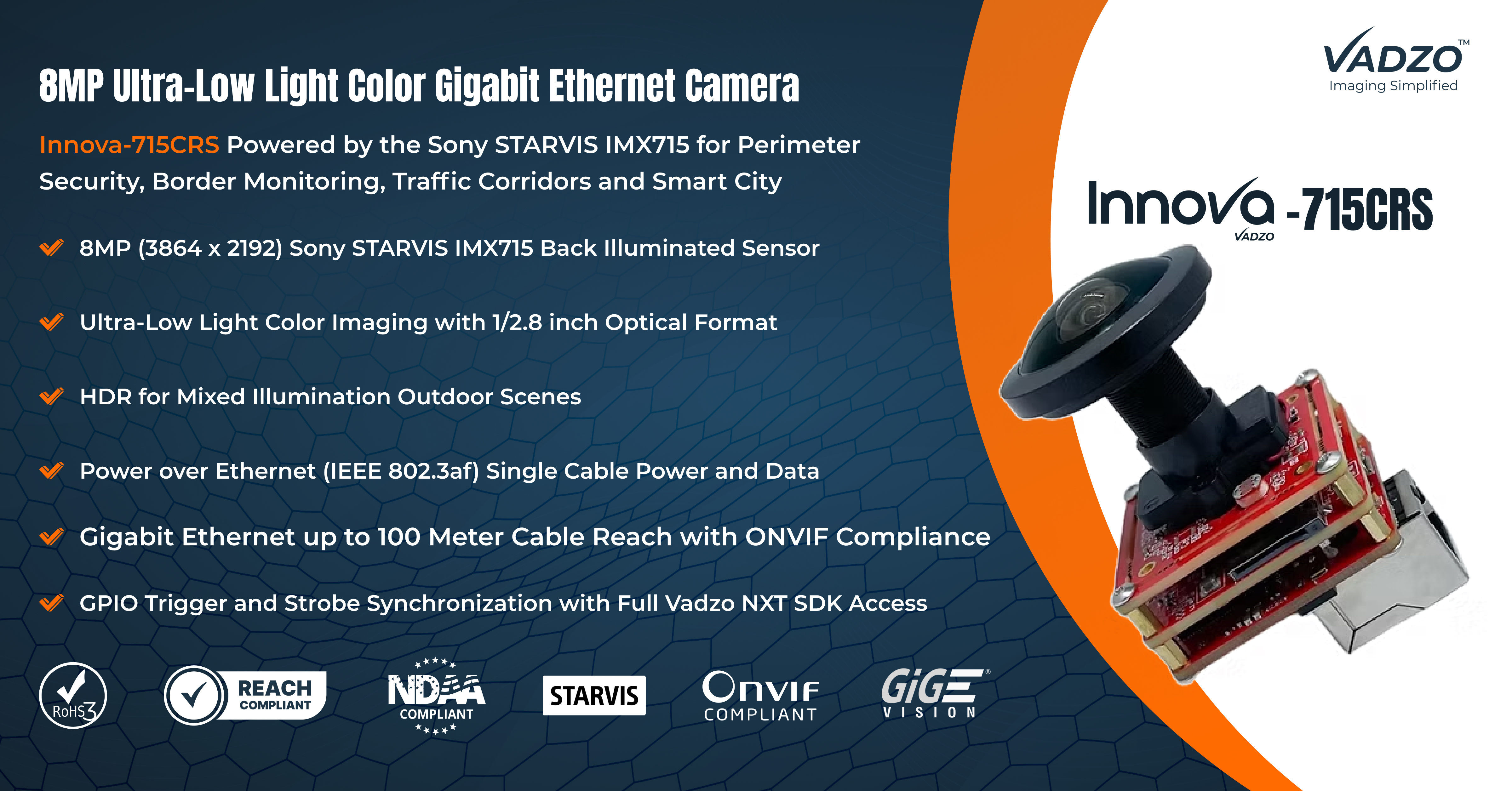
The Innova-715CRS is an 8MP color Gigabit Ethernet camera built on the Sony STARVIS IMX715 image sensor, positioned as an Ultra-Low Light Outdoor GigE Camera for outdoor vision deployments where the subject of interest sits far from the lens and the available light falls well below indoor levels, delivering back illuminated ultra low light color imaging, HDR handling of mixed illumination scenes, ONVIF compliant network video and Power over Ethernet single cable installation for perimeter surveillance, border security, traffic monitoring, smart city infrastructure and long range PTZ platforms.
SAN JOSE, CA / ACCESS Newswire / August 14, 2026 / The Innova-715CRS is an 8MP color Gigabit Ethernet camera built on the Sony STARVIS IMX715 image sensor, positioned as an Ultra-Low Light Outdoor GigE Camera for outdoor vision deployments where the subject of interest sits far from the lens and the available light falls well below indoor levels, delivering back illuminated ultra-low light color imaging, HDR handling of mixed illumination scenes, ONVIF compliant network video and Power over Ethernet single cable installation for perimeter surveillance, border security, traffic monitoring, smart city infrastructure and long range PTZ platforms.
Vadzo Imaging, a provider of embedded vision solutions, today announces the launch of the Innova-715CRS, an 8MP ultra-low-light Gigabit Ethernet camera built on the Sony STARVIS IMX715 image sensor. With this launch, Vadzo extends its Innova Gigabit Ethernet camera portfolio into the outdoor long-range imaging tier, targeting OEM engineers and system integrators building perimeter intrusion nodes, border monitoring towers, highway surveillance corridors, and smart city camera networks where night performance and standoff distance determine whether a vision system meets its detection specification.
The Engineering Problem: Detail Loss at Distance After Dark
Outdoor vision systems fail in a predictable way. During daylight hours, almost any modern sensor produces an image a detection model can work with. After sunset, the scene illuminance at a perimeter fence line, a rural highway shoulder, or an unlit industrial yard drops toward the range between full moonlight and sparse street lighting. At those levels, the photon flux reaching each pixel during the available exposure window is small enough that sensor read noise and dark current become significant fractions of the total signal. The camera compensates with gain, and gain amplifies noise along with signal, producing a grainy, low-contrast frame.
The operational result is worse than a cosmetic problem. Detection pipelines depend on edge gradients and local contrast at specific spatial frequencies, and when the signal-to-noise ratio collapses, those gradients disappear into sensor noise before any inference stage sees them. A license plate legible at dusk becomes a blur of luminance, and a person walking a fence line at eighty meters becomes indistinguishable from vegetation movement. False alarm rates climb, and operators stop trusting the alerts.
Distance compounds this. An Outdoor Surveillance GigE Camera monitoring a long approach corridor must resolve a target occupying a very small angular slice of the scene. Increasing focal length narrows the field of view and places more pixels on the target, but a longer lens at a fixed aperture diameter collects less light per unit of image area. Adding infrared illumination hits a physical limit because irradiance falls with the square of distance, so holding illumination out to one hundred meters requires roughly sixteen times the radiant power needed at twenty-five meters, which is rarely available at a PoE-powered pole node.
Engineering Rationale: Why Sensitivity and Pixels on Target Must Be Solved Together
Long-range outdoor imaging is governed by two constraints that engineering teams frequently address in isolation. The first is spatial sampling. Recognition tasks require a minimum number of pixels across the critical dimension of the target, and increasing sensor resolution raises pixels on target at any given focal length. This is why an 8MP GigE Camera covers a wider useful range than a 2MP sensor product on the same optics. The second constraint is radiometric. The signal collected by each pixel is a function of entrance pupil area, exposure time, optical transmission, and pixel quantum efficiency.
These two constraints pull in opposite directions. Raising resolution within a fixed optical format reduces pixel pitch and therefore the photon collection area of each pixel. Extending exposure time to recover that signal introduces motion blur, and motion is exactly what an outdoor monitoring system is deployed to observe. This is the trade space in which a Long-Distance Imaging Camera has to be specified, and it is why sensor architecture matters more than the headline resolution number.
The resolution to this trade space is a sensor that recovers sensitivity through pixel architecture rather than pixel size. A back-illuminated structure places the photodiode directly in the incoming optical path with the metal interconnect layers routed beneath the photosensitive area, raising fill factor and quantum efficiency substantially over a front-illuminated pixel of identical geometry. Sony developed the STARVIS family around this objective, which makes a Sony Starvis GigE Camera architecture the correct starting point for outdoor night imaging rather than a machine vision sensor optimized for well-lit factory floors.
Sensor and Camera Overview
The Innova-715CRS is built on the Sony IMX715 Image Sensor, a back-illuminated CMOS sensor in a 1/2.8 inch optical format with a 1.45 µm pixel pitch and a maximum resolution of 8MP at 3864 x 2192. The sensor uses a rolling shutter readout architecture and belongs to the Sony STARVIS line developed for surveillance imaging under low illumination. As a Sony Starvis 8MP GigE Camera, the Innova-715CRS carries that low-light lineage forward into an 8-megapixel resolution class that earlier STARVIS generations in this product line did not reach. As an IMX715 Color GigE Camera and 8MP Color GigE Camera, the product retains color output through the Bayer filter array, which matters for outdoor monitoring where vehicle, clothing, and signage color are descriptive attributes that operators and analytics both use.
Pairing 8MP resolution with a back-illuminated STARVIS pixel is the defining engineering decision in this product. At 1.45 µm, the pixel pitch is smaller than that of a 2MP sensor in the same optical format, so the back-illuminated structure is the mechanism that returns the per-pixel sensitivity the higher pixel count would otherwise cost. Pixel binning remains available where a deployment values sensitivity over spatial detail.
On the camera side, the Innova-715CRS connects through a single RJ45 connector and supports IEEE 802.3af Power over Ethernet, delivering power and video across a single cable run of up to 100 meters. The camera is ONVIF compliant for direct integration with Video Management Systems and Network Video Recorders, supports GPIO for hardware trigger and strobe synchronization, and accepts standard S-Mount (M12) optics. Driver and SDK support spans Windows, Linux, and Android platforms through Vadzo NXT. Within the broader Gigabit Ethernet camera module range, this product occupies the ultra-low-light 8MP tier of the Innova series.
Key specs: Sony STARVIS IMX715 | 8MP (3864 x 2192) | Rolling Shutter | Sensor Format 1/2.8 inch | Pixel Size 1.45 µm x 1.45 µm | Back Illuminated CMOS | HDR | Color | Gigabit Ethernet with PoE (IEEE 802.3af) | ONVIF Compliant | Standard RJ45 Ethernet Interface | GPIO Trigger and Strobe | S-Mount (M12 Standard) with Auto Switch IR-Cut Filter | Windows, Linux and Android
Key Capabilities of the Innova-715CRS
Ultra Low Light Color Imaging Built on a Back-Illuminated STARVIS Pixel: The primary capability of this product is usable color imaging after dark without supplemental illumination infrastructure. As an IMX715 Ultra-Lowlight GigE Camera, the Innova-715CRS uses the back-illuminated STARVIS pixel structure to raise quantum efficiency at the wavelengths that dominate night scenes lit by street lighting, headlights, and residual skylight. The practical consequence is a lower gain setting at any given scene illuminance, and lower gain means less amplified read noise reaching the encoder and the inference stage. Vadzo positions this configuration as both an IMX715 Ultra-Lowlight Rolling Shutter GigE Camera and an IMX715 Ultra-Lowlight Color GigE Camera within the Innova series. As an 8MP Ultra-Lowlight Color GigE Camera, it holds color discrimination into illumination levels where sensor products of the same resolution class have reverted to monochrome night mode. Where infrared illuminators are still required, the same sensitivity advantage lowers the radiant power budget, and teams can review how NIR imaging behaves at 850 nm and 940 nm before finalizing an illumination design.
8MP Resolution for Long Range Reach and PTZ Long Range Integration: Resolution is the mechanism that converts optical reach into recognition capability. An 8MP Ultra-Lowlight GigE Camera delivering 3864 x 2192 provides approximately four times the pixel count of a 1080p sensor product, which translates directly into pixels on target. For a fixed-mount Long Range GigE Camera node, a single unit covers an approach corridor that would otherwise need a narrower field of view and a second camera for situational context. For a PTZ Long Range Camera assembly, the same pixel density provides digital zoom headroom within the optical zoom range, so an operator can pull in on a region of interest without reaching the interpolation floor. Region of interest streaming transmits only the windowed area at full resolution, keeping bandwidth proportional to the area under observation.
HDR for the Mixed Illumination Reality of Outdoor Scenes: Outdoor scenes are rarely uniformly lit. A perimeter gate at night contains a floodlit apron next to unlit ground, and a highway shoulder contains oncoming headlights against a dark road surface. A sensor without dynamic range headroom saturates in the bright region and returns no signal in the dark region of the same frame. As an IMX715 HDR GigE Camera, the Innova-715CRS applies HDR processing across both extremes so a face in shadow and a plate under direct illumination stay readable in one capture. Specifying an 8MP HDR GigE Camera rather than a standard dynamic range unit is the difference between a frame that supports an enforcement decision and a frame that only proves something moved. Because sensitivity and dynamic range are addressed in the same pixel, the product serves as an IMX715 Ultra-Lowlight HDR GigE Camera and an 8MP Ultra-Lowlight HDR GigE Camera. As an IMX715 HDR Rolling Shutter GigE Camera, the product delivers this within the readout model appropriate to surveillance frame rates.
Gigabit Ethernet and Power over Ethernet for Perimeter Scale Installation: Interface choice determines installation cost at scale. As a Sony Starvis Gigabit Ethernet Camera, the Innova-715CRS provides up to 1000 Mbps of bandwidth, supporting 8MP streaming with deterministic low-latency delivery. IEEE 802.3af Power over Ethernet means a single run carries power and video up to 100 meters, removing local power provisioning at each mounting point. For nodes distributed along a fence line, or a smart city corridor with units on successive light poles, this is the difference between a network cable pull and an electrical contract. Nodes aggregate through standard managed switches, allowing an 8MP Gigabit Ethernet Camera network to scale without the cable length and host port constraints that limit USB architectures. The case for network interfaces in distributed vision systems is examined in the Vadzo analysis of the GigE camera in modern robotic vision.
ONVIF Compliance and GPIO Synchronization for System-Level Integration: An outdoor node rarely operates alone. ONVIF compliance allows the Innova-715CRS to register directly with Video Management Systems, Network Video Recorders, and third-party analytics platforms already deployed in security and smart city infrastructure, removing proprietary driver work from the integration path. GPIO support allows capture to be triggered by an external event such as an inductive loop detection, a radar trigger, or a beam break at a gate, so exposure timing aligns to the physical event rather than host-side software timing. The same architecture supports synchronized capture across units in corridor deployments where a vehicle is tracked across overlapping fields of view.
Product Specifications
Parameter |
Specification |
Model |
Innova-715CRS |
Image Sensor |
IMX715 CMOS Sensor from Sony Starvis |
Maximum Resolution |
8MP (3864 x 2192) |
Optical Format |
1/2.8 inch |
Pixel Size |
1.45 µm x 1.45 µm |
Shutter Type |
Rolling Shutter |
Output |
Color |
Dynamic Range |
HDR |
Interface |
Gigabit Ethernet, RJ45 |
Power |
Power over Ethernet (IEEE 802.3af) |
Network Compliance |
ONVIF Compliant |
Synchronization |
GPIO Trigger and Strobe |
Optics |
S-Mount (M12 Standard) |
Operating Temperature |
-30°C to +85°C |
Platform Support |
Windows, Linux and Android |
Compliance |
ONVIF, RoHS, REACH |
"Outdoor vision is where imaging specifications get tested honestly. A sensor that looks strong on a bench at 500 lux tells you very little about what an operator sees at a fence line at two in the morning. We selected the IMX715 for the Innova-715CRS because the back-illuminated STARVIS pixel gives 8MP spatial resolution without paying for it in night performance, and that combination is what perimeter, border, and traffic teams have been asking us for. The interface decision follows the same logic. Power over Ethernet and ONVIF compliance mean the imaging node drops into infrastructure that already exists." - Alwin Vincent, Product Manager, Vadzo Imaging
Applications
Perimeter Surveillance and Border Security: Perimeter intrusion detection at substations, water treatment plants, logistics yards, airports and correctional facilities requires reliable classification of human presence at standoff distances where thermal alternatives deliver detection without identification. As a Perimeter Surveillance Camera platform, the Innova-715CRS supplies the pixel density to separate an authorized worker from an intruder under residual lighting. In a Border Security GigE Camera role, PoE nodes on existing pole and tower infrastructure aggregate to a central control room over standard networking, and color output preserves clothing and vehicle descriptors that monochrome thermal imaging cannot. Vadzo supports these deployments across its security and surveillance imaging range.
Traffic Monitoring and Intelligent Transportation: Highway surveillance, intersection monitoring, tolling approach lanes, and automated number plate recognition all depend on preserving plate legibility and vehicle classification detail under headlight-dominated night scenes. As a Traffic Monitoring GigE Camera, the Innova-715CRS combines 8MP resolution for multiple lane coverage from a single gantry position with the HDR headroom to hold plate detail against direct headlight illumination. The 8MP Rolling Shutter Color GigE Camera output supports vehicle color as a search attribute in incident review, and network delivery integrates with roadside edge compute and traffic management platforms. The same characteristics extend to telematics and fleet management installations.
Smart City Infrastructure and Public Safety Nodes: Municipal deployments place imaging nodes on light poles, transit shelters, intersections, and plazas where power provisioning is constrained, and network backhaul already exists. As an 8MP Ultra-Lowlight Gigabit Ethernet Camera, the Innova-715CRS works within a PoE budget while delivering the resolution crowd monitoring, public safety review, and parking occupancy analytics require. ONVIF compliance lets units join municipal Video Management Systems without custom integration work, which matters when a city network aggregates hardware from several procurement cycles. Vadzo supports municipal integrators across its smart city solutions portfolio and pairs this unit with the ultra-low-light 1080p GigE camera built on the Sony IMX662 where 1080p is sufficient.
Industrial Automation, Robotics and Outdoor Asset Monitoring: Outdoor industrial environments including ports, rail yards, mining operations, construction sites and utility substations require imaging that survives variable natural lighting across a full diurnal cycle. As a Sony Starvis Rolling Shutter GigE Camera and IMX715 Rolling Shutter Color GigE Camera, the Innova-715CRS supports remote inspection, equipment monitoring, gate automation and yard management under uncontrolled illumination. GPIO triggering aligns capture with gate cycles, weighbridge events, or conveyor states. Vadzo covers these requirements across its automation and robotics imaging range, and applications needing distortion-free capture of fast motion are better served by the 1080p GigE global shutter camera built on the onsemi AR0234.
Retail, Kiosk and Public Interface Deployments: Retail loss prevention, forecourt monitoring, drive-through lanes, and outdoor kiosk installations operate under mixed illumination with a wide contrast range between interior and exterior lighting. As an 8MP HDR Color GigE Camera and IMX715 HDR Color GigE Camera, the Innova-715CRS resolves faces and transactions across that range in a single frame, and the 8MP HDR Rolling Shutter GigE Camera output supports live monitoring and forensic review from one stream. Vadzo addresses these use cases through its retail automation solutions and kiosk and digital signage imaging ranges, and resolution considerations for unattended terminals are covered in the Vadzo guide to a high-resolution camera portfolio for kiosks. Non-contact monitoring in clinical environments is addressed within the Vadzo medical device and patient care range.
Frequently Asked Questions
Q: What should engineers look for in a GigE camera intended for outdoor low-light surveillance?
A: Four parameters govern the outcome. The first is sensor architecture, where a back-illuminated pixel structure delivers substantially higher quantum efficiency than a front-illuminated pixel of the same pitch. The second is dynamic range, because outdoor scenes contain directly illuminated and unlit regions in the same frame, and a sensor without HDR headroom clips one or the other. The third is resolution relative to standoff distance, since sensitivity cannot compensate for insufficient spatial sampling. The fourth is power architecture, where Power over Ethernet removes local power provisioning from the installation budget. Vadzo Imaging builds its Innova Gigabit Ethernet camera module range around these parameters, and the Innova-715CRS IMX715 GigE Camera addresses all four in one 8MP unit.
Q: How does an 8MP ultra-low-light network camera improve long-range detection compared to a 1080p unit?
A: The improvement is spatial sampling. At a fixed focal length and mounting position, an 8MP sensor delivers roughly twice the linear pixel density of a 1080p sensor, extending the distance at which a face, a license plate, or a vehicle type stays resolvable without changing optics. The trade is bandwidth and per-pixel light collection, which is why sensor architecture matters as much as pixel count. The Innova-715CRS from Vadzo Imaging addresses that trade by combining 8MP output with a back-illuminated STARVIS pixel, and region of interest streaming keeps network load proportional to the area observed. Teams sizing resolution for a specific standoff distance can work through the Vadzo guide to field of view in camera systems before selecting optics.
Q: Can a rugged outdoor GigE camera be deployed without a separate enclosure design cycle?
A: It depends on the form factor. A board-level camera module gives the OEM full control over mechanical integration, thermal management, and optical path, which is the right choice when the housing is part of the product being built. When the requirement is direct outdoor mounting without a housing design cycle, an IP-rated enclosed unit is correct. Vadzo Imaging supports both paths. The Innova Gigabit Ethernet camera series is available in enclosed IP-rated configurations, and Vadzo provides IP-rated enclosure design and manufacturing as a standard customization service, which lets an integrator specify a Weatherproof GigE Camera assembly around the Innova-715CRS.
Q: Is a rolling shutter sensor acceptable for traffic monitoring and perimeter surveillance applications?
A: For most surveillance and traffic monitoring geometries, yes. Rolling shutter distortion becomes significant when the angular velocity of the subject across the sensor is high relative to the row readout interval, which is the case in conveyor inspection, high-speed sorting, and close-range robotic guidance. In a perimeter or roadside deployment, the camera sits at a standoff distance where even a fast vehicle traverses a modest number of pixels per readout period, so geometric distortion stays within tolerance for plate recognition and classification. Rolling shutter sensor products also offer higher sensitivity and lower cost per pixel at a given resolution, which is why an IMX715 Rolling Shutter GigE Camera or 8MP Rolling Shutter GigE Camera suits this class. Applications requiring simultaneous exposure of every pixel should specify a global shutter product, and Vadzo offers both, including monochrome units available to buy monochrome GigE camera online.
Q: Does Vadzo Imaging customize GigE camera products for specific OEM outdoor deployments?
A: Yes. Vadzo Imaging engages at the hardware and firmware level rather than reselling catalog configurations. Available customization covers board redesign and form factor changes, lens and lens holder modification for specific focal length and field of view requirements, optical filter changes including IR cut and band pass selection, NIR and visible LED array integration, IP-rated enclosure design and manufacturing for pole, tower, and gantry mounting, and firmware modification for custom exposure behavior, streaming profiles, and trigger logic. This matters for outdoor programs because mounting geometry, ambient lighting, and network topology differ at every site. Vadzo engineering teams work directly with OEM developers and integrators from evaluation through production scaling, and the Innova Sony Starvis IMX715 GigE Camera configuration can be adapted to project-specific requirements at any volume.
Availability and Customization
The Innova-715CRS 8MP Ultra-Lowlight Rolling Shutter GigE Camera is available for evaluation and production orders with no minimum order requirement. Evaluation units include the camera and lens assembly, PoE injector, Ethernet cable, and Vadzo NXT documentation. Configuration details are on the Vadzo online store, and engineering teams can reach the Vadzo applications group through the contact support page to discuss lens selection, enclosure requirements, or OEM integration.
About Vadzo Imaging
Vadzo Imaging is a global provider of embedded vision solutions delivering high-performance camera technologies and imaging platforms for robotics, industrial automation, UAVs, edge AI, security and medical systems. Its products are designed for integration with leading embedded platforms including NVIDIA Jetson, Raspberry Pi, Qualcomm RB series and NXP i.MX. Vadzo supports customers through hardware customization, firmware development, and the Vadzo NXT platform, enabling faster deployment of vision-based systems
Media Contact
Alwin Vincent
Vadzo Imaging
Email: alwin@vadzoimaging.com
LinkedIn: Vadzo Imaging
YouTube: Vadzo Imaging
X: Vadzo Imaging
SOURCE: Vadzo Imaging
View the original press release on ACCESS Newswire