Reusable packaging is shifting from cost to asset-driven by regulation, rising costs, and tech-enabled reverse logistics improving visibility, efficiency, and ROI.
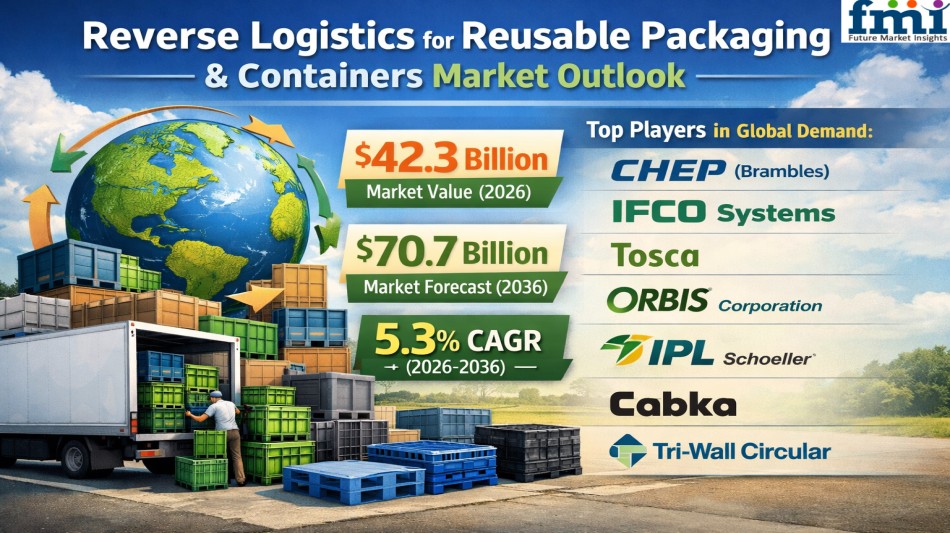
NEWARK, DE / ACCESS Newswire / April 7, 2026 / The global reverse logistics ecosystem for reusable packaging and containers is entering a decisive growth phase, as supply chains pivot toward circularity, cost efficiency, and regulatory compliance. Valued at USD 42.3 billion in 2026, the market is projected to reach USD 70.7 billion by 2036, expanding at a CAGR of 5.3%. This growth trajectory reflects a fundamental shift in how companies perceive packaging not as a disposable cost center, but as a managed, revenue-protecting asset within closed-loop logistics systems.
According to a comprehensive strategic outlook by Future Market Insights (FMI), rising regulatory pressure on packaging waste, increasing corrugated costs, and the need for improved asset utilization are accelerating the adoption of reusable transport packaging supported by efficient reverse logistics networks.
Reverse Logistics for Reusable Packaging and Containers Market Metrics at a Glance (2026-2036)
Market Size (2026): USD 42.3 Billion
Projected Value (2036): USD 70.7 Billion
CAGR (2026-2036): 5.3%
Top Growth Market: India
Leading Service Model: Pooling Services
Key Technology: RFID & Barcode Tracking
Discover Growth Opportunities in the Market - Get Your Sample Report Now
https://www.futuremarketinsights.com/reports/sample/rep-gb-32594
The Circular Shift: From One-Way Packaging to Managed Asset Systems
The economics of packaging are undergoing a structural transformation. Traditional single-use formats are rapidly losing ground as companies embrace reusable pallets, crates, totes, drums, and intermediate bulk containers (IBCs) that can be recovered, cleaned, repaired, and redeployed across multiple cycles.
This transition is not merely environmental it is financial. Value creation in the reverse logistics ecosystem is increasingly driven by asset recovery rates, circulation velocity, and lifecycle optimization, rather than volume-based packaging sales.
"Packaging is no longer consumed it is circulated," notes a senior logistics analyst. "The winners in this market will be those who can maintain high asset visibility, minimize dwell time, and ensure consistent recovery across fragmented supply chains."
However, the shift introduces operational complexity. Weak visibility across return loops-where containers remain idle, lost, or untracked continues to erode profitability. As a result, companies are investing heavily in digital tracking systems and network optimization to maintain control over reusable fleets.
The Visibility Imperative: Technology as the Backbone
One of the defining characteristics of this market is the increasing reliance on technology-enabled asset tracking. RFID and barcode systems are expected to account for 46% of the market in 2026, reflecting their role in improving traceability across large-scale reusable packaging fleets.
Without accurate tracking, reverse logistics systems break down. Containers that cannot be located, counted, or returned efficiently lead to reduced asset turns and higher replacement costs.
Emerging solutions including IoT-enabled sensors and integrated ERP-linked tracking platforms-are enhancing real-time visibility, enabling operators to:
Monitor asset movement across distribution nodes
Identify idle inventory points
Schedule maintenance and cleaning cycles
Reduce shrinkage and unauthorized diversion
This data-driven approach is transforming reverse logistics into a precision-managed operation, where analytics directly influence profitability and service reliability.
Evolving Cost Structures: Pooling Gains Momentum
The market is witnessing a strong shift toward pooling service models, which are projected to account for a significant share of total demand. In 2026, pooling services are expected to contribute approximately 34%-41% of the market, as companies increasingly outsource asset ownership and management.
Pooling providers offer a compelling value proposition:
Reduced capital expenditure on packaging assets
Access to established recovery and washing networks
Improved asset availability during peak demand cycles
Standardized hygiene and maintenance processes
This model is particularly attractive for mid-sized retailers and food producers, who prefer operational flexibility over asset ownership. However, adoption remains limited in specialized industrial applications where proprietary packaging designs restrict shared usage.
Segment Spotlight: Crates, Pallets, and Plastic Dominance
Crates and High-Velocity Retail
Reusable crates are emerging as a cornerstone of modern retail logistics, accounting for 28% of the market share. Their standardized design, durability, and compatibility with automated systems make them ideal for high-frequency food distribution networks.
Retailers favor crates for their ability to:
Reduce product damage during transit
Improve airflow for perishable goods
Enable faster shelf replenishment
Minimize reliance on corrugated packaging
Pallets: Scale Advantage
Pallets continue to dominate large-scale distribution, projected to hold 38% of the market in 2026. Their widespread use across manufacturing and retail supply chains ensures consistent demand, particularly within established pooling networks.
Plastic Materials Lead
Plastic is expected to account for 49% of total demand, driven by its durability, lightweight properties, and suitability for repeated-use cycles. Its washability and resistance to wear make it the preferred material for reusable systems across industries.
End-Use Dynamics: Food Retail Leads the Charge
The food and beverage sector remains the largest end-use segment, contributing 29% of the market in 2026. High turnover rates, strict hygiene requirements, and retailer-driven sustainability goals are accelerating the adoption of reusable packaging systems.
Supermarket chains are increasingly replacing single-use cardboard with reusable crates and pallets, enabling faster stocking, reduced waste, and improved operational efficiency.
Beyond food retail, strong demand is also emerging from:
Automotive and industrial manufacturing
Retail distribution and e-commerce
Healthcare and temperature-controlled logistics
Each of these sectors benefits from predictable return flows and high asset utilization, which are critical for the economic viability of reusable systems.
Regional Powerhouses: Asia Leads Growth Momentum
While reusable packaging adoption is global, growth patterns vary significantly by region:
India (5.6% CAGR): Rapid retail modernization and increased use of returnable plastic crates are driving market expansion. Standardization across vendor networks is improving efficiency and reducing spoilage.
United States (5.4% CAGR): Mature pooling networks and advanced tracking infrastructure support widespread adoption, particularly in retail and cold chain logistics.
China (5.3% CAGR): As a manufacturing powerhouse, China continues to expand reusable packaging use across automotive, industrial, and retail supply chains.
Europe remains a regulation-driven market, with stringent packaging waste policies pushing companies toward reusable systems. Countries such as Germany and the United Kingdom are characterized by mature infrastructure and strong compliance frameworks.
Dynamics of the Decade: Sustainability Meets Economics
Looking ahead to 2036, the reverse logistics market will be shaped by two powerful forces: sustainability mandates and economic efficiency.
Regulatory Acceleration: New packaging waste regulations particularly in Europe are mandating higher reuse rates and stricter reporting requirements. These policies are forcing companies to invest in robust reverse logistics systems to remain compliant.
Cost Optimization Pressure: Rising costs of single-use packaging materials are making reusable systems more attractive, especially in high-frequency distribution environments. Companies are increasingly evaluating packaging decisions based on lifecycle cost rather than upfront price.
Network Density as a Competitive Edge: The success of reverse logistics systems depends heavily on network density. Operators with extensive wash centers, repair hubs, and recovery routes are better positioned to minimize empty returns and maintain asset circulation efficiency.
Competitive Landscape: Networks Over Products
The competitive dynamics of the market are shifting away from product design toward network capabilities and data integration.
Key players including CHEP (Brambles), IFCO Systems, Tosca, ORBIS Corporation, IPL Schoeller, Cabka, and Tri-Wall Circular are focusing on expanding their recovery networks and enhancing digital tracking capabilities.
Market leadership is increasingly defined by:
Depot and wash-center density
Asset pool scale and availability
Data transparency and interoperability
Recovery efficiency and turnaround time
Meanwhile, new entrants are targeting niche opportunities through specialized container designs and technology-driven tracking solutions.
Future Outlook: A Data-Driven Circular Economy
The reverse logistics for reusable packaging and containers market is poised to become a cornerstone of the global circular economy. As companies strive to balance sustainability with profitability, reusable packaging systems will play a critical role in reducing waste, optimizing costs, and improving supply chain resilience.
By 2036, the market will not only be larger it will be smarter, more interconnected, and increasingly driven by data. Organizations that can integrate asset tracking, network optimization, and regulatory compliance into a unified strategy will be best positioned to capture long-term value in this evolving landscape.
For an in-depth analysis of evolving formulation trends and to access the complete strategic outlook for the Reverse Logistics for Reusable Packaging and Containers Market through 2036, visit the official report page at: https://www.futuremarketinsights.com/reports/reverse-logistics-for-reusable-packaging-and-containers-market
Explore More Research Reports by FMI
Cold Lamination Machine Market - https://www.futuremarketinsights.com/reports/cold-lamination-machine-market
Transparent rPET Market for Beverage Category - https://www.futuremarketinsights.com/reports/transparent-rpet-market-for-beverage-category
Paint Cans Market - https://www.futuremarketinsights.com/reports/paint-cans-market
Tarpaulin Sheets Market - https://www.futuremarketinsights.com/reports/tarpaulin-sheets-market
Digital Textile Printing Market - https://www.futuremarketinsights.com/reports/digital-textile-printing-market
About Future Market Insights (FMI)
Future Market Insights (FMI) is a leading provider of market intelligence and consulting services, serving clients in over 150 countries. Headquartered in Delaware, USA, with a global delivery center in India and offices in the UK and UAE, FMI delivers actionable insights to businesses across industries including automotive, technology, consumer products, manufacturing, energy, and chemicals.
An ESOMAR-certified research organization, FMI provides custom and syndicated market reports and consulting services, supporting both Fortune 1,000 companies and SMEs. Its team of 300+ experienced analysts ensures credible, data-driven insights to help clients navigate global markets and identify growth opportunities.
For Press & Corporate Inquiries
Rahul Singh
AVP - Marketing and Growth Strategy
Future Market Insights, Inc.
+91 8600020075
For Sales - sales@futuremarketinsights.com
For Media - Rahul.singh@futuremarketinsights.com
For web - https://www.futuremarketinsights.com/
SOURCE: Future Market Insights, Inc.
View the original press release on ACCESS Newswire