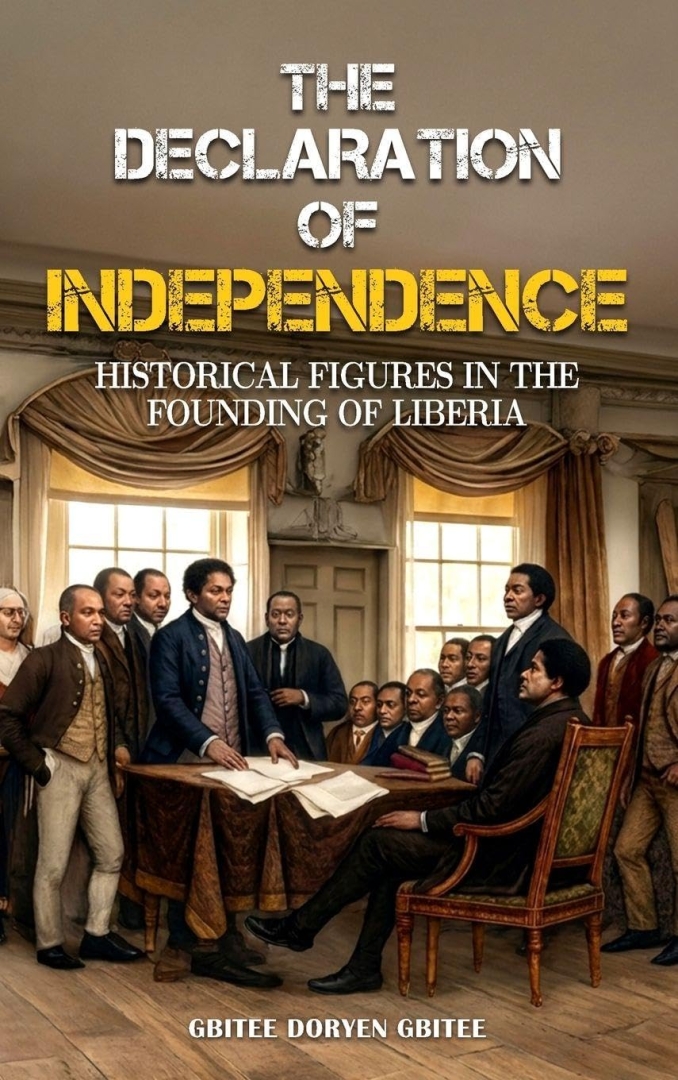
A new historical work titled The Declaration of Independence: Historical Figures in the Founding of Liberia by Gbitee Doryen Gbitee presents an expansive examination of the individuals, movements, and political structures that contributed to the establishment of Liberia during the nineteenth century. Drawing from documented historical records, political writings, missionary accounts, and colonization archives, the book explores the deeply layered process through which Liberia emerged as a settlement project and later developed into an independent republic.
Rather than presenting Liberia’s formation through a singular celebratory narrative, the work investigates the ideological tensions and structural contradictions embedded within the country’s origins. At the center of the book is the role played by the American Colonization Society, an institution established to relocate formerly enslaved African Americans to West Africa. Through detailed historical analysis, the book examines how the organization simultaneously promoted the language of liberation while maintaining systems of political control and racial hierarchy within the settlement.
The narrative traces the development of key settlements including Monrovia, New Georgia, Caldwell, Millsburg, Kentucky-in-Africa, Mississippi-in-Africa, and Maryland-in-Africa. These settlements are presented not simply as geographic expansions, but as political and cultural extensions of American social structures transplanted onto West African soil. The book documents how formerly enslaved settlers carried with them both the aspirations of self-governance and the social conditioning shaped by slavery and segregation in the United States.
A significant focus of the work is placed on historical figures whose influence shaped Liberia’s early identity. Individuals such as Lott Carey and Jehudi Ashmun are examined through both their humanitarian contributions and their political involvement in settlement expansion. The book also evaluates the ideological role of prominent American figures, including Henry Clay, whose advocacy for colonization reflected broader nineteenth-century debates surrounding slavery, race, citizenship, and national identity.
Throughout the work, the relationship between Americo-Liberian settlers and indigenous African communities remains central. The narrative documents how conflicts over land, governance, religion, and authority developed alongside settlement expansion, creating long-term social divisions that would continue to shape Liberian society for generations. These tensions are explored not as isolated incidents, but as structural outcomes of colonization, cultural transplantation, and unequal political power.
The Declaration of Independence also addresses the role of Christianity and missionary activity in the settlement process, illustrating how religion functioned both as a tool of education and as a mechanism of cultural transformation. Churches, schools, and missionary institutions became foundational to settlement life while simultaneously reinforcing settler influence over indigenous populations.
Positioned within the broader field of African and diasporic historical studies, The Declaration of Independence: Historical Figures In the Founding of Liberia combines historical documentation with critical interpretation to present a comprehensive account of Liberia’s formative years. The work is intended for readers interested in African history, Black diasporic movements, post-colonial studies, political history, and the transatlantic legacy of slavery and migration.
By examining the ambitions, contradictions, and power structures surrounding Liberia’s founding, Gbitee contributes to ongoing conversations about identity, governance, freedom, and the historical consequences of colonization. He presents Liberia not only as a political project, but as a deeply human story shaped by displacement, aspiration, conflict, and the search for self-determination.
Media Contact
Company Name: Gbitee Doryen Gbitee
Contact Person: Gbitee Doryen Gbitee
Email: Send Email
Country: United States
Website: https://doyengbiteeauthor.com/