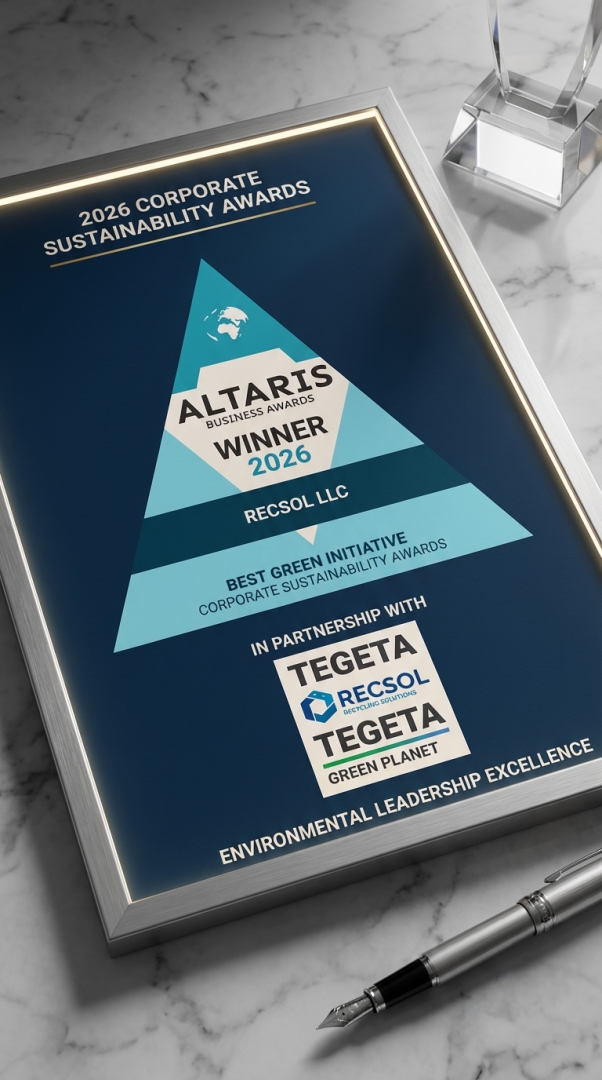
Every so often, a project comes along that does more than improve an existing system—it creates one where none existed. It fills a gap so fundamental that its absence had become invisible, accepted as simply the way things were. For Georgia’s waste infrastructure, that gap was end-of-life tires. And at the 2026 Altaris Corporate Sustainability Awards, the project that closed it was honored as the Best Green Initiative.
The recognition went to RECSOL, LLC, a company associated with Tegeta Holding, whose new tire recycling facility represents something rare in the sustainability landscape: not a pilot, not a prototype, but a fully operational, large-scale solution to a persistent environmental problem. It is Georgia’s first modern plant of its kind, and its impact extends far beyond the tons of material it processes.
The Problem Nobody Had Solved
For years, Georgia faced a quiet crisis. Millions of end-of-life tires accumulated each year, but the state lacked domestic capacity to process them. The tires that were not exported—often at significant cost and carbon expense—ended up in stockpiles, where they posed serious fire hazards and breeding grounds for disease-carrying mosquitoes. Others were simply lost to the environment, fragmenting into microplastics and leaching chemicals into soil and water.
The circular economy, for tires, was a concept that existed everywhere except in the infrastructure required to make it real. There was no modern facility capable of transforming these waste materials into reusable resources within the local economy. That gap was not just an environmental problem; it was a lost economic opportunity.
A Facility Built for the Circular Economy
RECSOL changed that calculation entirely. With significant investment and a nationwide collection network, the company-built Georgia’s first modern tire recycling plant—a facility designed from the ground up to close the loop on one of the state’s most persistent waste streams.
The plant does not simply dispose of tires; it transforms them. End-of-life tires entering the facility are processed into reusable materials that re-enter the industrial supply chain. What was once a liability becomes a resource. Waste is diverted from landfills and stockpiles. The environmental risk associated with tire accumulation is eliminated at the source.
This is circular economy infrastructure in its most tangible form. The facility creates domestic processing capacity where none previously existed, reducing the need for costly and carbon-intensive exports while building local resilience. It turns a linear waste stream—take, make, dispose—into a closed loop where materials are continuously cycled back into productive use.
What Made It a Winner
The Altaris Corporate Sustainability Awards are known for cutting through surface-level environmental claims to recognize genuine achievement. In selecting RECSOL as the Best Green Initiative, the judges highlighted what set the project apart.
“The project creates domestic processing capacity where there previously was none,” the awards announcement noted, “turning end-of-life tyres into reusable material rather than leaving them to be exported, stockpiled or lost to the environment. With significant investment, nationwide collection links and clear circular economy value, this is the kind of initiative that changes what is practically possible within a market.”
That last phrase is crucial. The award recognized not just a well-executed project, but one that alters the landscape of possibility. By establishing the infrastructure for tire recycling within Georgia, RECSOL has made circularity accessible in a way it simply was not before. Other businesses, municipalities, and industries can now engage with tire waste differently because there is now a local solution.
A Vision for Sustainable Infrastructure
For Shalva Akhvlediani, CEO of Tegeta Green Planet and RECSOL, the project represents a long-term commitment to environmental responsibility that extends beyond a single facility.
“This award is a recognition of our commitment to building sustainable infrastructure that serves both the environment and the economy,” said Akhvlediani. “RECSOL was created to solve a problem that Georgia had faced for decades. By establishing the country’s first modern tire recycling plant, we are not only eliminating a significant environmental hazard but also creating a circular model where waste becomes a valuable resource. This is just the beginning of our broader vision for sustainability across the Tegeta Holding portfolio.”
The quote underscores the strategic importance of the project within Tegeta Holding’s broader sustainability ambitions. RECSOL is not an isolated initiative; it is part of a larger commitment to environmental responsibility across the group’s diverse operations.
Beyond the Facility: A Model for Infrastructure Development
The significance of the project extends far beyond its own operations. It serves as a template for how to approach missing infrastructure in other sectors. RECSOL demonstrated that building a circular economy requires more than technology; it requires collection networks, investment discipline, and a long-term view of viability.
The nationwide collection links established alongside the plant ensure that tires can be aggregated efficiently from across the state. The scale of investment signals confidence in the long-term economics of circularity. And the plant’s design prioritizes durability and operational resilience, ensuring that the environmental benefits will persist for decades rather than years.
This integrated approach—linking processing capacity with collection infrastructure and commercial sustainability—is what elevates the project from a facility to a system. It is a model that could be replicated across other waste streams and other markets, demonstrating that the circular economy is not an abstract ideal but a practical, investable reality.
A Broader Shift in Sustainability Thinking
RECSOL’s Best Green Initiative award arrives at a moment when the sustainability community is increasingly focused on delivery over declarations. As the Altaris organizers noted in their 2026 awards, the strongest entries were those that treated sustainability not as positioning but as “something designed into systems, operations and long-term decision-making.”
The tire recycling plant embodies that philosophy. It is not a green initiative because of a marketing campaign or a set of offset purchases. It is a green initiative because it physically transforms a waste stream into a resource, creates infrastructure where none existed, and does so in a way that is built to last.
This is sustainability as engineering, as logistics, as investment. It is the kind of work that rarely makes headlines but fundamentally changes what is possible within an economy. And it is precisely the kind of work that the Altaris awards exist to celebrate.
The Partnership Behind the Achievement
None of this happened in isolation. Bringing a project of this scale to reality required not only vision but rigorous execution. Uniq Management Group, LLC—recognized in the same Altaris awards as Corporate Sustainability Advocate—played a critical supporting role, applying sustainability-driven procurement, strict quality control, and production metrics that gave RECSOL step-by-step control over the project. Together, the two organizations demonstrated that meaningful environmental progress is built on a foundation of commercial discipline and operational accountability.
The Path Forward
With the facility now operational, Georgia’s relationship with end-of-life tires has entered a new era. The stockpiles that once seemed inevitable are now a problem with a solution. The waste stream that once ended in export or environmental release is now a resource stream feeding back into the economy.
For RECSOL and Tegeta Holding, the Best Green Initiative award is recognition of what was achieved: a first-of-its-kind facility that closes a critical gap in the state’s environmental infrastructure. But the larger significance lies in what the project represents. It is proof that circular economy infrastructure can be built, financed, and operated successfully. It is a demonstration that sustainability is not only about reducing harm but about actively creating systems that are better than what came before.
As other regions and industries look to build their own circular economies, they will need more projects like this one—projects that do not just talk about change but build the facilities, networks, and systems that make it real. RECSOL’s tire recycling plant is one such project. And with the recognition of the Altaris awards, its example now reaches far beyond Georgia.
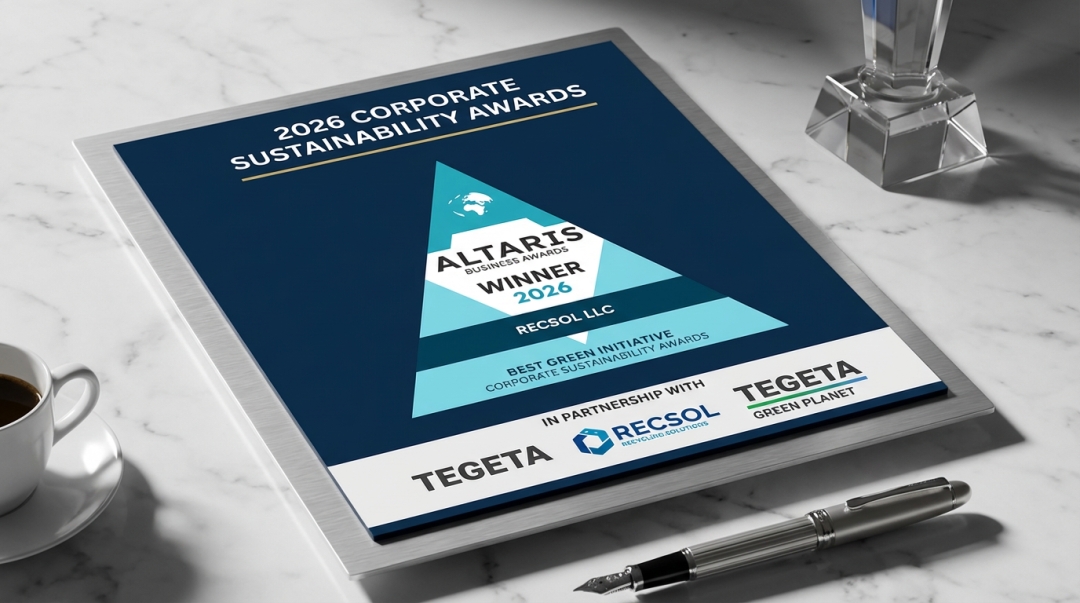
About the Altaris Corporate Sustainability Awards
The Altaris Corporate Sustainability Awards recognize organizations demonstrating credible, measurable progress in sustainability across governance, carbon reduction, circular economy, and net-zero strategy. The 2026 awards honored winners across multiple categories, with a focus on delivery, accountability, and long-term impact.
Media Contact
Company Name: RECSOL
Contact Person: Shalva Akhvlediani
Email: Send Email
Country: Georgia
Website: www.recsol.ge