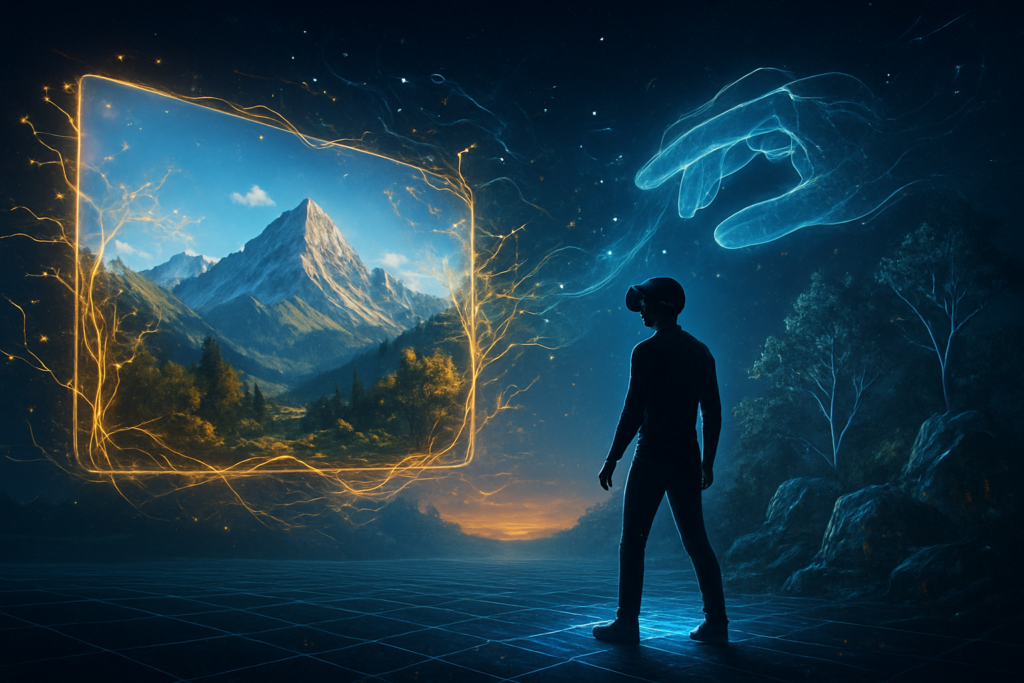
As of January 12, 2026, the landscape of generative artificial intelligence has shifted from merely creating content to constructing entire interactive realities. At the forefront of this evolution is Alphabet Inc. (NASDAQ: GOOGL) with its latest iteration of the Genie (Generative Interactive Environments) model. What began as a research experiment in early 2024 has matured into Genie 3, a sophisticated "world model" capable of transforming a single static image or a short text prompt into a fully navigable, 3D environment in real-time.
The immediate significance of Genie 3 lies in its departure from traditional video generation. While previous AI models could produce high-fidelity cinematic clips, they lacked the fundamental property of agency. Genie 3 allows users to not only watch a scene but to inhabit it—controlling a character, interacting with objects, and modifying the environment’s physics on the fly. This breakthrough signals a major milestone in the quest for "Physical AI," where machines learn to understand the laws of the physical world through visual observation rather than manual programming.
Technical Mastery: The Architecture of Infinite Environments
Technically, Genie 3 represents a massive leap over its predecessors. While the 2024 prototype was limited to low-resolution, 2D-style simulations, the 2026 version operates at a crisp 720p resolution at 24 frames per second. This is achieved through a massive autoregressive transformer architecture that predicts the next visual state of the world based on both previous frames and the user’s specific inputs. Unlike a traditional game engine like those from Unity Software Inc. (NYSE: U), which relies on pre-rendered assets and hard-coded physics, Genie 3 generates its world entirely through latent action models, meaning it "imagines" the consequences of a user's movement in real-time.
One of the most significant technical hurdles overcome in Genie 3 is "temporal consistency." In earlier generative models, turning around in a virtual space often resulted in the environment "hallucinating" a new layout when the user looked back. Google DeepMind has addressed this by implementing a dedicated visual memory mechanism. This allows the model to maintain consistent spatial geography and object permanence for extended periods, ensuring that a mountain or a building remains exactly where it was left, even after the user has navigated kilometers away in the virtual space.
Furthermore, Genie 3 introduces "Promptable World Events." While a user is actively playing within a generated environment, they can issue natural language commands to alter the simulation’s state. Typing "increase gravity" or "change the season to winter" results in an immediate, seamless transition of the environment's visual and physical properties. This indicates that the model has developed a deep, data-driven understanding of physical causality—knowing, for instance, how snow should accumulate on surfaces or how objects should fall under different gravitational constants.
Initial reactions from the AI research community have been transformative. Experts note that Genie 3 effectively bridges the gap between generative media and simulation science. By training on hundreds of thousands of hours of video data without explicit action labels, the model has learned to infer the "rules" of the world. This "unsupervised" approach to learning physics is seen by many as a more scalable path toward Artificial General Intelligence (AGI) than the labor-intensive process of manually coding every possible interaction in a virtual world.
The Battle for Spatial Intelligence: Market Implications
The release of Genie 3 has sent ripples through the tech industry, intensifying the competition between AI giants and specialized startups. NVIDIA (NASDAQ: NVDA), currently a leader in the space with its Cosmos platform, now faces a direct challenge to its dominance in industrial simulation. While NVIDIA’s tools are deeply integrated into the robotics and automotive sectors, Google’s Genie 3 offers a more flexible, "prompt-to-world" interface that could lower the barrier to entry for developers looking to create complex training environments for autonomous systems.
For Microsoft (NASDAQ: MSFT) and its partner OpenAI, the pressure is mounting to evolve Sora—their high-profile video generation model—into a truly interactive experience. While OpenAI’s Sora 2 has achieved near-photorealistic cinematic quality, Genie 3’s focus on interactivity and "playable" physics positions Google as a leader in the emerging field of spatial intelligence. This strategic advantage is particularly relevant as the tech industry pivots toward "Physical AI," where the goal is to move AI agents out of chat boxes and into the physical world.
The gaming and software development sectors are also bracing for disruption. Traditional game development is a multi-year, multi-million dollar endeavor. If a model like Genie 3 can generate a playable, consistent level from a single concept sketch, the role of traditional asset pipelines could be fundamentally altered. Companies like Meta Platforms, Inc. (NASDAQ: META) are watching closely, as the ability to generate infinite, personalized 3D spaces is the "holy grail" for the long-term viability of the metaverse and mixed-reality hardware.
Strategic positioning is now shifting toward "World Models as a Service." Google is currently positioning Genie 3 as a foundational layer for other AI agents, such as SIMA (Scalable Instructable Multiworld Agent). By providing an infinite variety of "gyms" for these agents to practice in, Google is creating a closed-loop ecosystem where its world models train its behavioral models, potentially accelerating the development of capable, general-purpose robots far beyond the capabilities of its competitors.
Wider Significance: A New Paradigm for Reality
The broader significance of Genie 3 extends beyond gaming or robotics; it represents a fundamental shift in how we conceptualize digital information. We are moving from an era of "static data" to "dynamic worlds." This fits into a broader AI trend where models are no longer just predicting the next word in a sentence, but the next state of a physical system. It suggests that the most efficient way to teach an AI about the world is not to give it a textbook, but to let it watch and then "play" in a simulated version of reality.
However, this breakthrough brings significant concerns, particularly regarding the blurring of lines between reality and simulation. As Genie 3 approaches photorealism and high temporal consistency, the potential for sophisticated "deepfake environments" increases. If a user can generate a navigable, interactive version of a real-world location from just a few photos, the implications for privacy and security are profound. Furthermore, the energy requirements for running such complex, real-time autoregressive simulations remain a point of contention in the context of global sustainability goals.
Comparatively, Genie 3 is being hailed as the "GPT-3 moment" for spatial intelligence. Just as GPT-3 proved that large language models could perform a dizzying array of tasks through simple prompting, Genie 3 proves that large-scale video training can produce a functional understanding of the physical world. It marks the transition from AI that describes the world to AI that simulates the world, a distinction that many researchers believe is critical for achieving human-level reasoning and problem-solving.
The Horizon: VR Integration and the Path to AGI
Looking ahead, the near-term applications for Genie 3 are likely to center on the rapid prototyping of virtual environments. Within the next 12 to 18 months, we expect to see the integration of Genie-like models into VR and AR headsets, allowing users to "hallucinate" their surroundings in real-time. Imagine a user putting on a headset and saying, "Take me to a cyberpunk version of Tokyo," and having the world materialize around them, complete with interactive characters and consistent physics.
The long-term challenge remains the "scaling of complexity." While Genie 3 can handle a single room or a small outdoor area with high fidelity, simulating an entire city with thousands of interacting agents and persistent long-term memory is still on the horizon. Addressing the computational cost of these models will be a primary focus for Google’s engineering teams throughout 2026. Experts predict that the next major milestone will be "Multi-Agent Genie," where multiple users or AI agents can inhabit and permanently alter the same generated world.
As we look toward the future, the ultimate goal is "Zero-Shot Transfer"—the ability for an AI to learn a task in a Genie-generated world and perform it perfectly in the real world on the first try. If Google can achieve this, the barrier between digital intelligence and physical labor will effectively vanish, fundamentally transforming industries from manufacturing to healthcare.
Final Reflections on a Generative Frontier
Google’s Genie 3 is more than a technical marvel; it is a preview of a future where the digital world is as malleable as our imagination. By turning static images into interactive playgrounds, Google has provided a glimpse into the next phase of the AI revolution—one where models understand not just what we say, but how our world works. The transition from 2D pixels to 3D playable environments marks a definitive end to the era of "passive" AI.
As we move further into 2026, the key metric for AI success will no longer be the fluency of a chatbot, but the "solidity" of the worlds it can create. Genie 3 stands as a testament to the power of large-scale unsupervised learning and its potential to unlock the secrets of physical reality. For now, the model remains in a limited research preview, but its influence is already being felt across every sector of the technology industry.
In the coming weeks, observers should watch for the first public-facing "creator tools" built on the Genie 3 API, as well as potential counter-moves from OpenAI and NVIDIA. The race to build the ultimate simulator is officially on, and Google has just set a very high bar for the rest of the field.
This content is intended for informational purposes only and represents analysis of current AI developments.
TokenRing AI delivers enterprise-grade solutions for multi-agent AI workflow orchestration, AI-powered development tools, and seamless remote collaboration platforms.
For more information, visit https://www.tokenring.ai/.