As of January 1, 2026, the artificial intelligence landscape has undergone a profound metamorphosis. The era of "Chatbot AI"—where intelligence was confined to text boxes and cloud-based image generation—has been superseded by the era of Physical AI. This shift represents the transition from digital intelligence to embodied intelligence: AI that can perceive, reason, and interact with the three-dimensional world in real-time. This revolution has been catalyzed by a new generation of "Physical AI" silicon that brings unprecedented compute power to the edge, effectively giving AI a body and a nervous system.
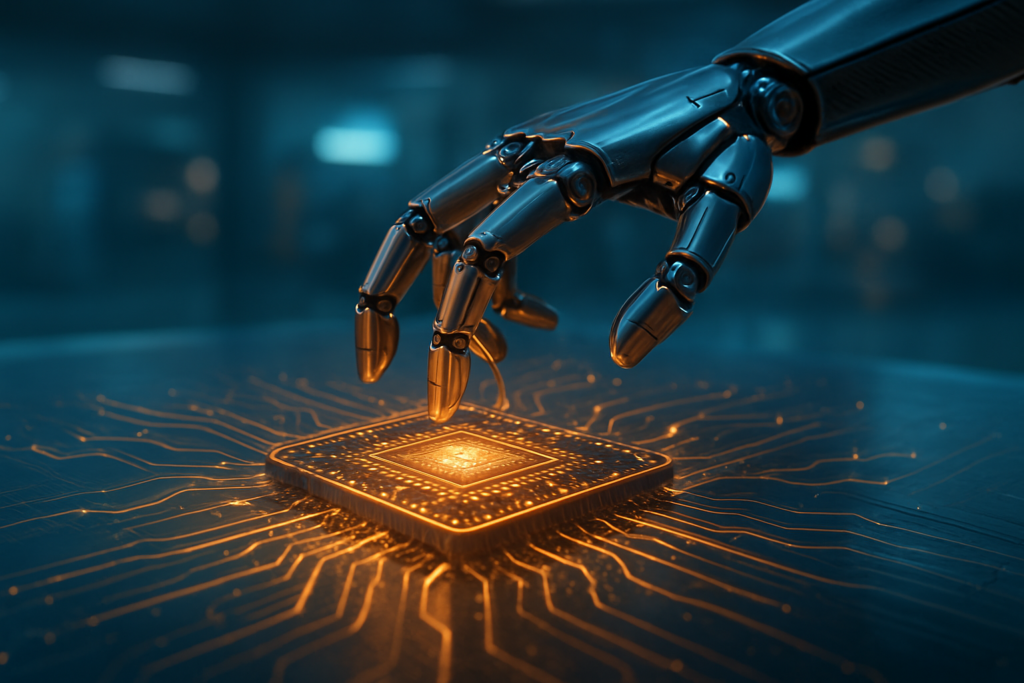
The cornerstone of this movement is the arrival of ultra-high-performance, low-power chips designed specifically for autonomous machines. Leading the charge are Qualcomm’s (NASDAQ: QCOM) newly rebranded Dragonwing platform and NVIDIA’s (NASDAQ: NVDA) Jetson AGX Thor. These processors have moved the "brain" of the AI from distant data centers directly into the chassis of humanoid robots, autonomous delivery vehicles, and smart automotive cabins. By eliminating the latency of the cloud and providing the raw horsepower necessary for complex sensor fusion, these chips have turned the dream of "Edge AI" into a tangible, physical reality.
The Silicon Architecture of Embodiment
Technically, the leap from 2024’s edge processors to the hardware of 2026 is staggering. NVIDIA’s Jetson AGX Thor, which began shipping to developers in late 2025, is built on the Blackwell GPU architecture. It delivers a massive 2,070 FP4 TFLOPS of performance—a nearly 7.5-fold increase over its predecessor, the Jetson Orin. This level of compute is critical for "Project GR00T," NVIDIA’s foundation model for humanoid robots, allowing machines to process multimodal data from cameras, LiDAR, and force sensors simultaneously to navigate complex human environments. Thor also introduces a specialized "Holoscan Sensor Bridge," which slashes the time it takes for data to travel from a robot's "eyes" to its "brain," a necessity for safe real-time interaction.
In contrast, Qualcomm has carved out a dominant position in industrial and enterprise applications with its Dragonwing IQ-9075 flagship. While NVIDIA focuses on raw TFLOPS for complex humanoids, Qualcomm has optimized for power efficiency and integrated connectivity. The Dragonwing platform features dual Hexagon NPUs capable of 100 INT8 TOPS, designed to run 13-billion parameter models locally while maintaining a thermal profile suitable for fanless industrial drones and Autonomous Mobile Robots (AMRs). Crucially, the IQ-9075 is the first of its kind to integrate UHF RFID, 5G, and Wi-Fi 7 directly into the SoC, allowing robots in smart warehouses to track inventory with centimeter-level precision while maintaining a constant high-speed data link.
This new hardware differs from previous iterations by prioritizing "Sim-to-Real" capabilities. Previous edge chips were largely reactive, running simple computer vision models. Today’s Physical AI chips are designed to run "World Models"—AI that understands the laws of physics. Industry experts have noted that the ability of these chips to run local, high-fidelity simulations allows robots to "rehearse" a movement in a fraction of a second before executing it in the real world, drastically reducing the risk of accidents in shared human-robot spaces.
A New Competitive Landscape for the AI Titans
The emergence of Physical AI has reshaped the strategic priorities of the world’s largest tech companies. For NVIDIA, Jetson AGX Thor is the final piece of CEO Jensen Huang’s "Three-Computer" vision, positioning the company as the end-to-end provider for the robotics industry—from training in the cloud to simulation in the Omniverse and deployment at the edge. This vertical integration has forced competitors to accelerate their own hardware-software stacks. Qualcomm’s pivot to the Dragonwing brand signals a direct challenge to NVIDIA’s industrial dominance, leveraging Qualcomm’s historical strength in mobile power efficiency to capture the massive market for battery-operated edge devices.
The impact extends deep into the automotive sector. Manufacturers like BYD (OTC: BYDDF) and Volvo (OTC: VLVLY) have already begun integrating DRIVE AGX Thor into their 2026 vehicle lineups. These chips don't just power self-driving features; they transform the automotive cabin into a "Physical AI" environment. With Dragonwing and Thor, cars can now perform real-time "cabin sensing"—detecting a driver’s fatigue level or a passenger’s medical distress—and respond with localized AI agents that don't require an internet connection to function. This has created a secondary market for "AI-first" automotive software, where startups are competing to build the most responsive and intuitive in-car assistants.
Furthermore, the democratization of this technology is occurring through strategic partnerships. Qualcomm’s 2025 acquisition of Arduino led to the release of the Arduino Uno Q, a "dual-brain" board that pairs a Dragonwing processor with a traditional microcontroller. This move has lowered the barrier to entry for smaller robotics startups and the maker community, allowing them to build sophisticated machines that were previously the sole domain of well-funded labs. As a result, we are seeing a surge in "TinyML" applications, where ultra-low-power sensors act as a "peripheral nervous system," waking up the more powerful "central brain" (Thor or Dragonwing) only when complex reasoning is required.
The Broader Significance: AI Gets a Sense of Self
The rise of Physical AI marks a departure from the "Stochastic Parrot" era of AI. When an AI is embodied in a robot powered by a Jetson AGX Thor, it is no longer just predicting the next word in a sentence; it is predicting the next state of the physical world. This has profound implications for AI safety and reliability. Because these machines operate at the edge, they are not subject to the "hallucinations" caused by cloud latency or connectivity drops. The intelligence is local, grounded in the immediate physical context of the machine, which is a prerequisite for deploying AI in high-stakes environments like surgical suites or nuclear decommissioning sites.
However, this shift also brings new concerns, particularly regarding privacy and security. With machines capable of processing high-resolution video and sensor data locally, the "Edge AI" promise of privacy is put to the test. While data doesn't necessarily leave the device, the sheer amount of information these machines "see" is unprecedented. Regulators are already grappling with how to categorize "Physical AI" entities—are they tools, or are they a new class of autonomous agents? The comparison to previous milestones, like the release of GPT-4, is clear: while LLMs changed how we write and code, Physical AI is changing how we build and move.
The transition to Physical AI also represents the ultimate realization of TinyML. By moving the most critical inference tasks to the very edge of the network, the industry is reducing its reliance on massive, energy-hungry data centers. This "distributed intelligence" model is seen as a more sustainable path for the future of AI, as it leverages the efficiency of specialized silicon like the Dragonwing series to perform tasks that would otherwise require kilowatts of power in a server farm.
The Horizon: From Factories to Front Porches
Looking ahead to the remainder of 2026 and beyond, we expect to see Physical AI move from industrial settings into the domestic sphere. Near-term developments will likely focus on "General Purpose Humanoids" capable of performing unstructured tasks in the home, such as folding laundry or organizing a kitchen. These applications will require even further refinements in "Sim-to-Real" technology, where AI models can generalize from virtual training to the messy, unpredictable reality of a human household.
The next great challenge for the industry will be the "Battery Barrier." While chips like the Dragonwing IQ-9075 have made great strides in efficiency, the mechanical actuators of robots remain power-hungry. Experts predict that the next breakthrough in Physical AI will not be in the "brain" (the silicon), but in the "muscles"—new types of high-efficiency electric motors and solid-state batteries designed specifically for the robotics form factor. Once the power-to-weight ratio of these machines improves, we may see the first truly ubiquitous personal robots.
A New Chapter in the History of Intelligence
The "Edge AI Revolution" of 2025 and 2026 will likely be remembered as the moment AI became a participant in our world rather than just an observer. The release of NVIDIA’s Jetson AGX Thor and Qualcomm’s Dragonwing platform provided the necessary "biological" leap in compute density to make embodied intelligence possible. We have moved beyond the limits of the screen and entered an era where intelligence is woven into the very fabric of our physical environment.
As we move forward, the key metric for AI success will no longer be "parameters" or "pre-training data," but "physical agency"—the ability of a machine to safely and effectively navigate the complexities of the real world. In the coming months, watch for the first large-scale deployments of Thor-powered humanoids in logistics hubs and the integration of Dragonwing-based "smart city" sensors that can manage traffic and emergency responses in real-time. The revolution is no longer coming; it is already here, and it has a body.
This content is intended for informational purposes only and represents analysis of current AI developments.
TokenRing AI delivers enterprise-grade solutions for multi-agent AI workflow orchestration, AI-powered development tools, and seamless remote collaboration platforms.
For more information, visit https://www.tokenring.ai/.