In the final weeks of 2025, the halls of OpenAI’s San Francisco headquarters were reportedly vibrating with a tension not felt since the company’s leadership crisis of 2023. Internal memos, leaked to major tech outlets, revealed that CEO Sam Altman had declared a "Code Red" strategy in response to a sudden and aggressive erosion of OpenAI’s market dominance. The catalyst? A one-two punch from Alphabet Inc. (NASDAQ: GOOGL) with its Gemini 3 release and Anthropic, heavily backed by Amazon.com, Inc. (NASDAQ: AMZN), with its Claude 4 series, which together began to outperform OpenAI’s flagship GPT-5 in critical enterprise benchmarks.
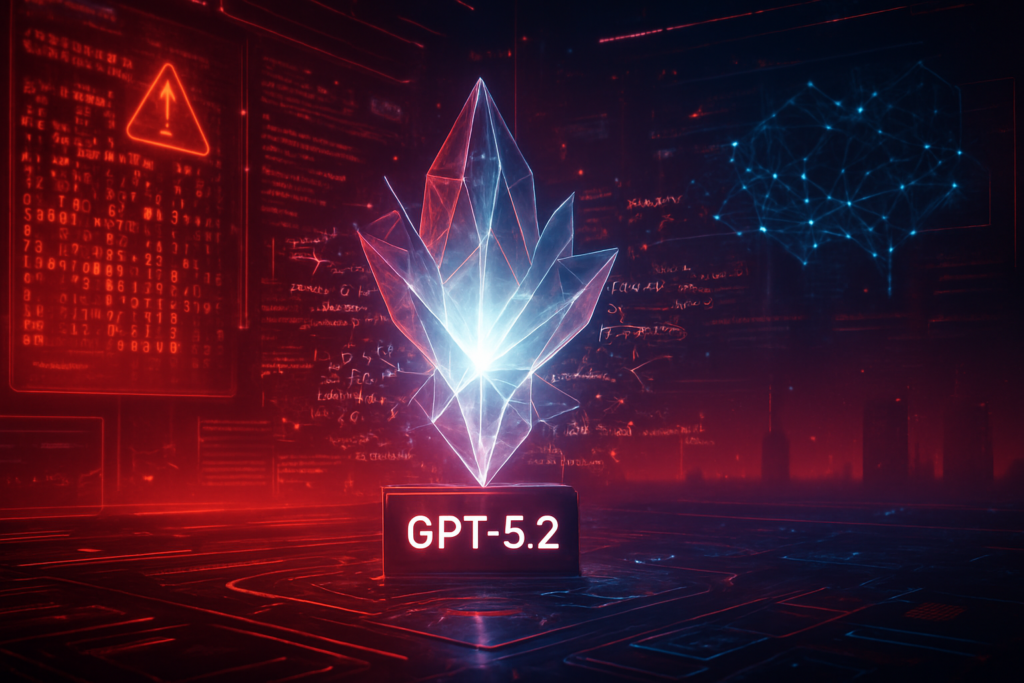
The culmination of this "Code Red" was the surprise release of GPT-5.2, codenamed "Garlic," on December 11, 2025. This model was not just an incremental update; it represented a fundamental shift in OpenAI’s development philosophy. By pivoting away from experimental "side quests" like autonomous shopping agents and integrated advertising features, OpenAI refocused its entire engineering core on raw intelligence and reasoning. The immediate significance of GPT-5.2 "Garlic" lies in its ability to reclaim the lead in abstract reasoning and mathematical problem-solving, signaling that the "AI arms race" has entered a new, more volatile phase where leadership is measured in weeks, not years.
The Technical "Garlic" Pivot: Reasoning over Scale
GPT-5.2, or "Garlic," marks a departure from the "bigger is better" scaling laws that defined the early 2020s. While GPT-5 was a massive multimodal powerhouse, Garlic was optimized for what OpenAI calls "Active Context Synthesis." The model features a 400,000-token context window—a fivefold increase over the original GPT-4—but more importantly, it introduces a native "Thinking" variant. This architecture integrates reasoning-token support directly into the inference process, allowing the model to "pause and reflect" on complex queries before generating a final response. This approach has led to a 30% reduction in hallucinations compared to the GPT-5.1 interim model released earlier in the year.
The technical specifications are staggering. In the AIME 2025 mathematical benchmarks, GPT-5.2 achieved a perfect 100% score without the need for external calculators or Python execution—a feat that leapfrogged Google’s Gemini 3 Pro (95%) and Claude Opus 4.5 (94%). For developers, the "Instant" variant of Garlic provides a 128,000-token maximum output, enabling the generation of entire multi-file applications in a single pass. Initial reactions from the research community have been a mix of awe and caution, with experts noting that OpenAI has successfully "weaponized" its internal "Strawberry" reasoning architecture to bridge the gap between simple prediction and true logical deduction.
A Fractured Frontier: The Competitive Fallout
The "Code Red" was a direct result of OpenAI’s shrinking moat. By mid-2025, Google’s Gemini 3 had become the industry leader in native multimodality, particularly in video understanding and scientific research. Simultaneously, Anthropic’s Claude 4 series had captured an estimated 40% of the enterprise AI spending market, with major firms like IBM (NYSE: IBM) and Accenture (NYSE: ACN) shifting their internal training programs toward Claude’s more "human-aligned" and reliable coding outputs. Perhaps the most stinging blow came from Microsoft Corp. (NASDAQ: MSFT), which in late 2025 began diversifying its AI stack by offering Claude models directly within Microsoft 365 Copilot, signaling that even OpenAI’s closest partner was no longer willing to rely on a single provider.
This competitive pressure forced OpenAI to abandon its "annual flagship" release cycle in favor of what insiders call a "tactical nuke" approach—deploying high-impact, incremental updates like GPT-5.2 to disrupt the news cycles of its rivals. For startups and smaller AI labs, this environment is increasingly hostile. As the tech giants engage in a price war—with Google undercutting competitors by up to 83% for its Gemini 3 Flash model—the barrier to entry for training frontier models has shifted from mere compute power, provided largely by NVIDIA (NASDAQ: NVDA), to the ability to innovate on architecture and reasoning speed.
Beyond the Benchmarks: The Wider Significance
The release of "Garlic" and the declaration of a "Code Red" signify a broader shift in the AI landscape: the end of the "Scaling Era" and the beginning of the "Efficiency and Reasoning Era." For years, the industry assumed that simply adding more parameters and more data would lead to AGI. However, the late 2025 crisis proved that even the largest models can be outmaneuvered by those with better logic-processing and lower latency. GPT-5.2’s dominance in the ARC-AGI-2 reasoning benchmark (scoring between 52.9% and 54.2%) suggests that we are nearing a point where AI can handle novel tasks it has never seen in its training data—a key requirement for true artificial general intelligence.
However, this rapid-fire deployment has raised significant concerns among AI safety advocates. The "Code Red" atmosphere reportedly led to a streamlining of internal safety reviews to ensure GPT-5.2 hit the market before the Christmas holiday. While OpenAI maintains that its safety protocols remain robust, the pressure to maintain market share against Google and Anthropic has created a "tit-for-tat" dynamic that mirrors the nuclear arms race of the 20th century. The energy consumption required to maintain these "always-on" reasoning models also continues to be a point of contention, as the industry’s demand for power begins to outpace local grid capacities in major data center hubs.
The Horizon: Agents, GPT-6, and the 2026 Landscape
Looking ahead, the success of the Garlic model is expected to pave the way for "Agentic Workflows" to become the standard in 2026. Experts predict that the next major milestone will not be a better chatbot, but the "Autonomous Employee"—AI systems capable of managing long-term projects, interacting with other AIs, and making independent decisions within a corporate framework. OpenAI is already rumored to be using the lessons learned from the GPT-5.2 deployment to accelerate the training of GPT-6, which is expected to feature "Continuous Learning" capabilities, allowing the model to update its knowledge base in real-time without needing a full re-train.
The near-term challenge for OpenAI will be managing its relationship with Microsoft while fending off the "open-weights" movement, which has seen a resurgence in late 2025 as Meta and other players release models that rival GPT-4 class performance for free. As we move into 2026, the focus will likely shift from who has the "smartest" model to who has the most integrated ecosystem. The "Code Red" may have saved OpenAI's lead for now, but the margin of victory is thinner than it has ever been.
A New Chapter in AI History
The "Code Red" of late 2025 will likely be remembered as the moment the AI industry matured. The era of easy wins and undisputed leadership for OpenAI has ended, replaced by a brutal, multi-polar competition where Alphabet, Amazon-backed Anthropic, and Microsoft all hold significant leverage. GPT-5.2 "Garlic" is a testament to OpenAI’s ability to innovate under extreme pressure, reclaiming the reasoning throne just as its competitors were preparing to take the crown.
As we look toward 2026, the key takeaway is that the "vibe" of AI has changed. It is no longer a world of wonder and experimentation, but one of strategic execution and enterprise dominance. Investors and users alike should watch for how Google responds to the "Garlic" release in the coming weeks, and whether Anthropic can maintain its hold on the professional coding market. For now, OpenAI has bought itself some breathing room, but in the fast-forward world of artificial intelligence, a few weeks is a lifetime.
This content is intended for informational purposes only and represents analysis of current AI developments.
TokenRing AI delivers enterprise-grade solutions for multi-agent AI workflow orchestration, AI-powered development tools, and seamless remote collaboration platforms.
For more information, visit https://www.tokenring.ai/.