

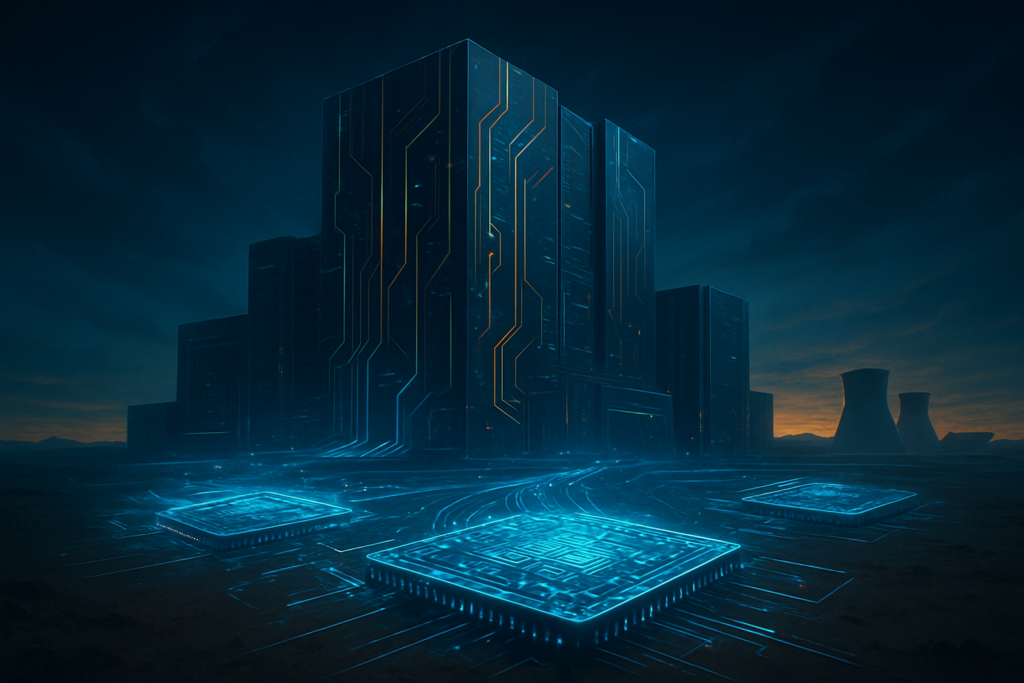
SAN FRANCISCO — December 18, 2025 — OpenAI is currently navigating a transformative period that is reshaping the global technology landscape, as the company enters the final stages of a historic $100 billion funding round. This massive capital injection, which values the AI pioneer at a staggering $750 billion, is not merely a play for software dominance but the cornerstone of a radical shift toward vertical integration. By securing unprecedented levels of investment from entities like SoftBank Group Corp. (OTC:SFTBY), Thrive Capital, and a strategic $10 billion-plus commitment from Amazon.com, Inc. (NASDAQ: AMZN), OpenAI is positioning itself to bridge the "electron gap" and the chronic shortage of high-performance semiconductors that have defined the AI era.
The immediate significance of this development lies in the decoupling of OpenAI from its total reliance on merchant silicon. While the company remains a primary customer of NVIDIA Corporation (NASDAQ: NVDA), this new funding is being funneled into "Stargate LLC," a multi-national joint venture designed to build "gigawatt-scale" data centers and proprietary AI chips. This move signals the end of the "software-only" era for AI labs, as Sam Altman’s vision for AI infrastructure begins to dictate the roadmap for the entire semiconductor industry, forcing a realignment of global supply chains and energy policies.
The Architecture of "Stargate": Custom Silicon and Gigawatt-Scale Compute
At the heart of OpenAI’s infrastructure push is a custom Application-Specific Integrated Circuit (ASIC) co-developed with Broadcom Inc. (NASDAQ: AVGO). Unlike the general-purpose power of NVIDIA’s upcoming Rubin architecture, the OpenAI-Broadcom chip is a "bespoke" inference engine built on Taiwan Semiconductor Manufacturing Company’s (NYSE: TSM) 3nm process. Technical specifications reveal a systolic array design optimized for the dense matrix multiplications inherent in Transformer-based models like the recently teased "o2" reasoning engine. By stripping away the flexibility required for non-AI workloads, OpenAI aims to reduce the power consumption per token by an estimated 30% compared to off-the-shelf hardware.
The physical manifestation of this vision is "Project Ludicrous," a 1.2-gigawatt data center currently under construction in Abilene, Texas. This site is the first of many planned under the Stargate LLC umbrella, a partnership that now includes Oracle Corporation (NYSE: ORCL) and the Abu Dhabi-backed MGX. These facilities are being designed with liquid-cooling at their core to handle the 1,800W thermal design power (TDP) of modern AI racks. Initial reactions from the research community have been a mix of awe and concern; while the scale promises a leap toward Artificial General Intelligence (AGI), experts warn that the sheer concentration of compute power in a single entity’s hands creates a "compute moat" that may be insurmountable for smaller rivals.
A New Semiconductor Order: Winners, Losers, and Strategic Pivots
The ripple effects of OpenAI’s funding and infrastructure plans are being felt across the "Magnificent Seven" and the broader semiconductor market. Broadcom has emerged as a primary beneficiary, now controlling nearly 89% of the custom AI ASIC market as it helps OpenAI, Meta Platforms, Inc. (NASDAQ: META), and Alphabet Inc. (NASDAQ: GOOGL) design their own silicon. Meanwhile, NVIDIA has responded to the threat of custom chips by accelerating its product cycle to a yearly cadence, moving from Blackwell to the Rubin (R100) platform in record time to maintain its performance lead in training-heavy workloads.
For tech giants like Amazon and Microsoft Corporation (NASDAQ: MSFT), the relationship with OpenAI has become increasingly complex. Amazon’s $10 billion investment is reportedly tied to OpenAI’s adoption of Amazon’s Trainium chips, a strategic move by the e-commerce giant to ensure its own silicon finds a home in the world’s most advanced AI models. Conversely, Microsoft, while still a primary partner, is seeing OpenAI diversify its infrastructure through Stargate LLC to avoid vendor lock-in. This "multi-vendor" strategy has also provided a lifeline to Advanced Micro Devices, Inc. (NASDAQ: AMD), whose MI300X and MI350 series chips are being used as critical bridging hardware until OpenAI’s custom silicon reaches mass production in late 2026.
The Electron Gap and the Geopolitics of Intelligence
Beyond the chips themselves, Sam Altman’s vision has highlighted a looming crisis in the AI landscape: the "electron gap." As OpenAI aims for 100 GW of new energy capacity per year to fuel its scaling laws, the company has successfully lobbied the U.S. government to treat AI infrastructure as a national security priority. This has led to a resurgence in nuclear energy investment, with startups like Oklo Inc. (NYSE: OKLO)—where Altman serves as chairman—breaking ground on fission sites to power the next generation of data centers. The transition to a Public Benefit Corporation (PBC) in October 2025 was a key prerequisite for this, allowing OpenAI to raise the trillions needed for energy and foundries without the constraints of a traditional profit cap.
This massive scaling effort is being compared to the Manhattan Project or the Apollo program in its scope and national significance. However, it also raises profound environmental and social concerns. The 10 GW of power OpenAI plans to consume by 2029 is equivalent to the energy usage of several small nations, leading to intense scrutiny over the carbon footprint of "reasoning" models. Furthermore, the push for "Sovereign AI" has sparked a global arms race, with the UK, UAE, and Australia signing deals for their own Stargate-class data centers to ensure they are not left behind in the transition to an AI-driven economy.
The Road to 2026: What Lies Ahead for AI Infrastructure
Looking toward 2026, the industry expects the first "silicon-validated" results from the OpenAI-Broadcom partnership. If these custom chips deliver the promised efficiency gains, it could lead to a permanent shift in how AI is monetized, significantly lowering the "cost-per-query" and enabling widespread integration of high-reasoning agents in consumer devices. However, the path is fraught with challenges, most notably the advanced packaging bottleneck at TSMC. The global supply of CoWoS (Chip-on-Wafer-on-Substrate) remains the single greatest constraint on OpenAI’s ambitions, and any geopolitical instability in the Taiwan Strait could derail the entire $1.4 trillion infrastructure plan.
In the near term, the AI community is watching for the official launch of GPT-5, which is expected to be the first model trained on a cluster of over 100,000 H100/B200 equivalents. Analysts predict that the success of this model will determine whether the massive capital expenditures of 2025 were a visionary investment or a historic overreach. As OpenAI prepares for a potential IPO in late 2026, the focus will shift from "how many chips can they buy" to "how efficiently can they run the chips they have."
Conclusion: The Dawn of the Infrastructure Era
The ongoing funding talks and infrastructure maneuvers of late 2025 mark a definitive turning point in the history of artificial intelligence. OpenAI is no longer just an AI lab; it is becoming a foundational utility company for the cognitive age. By integrating chip design, energy production, and model development, Sam Altman is attempting to build a vertically integrated empire that rivals the industrial titans of the 20th century. The significance of this development cannot be overstated—it represents a bet that the future of the global economy will be written in silicon and powered by nuclear-backed data centers.
As we move into 2026, the key metrics to watch will be the progress of "Project Ludicrous" in Texas and the stability of the burgeoning partnership between OpenAI and the semiconductor giants. Whether this trillion-dollar gamble leads to the realization of AGI or serves as a cautionary tale of "compute-maximalism," one thing is certain: the relationship between AI funding and hardware demand has fundamentally altered the trajectory of the tech industry.
This content is intended for informational purposes only and represents analysis of current AI developments.
TokenRing AI delivers enterprise-grade solutions for multi-agent AI workflow orchestration, AI-powered development tools, and seamless remote collaboration platforms.
For more information, visit https://www.tokenring.ai/.