Online home goods retailer Wayfair (NYSE: W) reported Q2 CY2026 results exceeding the market’s revenue expectations, with sales up 7.5% year on year to $3.52 billion. Its non-GAAP profit of $0.95 per share was 3.1% above analysts’ consensus estimates.
Is now the time to buy Wayfair? Find out by accessing our full research report, it’s free.
Wayfair (W) Q2 CY2026 Highlights:
- Revenue: $3.52 billion vs analyst estimates of $3.47 billion (7.5% year-on-year growth, 1.4% beat)
- Adjusted EPS: $0.95 vs analyst estimates of $0.92 (3.1% beat)
- Adjusted EBITDA: $242 million vs analyst estimates of $230 million (6.9% margin, 5.2% beat)
- Operating Margin: 3%, up from 0.5% in the same quarter last year
- Free Cash Flow was $301 million, up from -$106 million in the previous quarter
- Active Customers: 21.7 million, up 700,000 year on year
- Market Capitalization: $11.79 billion
Company Overview
Founded in 2002 by Niraj Shah, Wayfair (NYSE: W) is a leading online retailer of mass-market home goods in the US, UK, Canada, and Germany.
Revenue Growth
A company’s long-term sales performance is one signal of its overall quality. Even a bad business can shine for one or two quarters, but a top-tier one grows for years. Unfortunately, Wayfair’s 2.8% annualized revenue growth over the last three years was sluggish. This was below our standards and is a poor baseline for our analysis.
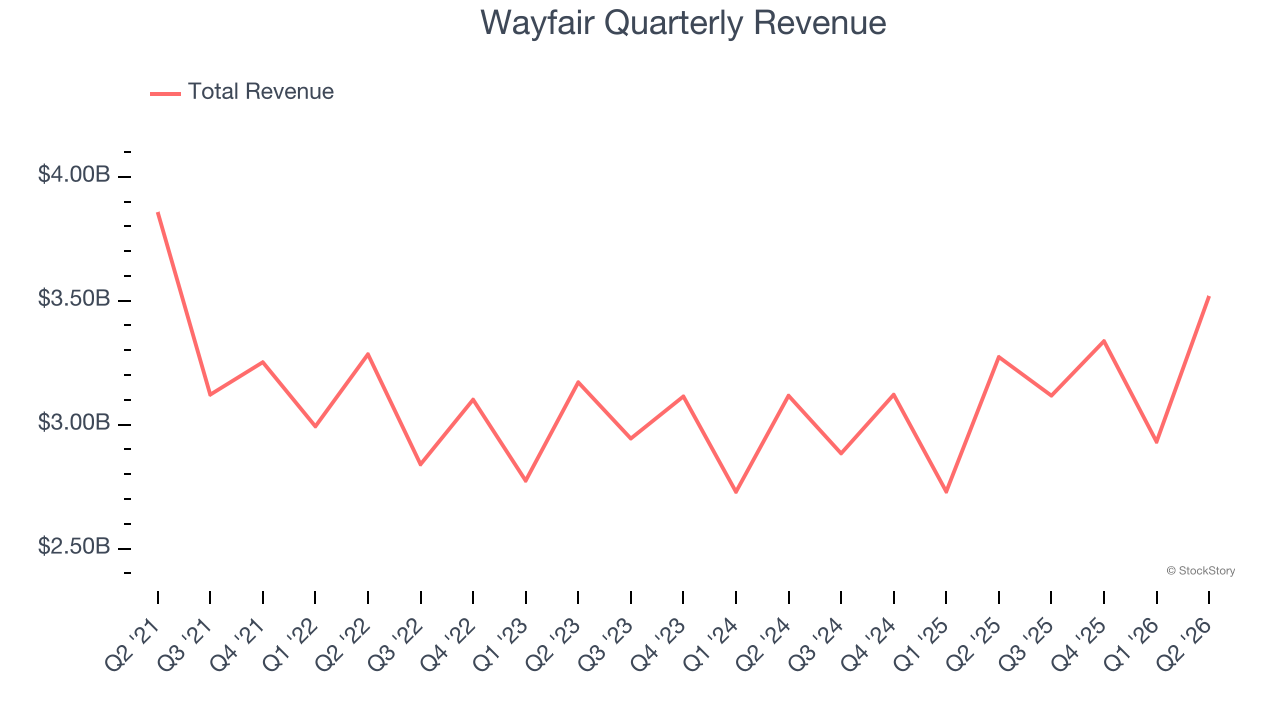
This quarter, Wayfair reported year-on-year revenue growth of 7.5%, and its $3.52 billion of revenue exceeded Wall Street’s estimates by 1.4%.
Looking ahead, sell-side analysts expect revenue to grow 5.2% over the next 12 months. While this projection indicates its newer products and services will fuel better top-line performance, it is still below the sector average.
WHILE YOU’RE HERE: The Next Palantir? One satellite company captures images of every point on Earth. Every single day. The Pentagon wants it. Hedge funds are using it to beat earnings. You’ve probably never heard of it.
This is what the early days of Palantir looked like before it became a giant. Same playbook. Different technology. If you missed Palantir, you need to see this. Claim The Stock Ticker for Free HERE.
Active Customers
Buyer Growth
As an online retailer, Wayfair generates revenue growth by expanding its number of users and the average order size in dollars.
Wayfair struggled with new customer acquisition over the last two years as its active customers have declined by 2.2% annually to 21.7 million in the latest quarter. This performance isn’t ideal because internet usage is secular, meaning there are typically unaddressed market opportunities. If Wayfair wants to accelerate growth, it likely needs to enhance the appeal of its current offerings or innovate with new products. 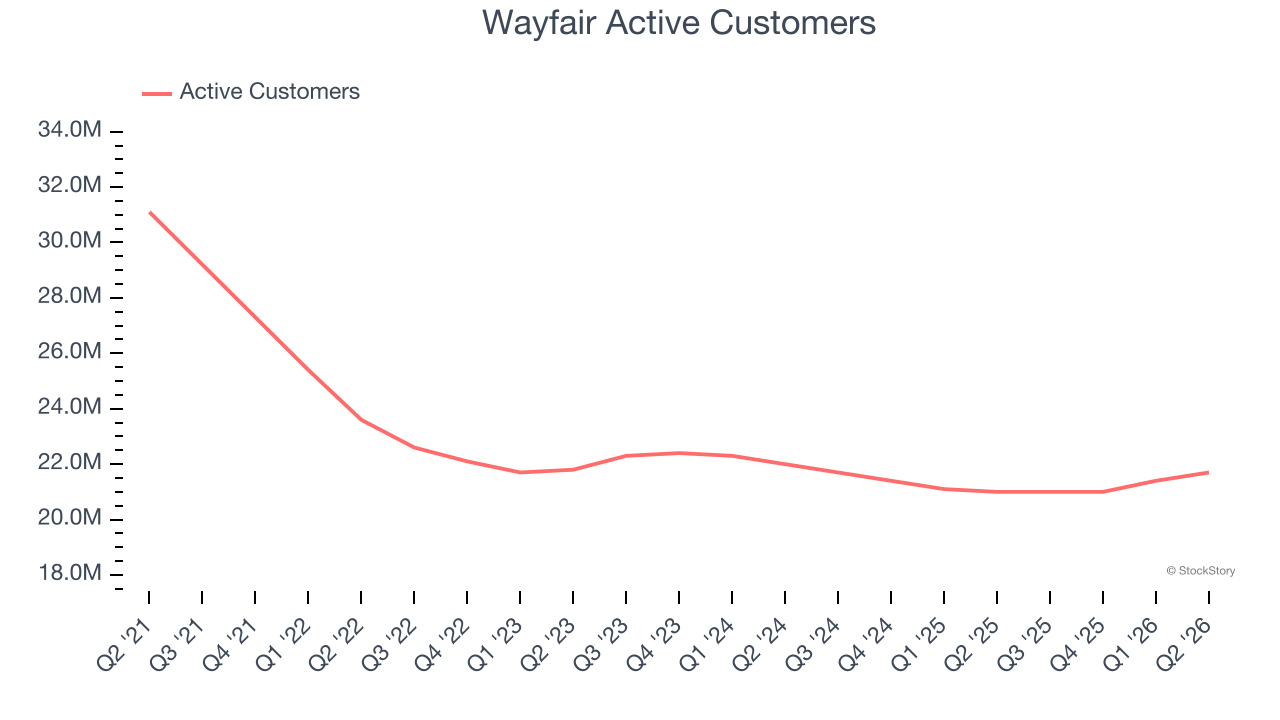
Luckily, Wayfair added 700,000 active customers in Q2, leading to 3.3% year-on-year growth. The quarterly print was higher than its two-year result, suggesting its new initiatives are accelerating buyer growth.
Revenue Per Buyer
Average revenue per buyer (ARPB) is a critical metric to track because it measures how much customers spend per order.
Wayfair’s ARPB growth has been exceptional over the last two years, averaging 43.5%. Although its active customers shrank during this time, the company’s ability to successfully increase monetization demonstrates its platform’s value for existing buyers. 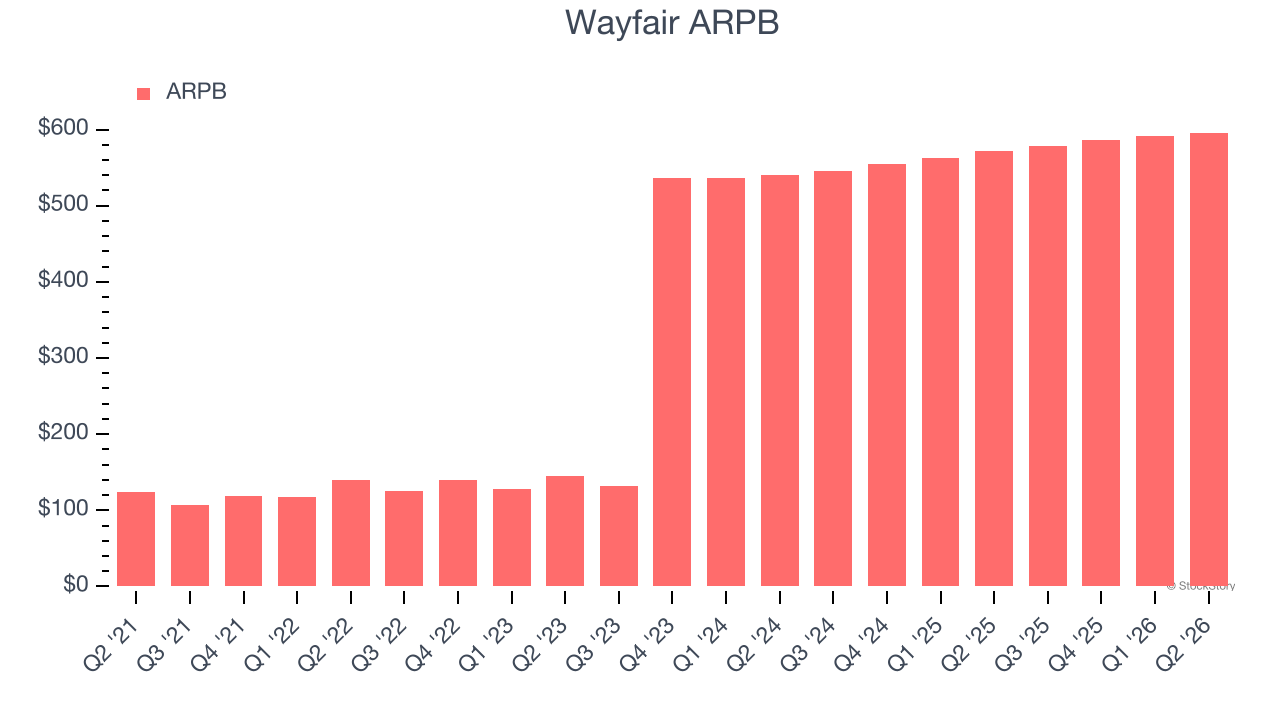
This quarter, Wayfair’s ARPB clocked in at $596. It grew by 4.2% year on year, mirroring the performance of its active customers.
Key Takeaways from Wayfair’s Q2 Results
We enjoyed seeing Wayfair beat analysts’ EBITDA expectations this quarter. We were also happy its revenue narrowly outperformed Wall Street’s estimates. Overall, we think this was a solid quarter with some key areas of upside. The stock traded up 15.8% to $103.44 immediately following the results.
Wayfair put up rock-solid earnings, but one quarter doesn’t necessarily make the stock a buy. Let’s see if this is a good investment. If you’re making that decision, you should consider the bigger picture of valuation, business qualities, as well as the latest earnings. We cover that in our actionable full research report which you can read here (it’s free).