
The end of the earnings season is always a good time to take a step back and see who shined (and who didn’t). Let’s take a look at how health insurance providers stocks fared in Q2, starting with Elevance Health (NYSE: ELV).
Upfront premiums collected by health insurers lead to reliable revenue, but profitability ultimately depends on accurate risk assessments and the ability to control medical costs. Health insurers are also highly sensitive to regulatory changes and economic conditions such as unemployment. Going forward, the industry faces tailwinds from an aging population, increasing demand for personalized healthcare services, and advancements in data analytics to improve cost management. However, continued regulatory scrutiny on pricing practices, the potential for government-led reforms such as expanded public healthcare options, and inflation in medical costs could add volatility to margins. One big debate among investors is the long-term impact of AI and whether it will help underwriting, fraud detection, and claims processing or whether it may wade into ethical grey areas like reinforcing biases and widening disparities in medical care.
The 12 health insurance providers stocks we track reported a strong Q2. As a group, revenues beat analysts’ consensus estimates by 2.8% while next quarter’s revenue guidance was 1.7% below.
Amidst this news, share prices of the companies have had a rough stretch. On average, they are down 5.7% since the latest earnings results.
Elevance Health (NYSE: ELV)
Formerly known as Anthem until its 2022 rebranding, Elevance Health (NYSE: ELV) is one of America's largest health insurers, serving approximately 47 million medical members through its network-based managed care plans.
Elevance Health reported revenues of $49.83 billion, flat year on year. This print exceeded analysts’ expectations by 2.5%. Overall, it was a very strong quarter for the company with a beat of analysts’ EPS estimates and full-year EPS guidance in line with analysts’ estimates.
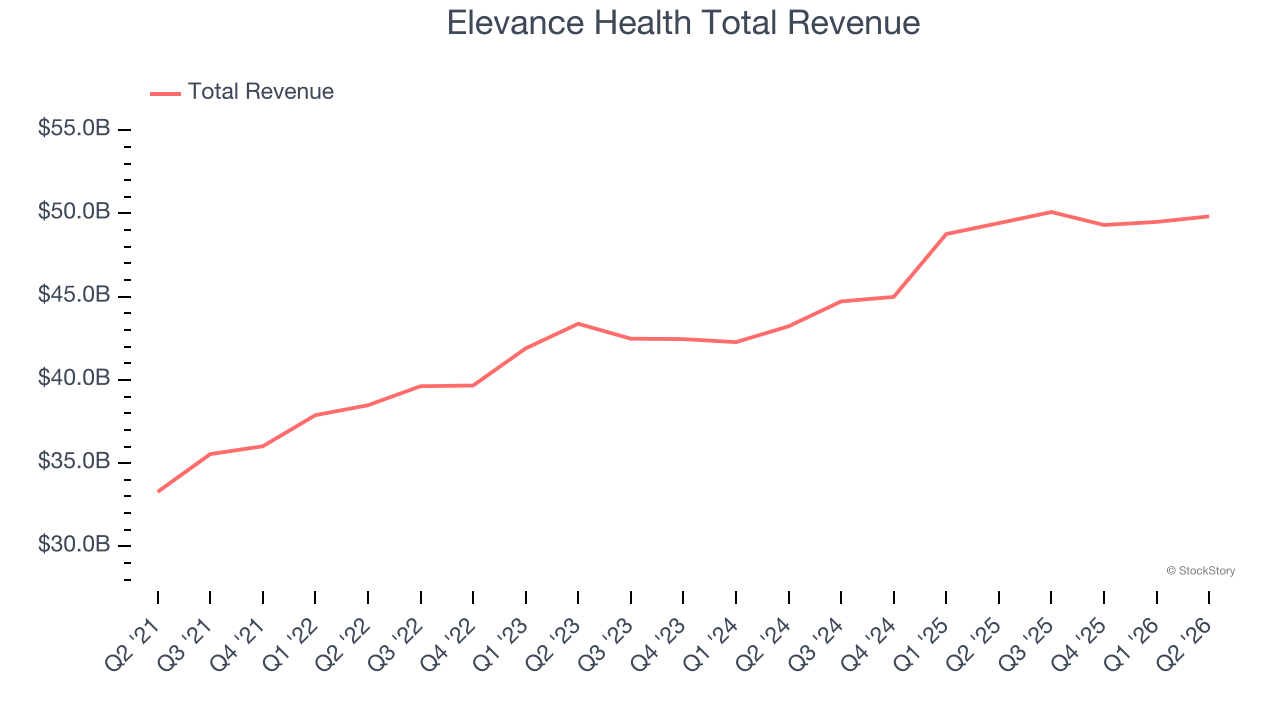
Investor expectations, however, were likely higher than Wall Street’s published projections, leaving some wishing for even better results (analysts’ consensus estimates are those published by big banks and advisory firms, not the investors who make buy and sell decisions). The stock is down 5.1% since reporting and currently trades at $404.91.
Best Q2: CVS Health (NYSE: CVS)
With over 9,000 retail pharmacy locations serving as neighborhood health destinations across America, CVS Health (NYSE: CVS) operates retail pharmacies, provides pharmacy benefit management services, and offers health insurance through its Aetna subsidiary.
CVS Health reported revenues of $106.1 billion, up 7.3% year on year, outperforming analysts’ expectations by 6.7%. The business had an incredible quarter with a beat of analysts’ EPS estimates and an impressive beat of analysts’ full-year EPS guidance estimates.
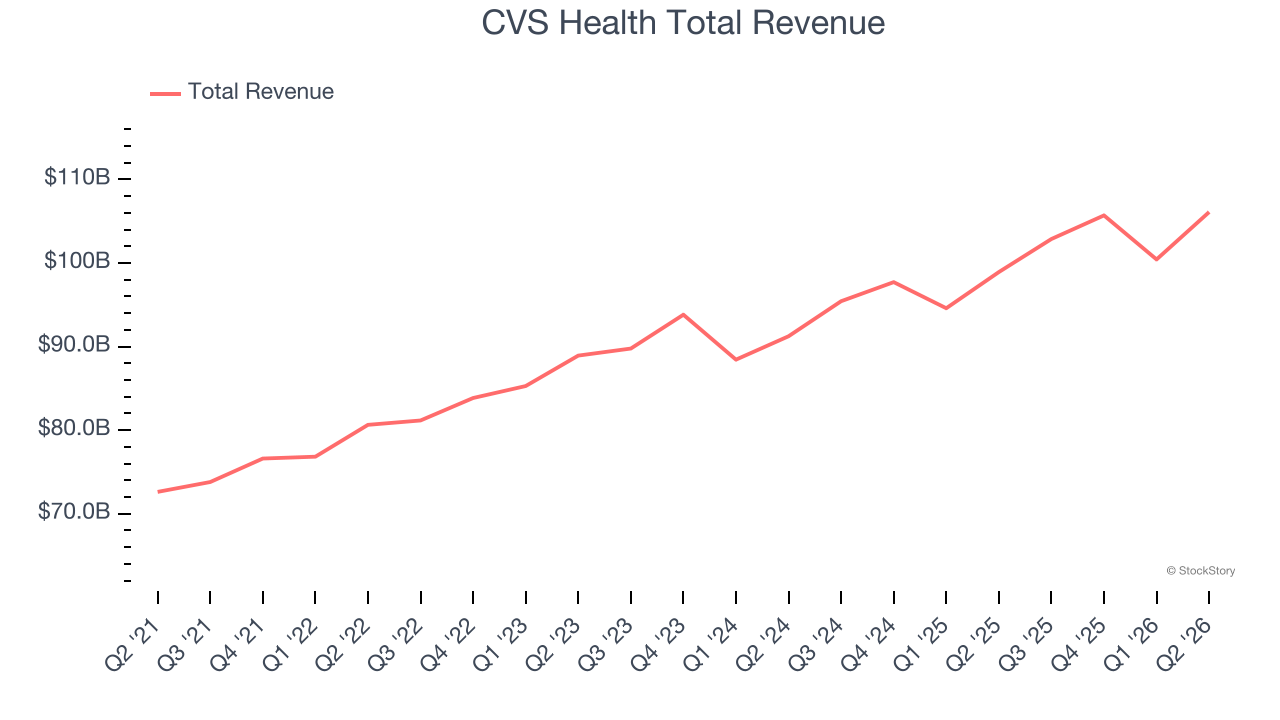
Although it had a fine quarter compared to its peers, the market seems unhappy with the results as the stock is down 10.9% since reporting. It currently trades at $93.01.
Is now the time to buy CVS Health? Access our full analysis of the earnings results here, it’s free.
Weakest Q2: Progyny (NASDAQ: PGNY)
Pioneering a data-driven approach to family building that has achieved an industry-leading patient satisfaction score of +80, Progyny (NASDAQ: PGNY) provides comprehensive fertility and family building benefits solutions to employers, helping employees access quality fertility treatments and support services.
Progyny reported revenues of $350.5 million, up 5.3% year on year, exceeding analysts’ expectations by 0.6%. Still, it was a slower quarter as it posted EBITDA guidance for next quarter missing analysts’ expectations and full-year revenue guidance slightly missing analysts’ expectations.
Progyny delivered the weakest guidance update among its peers. As expected, the stock is down 13.9% since the results and currently trades at $26.
Read our full analysis of Progyny’s results here.
UnitedHealth (NYSE: UNH)
With over 100 million people served across its various businesses and a workforce of more than 400,000, UnitedHealth Group (NYSE: UNH) operates a health insurance business and Optum, a healthcare services division that provides everything from pharmacy benefits to primary care.
UnitedHealth reported revenues of $112 billion, flat year on year. This number surpassed analysts’ expectations by 1.3%. Overall, it was a very strong quarter as it also produced a beat of analysts’ EPS estimates.
The stock is down 5.6% since reporting and currently trades at $394.88.
Read our full, actionable report on UnitedHealth here, it’s free.
Molina Healthcare (NYSE: MOH)
Founded in 1980 as a provider for underserved communities in Southern California, Molina Healthcare (NYSE: MOH) provides managed healthcare services primarily to low-income individuals through Medicaid, Medicare, and Marketplace insurance programs across 21 states.
Molina Healthcare reported revenues of $10.87 billion, down 4.8% year on year. This print met analysts’ expectations. Aside from that, it was a slower quarter as it produced full-year revenue guidance missing analysts’ expectations significantly.
Molina Healthcare had the weakest performance against analyst estimates, slowest revenue growth, and weakest full-year guidance update in the group. The company lost 108,000 customers and ended up with a total of 4.93 million. The stock is down 9.9% since reporting and currently trades at $199.88.
Read our full, actionable report on Molina Healthcare here, it’s free.
Market Update
Over the past year, investors have been forced to repeatedly answer the same question: what is the market’s biggest risk? The answer has changed several times, and each shift has reshaped market leadership.
Late in 2025 and early 2026, artificial intelligence became the market’s primary uncertainty. Investors questioned whether AI would erode software pricing power and weaken competitive moats as AI made it easier to replicate once-differentiated products.
By the spring, technology took a back seat to geopolitics. The U.S. conflict with Iran briefly became the market’s dominant narrative, raising concerns about oil prices, inflation, and global growth. But as energy markets remained orderly and fears of a prolonged supply disruption faded, investors quickly turned their focus back to fundamentals.
Want to invest in winners with rock-solid fundamentals? Check out our Top 6 Stocks and add them to your watchlist. These companies are poised for growth regardless of the political or macroeconomic climate.