Online freelance marketplace Fiverr (NYSE: FVRR) missed Wall Street’s revenue expectations in Q2 CY2026, with sales falling 10% year on year to $97.78 million. Next quarter’s revenue guidance of $84 million underwhelmed, coming in 15.2% below analysts’ estimates. Its non-GAAP profit of $0.50 per share was 3.6% below analysts’ consensus estimates.
Is now the time to buy Fiverr? Find out by accessing our full research report, it’s free.
Fiverr (FVRR) Q2 CY2026 Highlights:
- Revenue: $97.78 million vs analyst estimates of $99.47 million (10% year-on-year decline, 1.7% miss)
- Adjusted EPS: $0.50 vs analyst expectations of $0.52 (3.6% miss)
- Adjusted EBITDA: $17.52 million vs analyst estimates of $18.18 million (17.9% margin, 3.6% miss)
- The company dropped its revenue guidance for the full year to $364 million at the midpoint from $400 million, a 9% decrease
- EBITDA guidance for the full year is $57 million at the midpoint, below analyst estimates of $73.29 million
- Operating Margin: 4.5%, up from -1.8% in the same quarter last year
- Free Cash Flow Margin: 13.9%, down from 19.9% in the previous quarter
- Active Buyers: 2.7 million, down 700,000 year on year
- Market Capitalization: $416.7 million
“What we’re seeing right now is an accelerated evolution of the freelance economy. Our second quarter results reflect a market that is changing faster than expected, driven by rapid AI adoption. As a result, we are focused on repositioning toward higher-value work. While AI absorbs high-volume, low-value, transactional tasks, it is also unlocking the need for longer duration projects where AI tools enhance human expertise, workflow management, and accountability,” said Micha Kaufman, founder and CEO of Fiverr.
Company Overview
Based in Tel Aviv, Fiverr (NYSE: FVRR) operates a fixed price global freelance marketplace for digital services.
Revenue Growth
Reviewing a company’s long-term sales performance reveals insights into its quality. Even a bad business can shine for one or two quarters, but a top-tier one grows for years. Regrettably, Fiverr’s sales grew at a tepid 6.8% compounded annual growth rate over the last three years. This fell short of our benchmark for the consumer internet sector and is a rough starting point for our analysis.
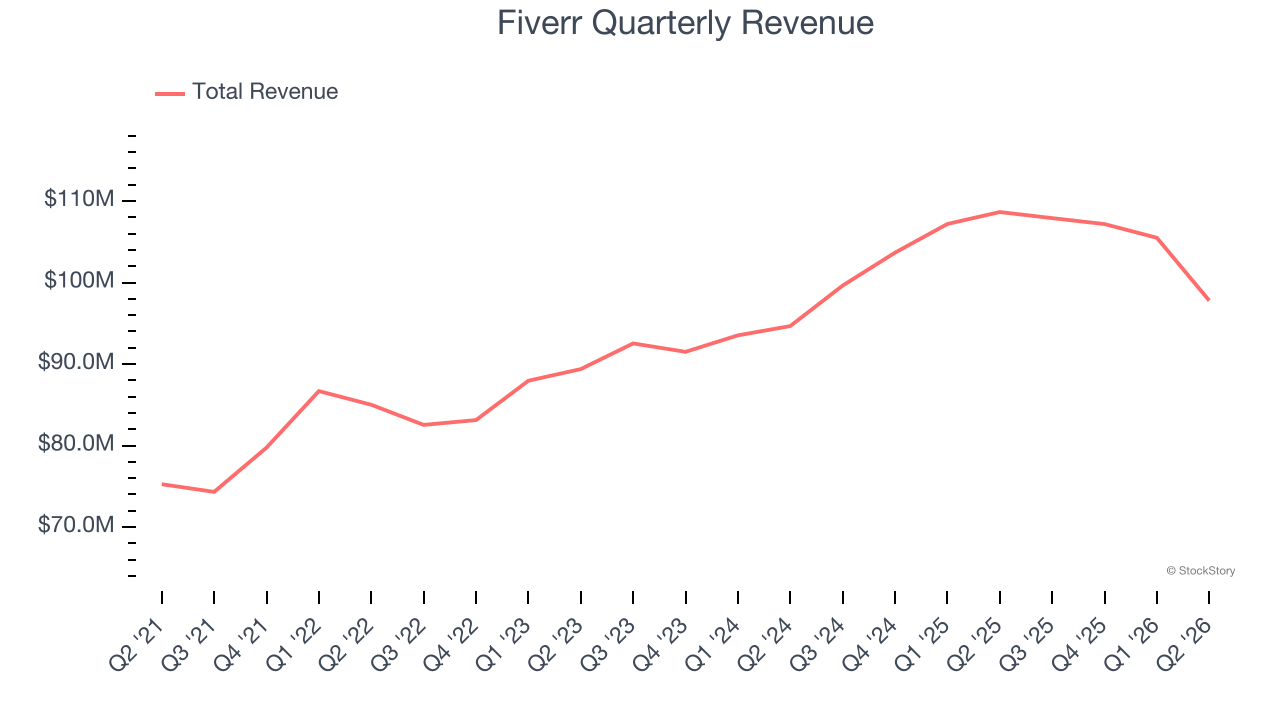
This quarter, Fiverr missed Wall Street’s estimates and reported a rather uninspiring 10% year-on-year revenue decline, generating $97.78 million of revenue. Company management is currently guiding for a 22.2% year-on-year decline in sales next quarter.
Looking further ahead, sell-side analysts expect revenue to decline by 4.5% over the next 12 months, a deceleration versus the last three years. This projection is underwhelming and implies its products and services will see some demand headwinds.
ONE MORE THING: The $21 AI Application Stock Wall Street Forgot. While Wall Street obsesses over who’s building AI, one company is already using it to print money. And nobody’s paying attention.
AI chip stocks trade at ridiculous valuations. This company processes a trillion consumer signals monthly using AI and trades at a third of the price. The gap won’t last. The institutions will figure it out. You need to see this first. Read the FREE Report Before They Notice.
Active Buyers
Buyer Growth
As a gig economy marketplace, Fiverr generates revenue growth by expanding the number of services on its platform (e.g. rides, deliveries, freelance jobs) and raising the commission fee from each service provided.
Fiverr struggled with new customer acquisition over the last two years as its active buyers have declined by 14% annually to 2.7 million in the latest quarter. This performance isn’t ideal because internet usage is secular, meaning there are typically unaddressed market opportunities. If Fiverr wants to accelerate growth, it likely needs to enhance the appeal of its current offerings or innovate with new products. 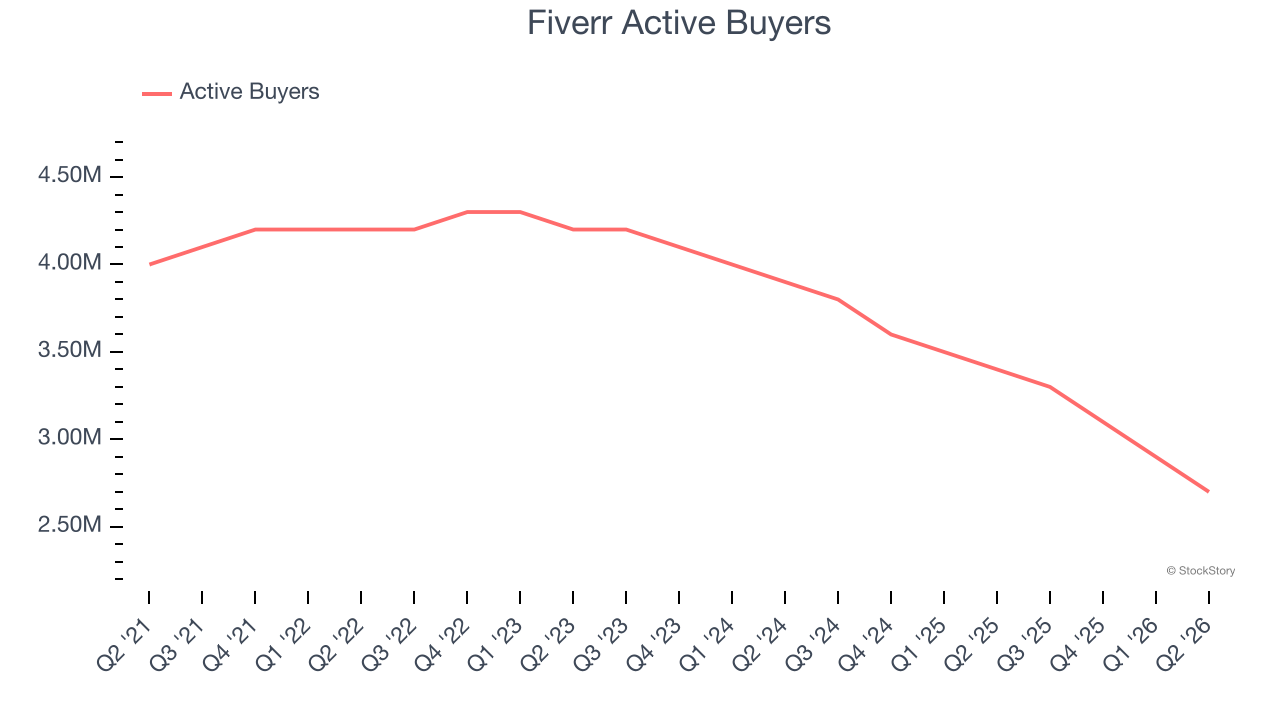
In Q2, Fiverr’s active buyers once again decreased by 700,000, a 20.6% drop since last year. The quarterly print was lower than its two-year result, suggesting its new initiatives aren’t moving the needle for buyers yet.
Revenue Per Buyer
Average revenue per buyer (ARPB) is a critical metric to track because it measures how much the company earns in transaction fees from each buyer. This number also informs us about Fiverr’s take rate, which represents its pricing leverage over the ecosystem, or “cut” from each transaction.
Fiverr’s ARPB growth has been exceptional over the last two years, averaging 23.4%. Although its active buyers shrank during this time, the company’s ability to successfully increase monetization demonstrates its platform’s value for existing buyers. 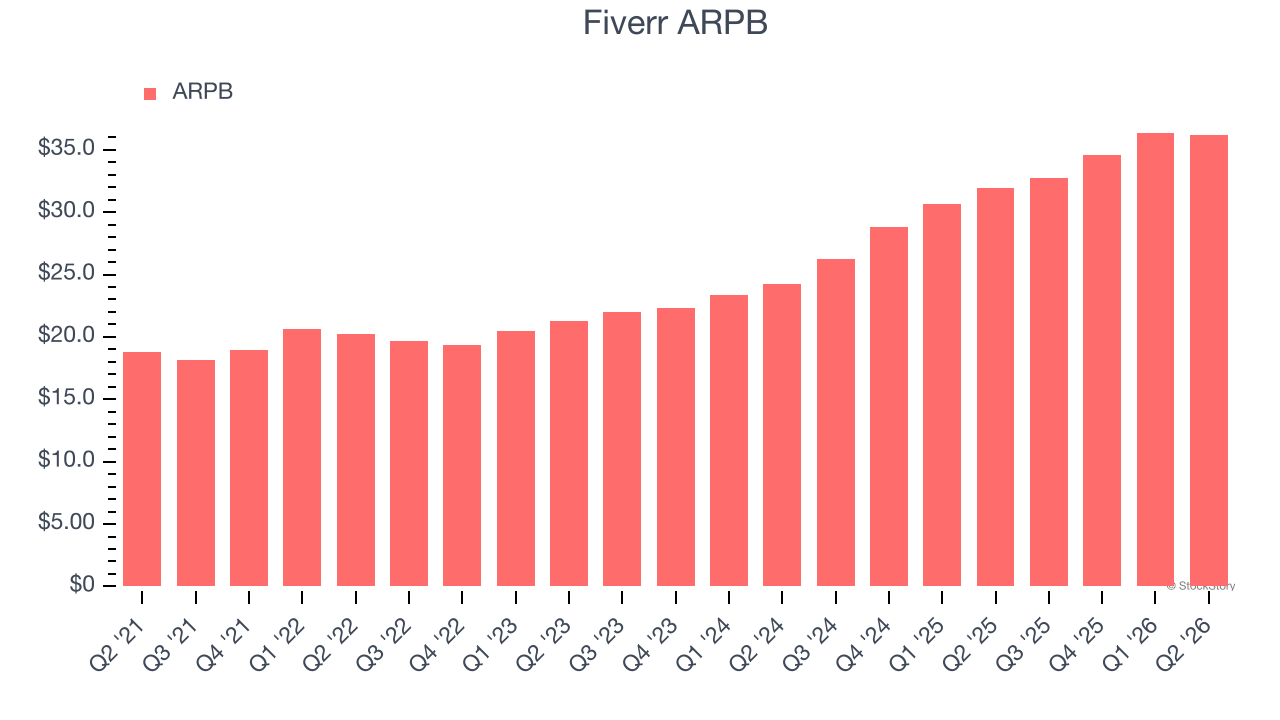
This quarter, Fiverr’s ARPB clocked in at $36.22. It grew by 13.3% year on year, faster than its active buyers.
Key Takeaways from Fiverr’s Q2 Results
We struggled to find many positives in these results. Its full-year revenue guidance missed and its full-year EBITDA guidance fell short of Wall Street’s estimates. Overall, this was a softer quarter. The stock traded up 1.2% to $11.73 immediately following the results.
So should you invest in Fiverr right now? If you’re making that decision, you should consider the bigger picture of valuation, business qualities, as well as the latest earnings. We cover that in our actionable full research report which you can read here (it’s free).