The end of an earnings season can be a great time to discover new stocks and assess how companies are handling the current business environment. Let’s take a look at how Bunge Global (NYSE: BG) and the rest of the ingredients, flavors & fragrances stocks fared in Q1.
Ingredients, flavors, and fragrances companies supply essential components to food, beverage, personal care, and household product manufacturers. These firms develop proprietary formulations that enhance taste, scent, and texture, creating customer stickiness through specialized expertise and regulatory-approved ingredient portfolios. Tailwinds include growing consumer demand for natural and clean-label products, expansion in emerging markets, and innovation in plant-based and functional ingredients. However, headwinds persist from volatile raw material costs, particularly for agricultural and petrochemical inputs. Regulatory scrutiny over synthetic additives and fragrance allergens poses compliance challenges, while consolidation among major customers increases pricing pressure and negotiating leverage against suppliers.
The 5 ingredients, flavors & fragrances stocks we track reported a mixed Q1. As a group, revenues were in line with analysts’ consensus estimates.
In light of this news, share prices of the companies have held steady. On average, they are relatively unchanged since the latest earnings results.
Bunge Global (NYSE: BG)
With origins dating back to 1818 and operations spanning both hemispheres to balance seasonal harvests, Bunge Global (NYSE: BG) is an agribusiness and food company that processes oilseeds, grains, and other agricultural commodities into vegetable oils, protein meals, flours, and specialty ingredients.
Bunge Global reported revenues of $21.86 billion, up 87.8% year on year. This print fell short of analysts’ expectations by 3.1%, but it was still a very strong quarter for the company with a beat of analysts’ EPS estimates and full-year EPS guidance exceeding analysts’ expectations.
Greg Heckman, Bunge’s Chief Executive Officer said, "The Bunge team delivered a strong first quarter, executing with the discipline and speed that define this organization, while navigating one of the more rapidly changing market environments in recent years. Amid geopolitical uncertainty and shifting trade flows, our global platform performed as designed, enabling us to capture opportunities, manage risks, and connect farmers to consumers with the products, services, and solutions they need as they face increasing complexity.
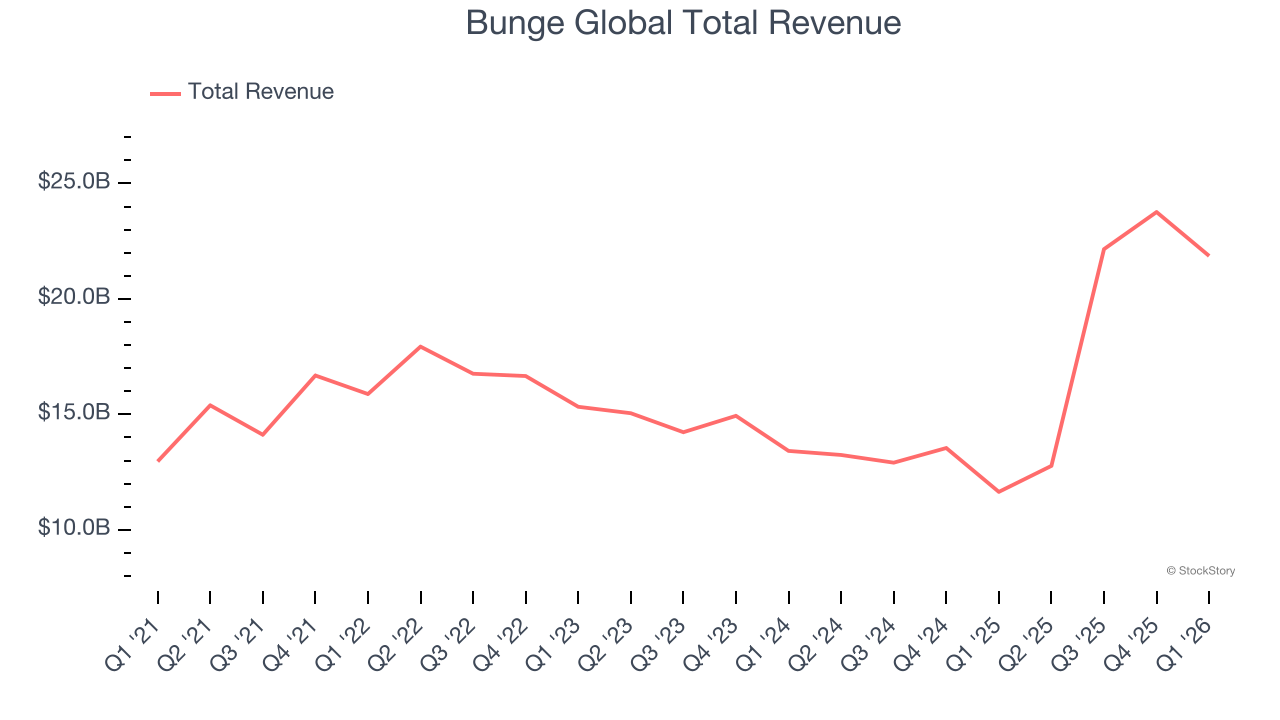
Bunge Global pulled off the fastest revenue growth but had the weakest performance against analyst estimates among its peers. Investor expectations, however, were likely higher than Wall Street’s published projections, leaving some wishing for even better results (analysts’ consensus estimates are those published by big banks and advisory firms, not the investors who make buy and sell decisions). The stock is down 7.1% since reporting and currently trades at $117.42.
Is now the time to buy Bunge Global? Access our full analysis of the earnings results here, it’s free.
Best Q1: International Flavors & Fragrances (NYSE: IFF)
Responsible for the scents in your favorite perfumes and the flavors in your daily snacks, International Flavors & Fragrances (NYSE: IFF) creates and manufactures ingredients for food, beverages, personal care products, and pharmaceuticals used in countless consumer goods.
International Flavors & Fragrances reported revenues of $2.74 billion, down 3.6% year on year, outperforming analysts’ expectations by 3.9%. The business had a very strong quarter with a solid beat of analysts’ EBITDA and organic revenue estimates.
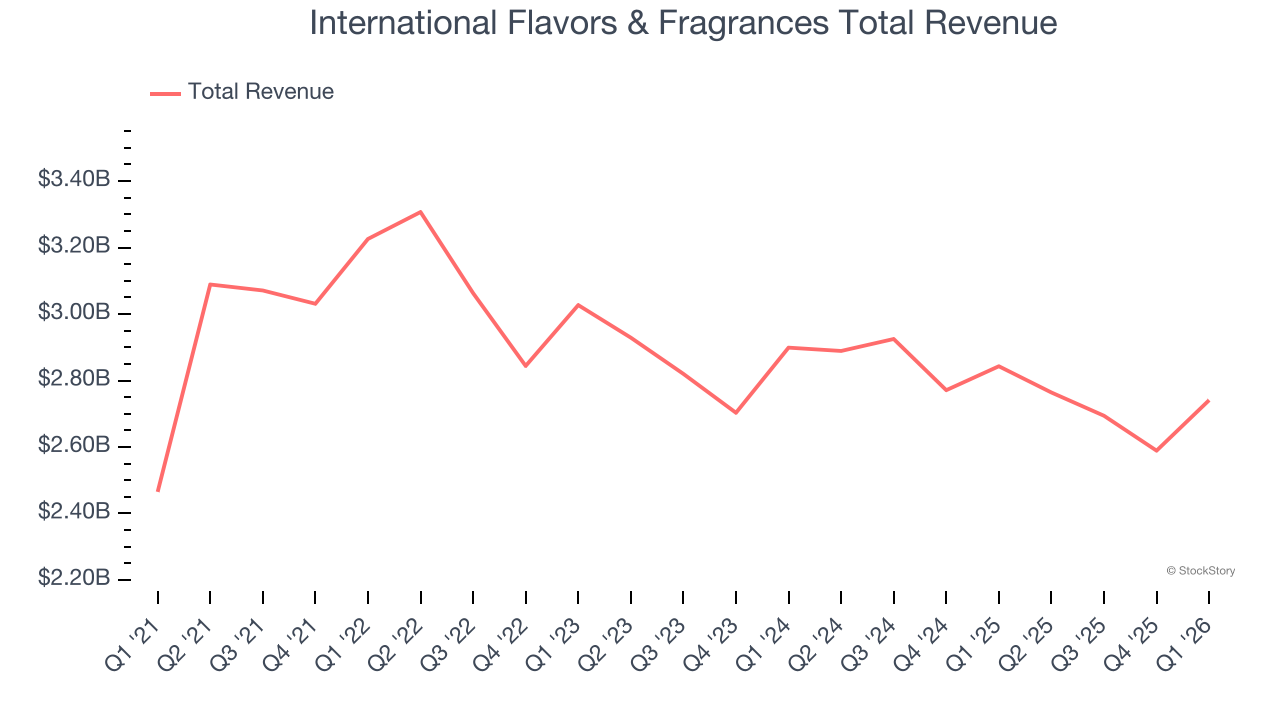
International Flavors & Fragrances scored the biggest analyst estimate beat in the group. The market seems happy with the results as the stock is up 5.5% since reporting. It currently trades at $74.67.
Is now the time to buy International Flavors & Fragrances? Access our full analysis of the earnings results here, it’s free.
Weakest Q1: Ingredion (NYSE: INGR)
Known for its ability to turn ordinary corn into thousands of different food ingredients, Ingredion (NYSE: INGR) transforms grains, fruits, vegetables and other plant-based materials into specialty starches, sweeteners and other ingredients for food, beverage and industrial markets.
Ingredion reported revenues of $1.79 billion, down 1.2% year on year, in line with analysts’ expectations. It was a slower quarter as it posted a significant miss of analysts’ gross margin and EPS estimates.
As expected, the stock is down 7% since the results and currently trades at $99.35.
Read our full analysis of Ingredion’s results here.
Darling Ingredients (NYSE: DAR)
Turning what others consider waste into valuable resources, Darling Ingredients (NYSE: DAR) collects and transforms animal by-products, used cooking oil, and other bio-nutrients into valuable ingredients for food, feed, fuel, and industrial applications.
Darling Ingredients reported revenues of $1.55 billion, up 12.3% year on year. This print was in line with analysts’ expectations. Zooming out, it was a mixed quarter as it also logged a beat of analysts’ EPS estimates but a significant miss of analysts’ EBITDA estimates.
The stock is down 1.2% since reporting and currently trades at $62.05.
Read our full, actionable report on Darling Ingredients here, it’s free.
Archer-Daniels-Midland (NYSE: ADM)
Transforming crops from the world's most productive agricultural regions into everyday essentials, Archer-Daniels-Midland (NYSE: ADM) processes and transports agricultural commodities like grains and oilseeds while manufacturing ingredients for food, beverages, feed, and industrial applications.
Archer-Daniels-Midland reported revenues of $20.49 billion, up 1.6% year on year. This result missed analysts’ expectations by 1.2%. Overall, it was a slower quarter as it also recorded a miss of analysts’ gross margin estimates.
The stock is up 6.7% since reporting and currently trades at $81.38.
Read our full, actionable report on Archer-Daniels-Midland here, it’s free.
Market Update
Over the past year, investors have been forced to repeatedly answer the same question: what is the market’s biggest risk? The answer has changed several times, and each shift has reshaped market leadership.
Late in 2025 and early 2026, artificial intelligence became the market’s primary uncertainty. Investors questioned whether AI would erode software pricing power and weaken competitive moats as AI made it easier to replicate once-differentiated products.
By the spring, technology took a back seat to geopolitics. The U.S. conflict with Iran briefly became the market’s dominant narrative, raising concerns about oil prices, inflation, and global growth. But as energy markets remained orderly and fears of a prolonged supply disruption faded, investors quickly turned their focus back to fundamentals.
Want to invest in winners with rock-solid fundamentals? Check out our Top 5 Quality Compounder Stocks and add them to your watchlist. These companies are poised for growth regardless of the political or macroeconomic climate.